The Cost of Irrigation Water for Farms and Growers
What irrigation water costs per acre-foot, per acre and per 1,000 gallons, and how lift, pressure, pump efficiency and power rates set the bill.

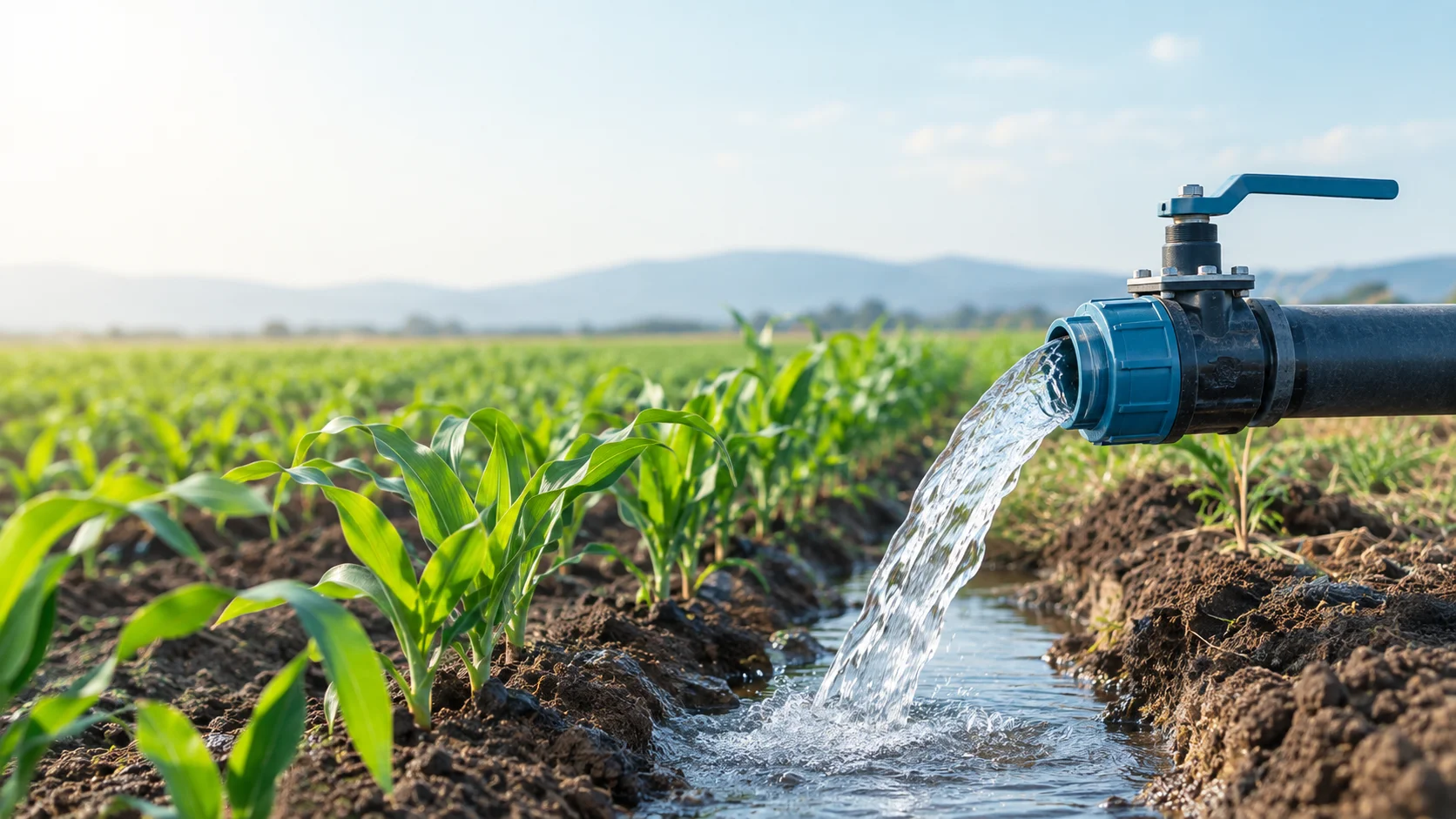
For a farm that pumps its own water with electricity, the energy to deliver irrigation water costs roughly $6 to $93 per acre-foot, or about $0.02 to $0.29 per 1,000 gallons. That is our estimate for 50 to 400 feet of total head, power at $0.08 to $0.16 per kWh and a 70% efficient pumping plant. The spread is wide because pumping cost is mostly physics: every extra foot of lift or pressure adds energy, and a worn pump wastes a large share of it. Water bought from a district or supplier is billed on top, at locally set rates. Here is how to work out your own cost per acre-foot, per acre and per 1,000 gallons, and which levers move it most.
Skip the math Pump Energy Cost Calculator Open →Irrigation water costs at a glance
Irrigation water has two cost layers: the energy to lift and pressurize it, and the price of the water itself when you buy it. USDA's 2023 Irrigation and Water Management Survey shows how they stack up across U.S. farms. Pumping energy is the largest of the four expense categories it tracks.
| Expense | U.S. total | Average per farm with the expense |
|---|---|---|
| Energy for pumping | $3.3 billion | $20,698 |
| Infrastructure (equipment, facilities, land improvement, computers) | $3.0 billion | $34,623 |
| Labor (hired and contract) | $2.1 billion | $39,935 |
| Water purchased off-farm | $1.1 billion | $18,916 |
Those are national averages across very different operations, so your own number comes from three things you can measure: how many acre-feet you apply, how far you lift and pressurize them, and what you pay for energy. For context, the same survey puts the average application at 1.5 acre-feet per irrigated acre, with on-farm wells supplying 54% of the water applied.
Irrigation water units: acre-foot, acre-inch and 1,000 gallons
Farm water is sold in acre-feet, utility water in gallons, and sprinkler schedules are set in inches. Converting between them is the first step in comparing any two prices.
| Unit | Equivalent volume |
|---|---|
| 1 acre-foot | 325,851 US gal (43,560 ft³) |
| 1 acre-inch (1/12 acre-foot) | about 27,150 US gal |
| 1,000 US gallons | about 0.0031 acre-foot |
One acre-foot also weighs about 2.7 million pounds (325,851 gallons at 8.34 lb each), which is why moving it uphill takes real energy.
How to calculate your pumping cost per acre-foot
Lifting water is work: weight times height. Combine the weight of an acre-foot with the energy in a kilowatt-hour (2,655,220 foot-pounds) and lifting one acre-foot one foot takes about 1.02 kWh at 100% efficiency, the figure UC Cooperative Extension uses in its pumping guidance. Real pumping plants lose energy in the motor, the pump and the piping, so you divide by overall plant efficiency.
Worked example. A 130-acre center pivot runs from a well with a pumping water level 180 feet down and 35 psi at the pivot (35 × 2.31 ≈ 81 ft). Ignoring pipe friction for simplicity, TDH is about 261 ft. With a 70% efficient plant and power at $0.12 per kWh:
| Total head (TDH) | kWh per acre-foot | At $0.08/kWh | At $0.12/kWh | At $0.16/kWh |
|---|---|---|---|---|
| 50 ft | 73 | $6 | $9 | $12 |
| 100 ft | 146 | $12 | $17 | $23 |
| 200 ft | 291 | $23 | $35 | $47 |
| 300 ft | 437 | $35 | $52 | $70 |
| 400 ft | 583 | $47 | $70 | $93 |
Read it across and the sensitivity is clear: doubling the head doubles the cost, and so does doubling the power price. The pump energy cost calculator runs these numbers for your own head, flow and rates.
Use your effective power rate. Divide your total irrigation electric bill by the kWh used. That folds in demand and fixed charges that the headline per-kWh rate leaves out, and it is the figure that belongs in the formula.
Pump efficiency: the cost lever most growers overlook
Overall plant efficiency is the share of the energy you buy that ends up lifting and pushing water. UC Cooperative Extension puts a properly designed and adjusted electric plant at about 70%, and a poorly designed, worn or misadjusted one as low as 40%. Because cost scales with 1 ÷ efficiency, the gap is large:
| Overall efficiency | kWh per acre-foot per foot | Cost per acre-foot at 100 ft |
|---|---|---|
| 100% (ideal, for reference) | 1.02 | $12.24 |
| 70% (well-matched plant) | 1.46 | $17.49 |
| 60% | 1.70 | $20.40 |
| 50% | 2.04 | $24.48 |
| 40% (worn or mismatched) | 2.55 | $30.60 |
A plant at 50% instead of 70% uses 40% more energy on every acre-foot (70 ÷ 50 = 1.4). You can find your own number from meter data: divide the kWh used by the acre-feet pumped, then compare that with the ideal for your head.
Pressure counts as lift
Pressurizing water for sprinklers or drip costs the same energy as lifting it. One psi equals 2.31 feet of head, so a system running at 30 psi adds about 69 feet to the load before a single foot of well lift is counted. UC notes that drip and sprinkler systems typically run at 20 to 40 psi.
| Operating pressure | Equivalent head | Cost per acre-foot |
|---|---|---|
| 20 psi | 46.2 ft | $8.08 |
| 30 psi | 69.3 ft | $12.12 |
| 40 psi | 92.4 ft | $16.16 |
| 60 psi | 138.6 ft | $24.24 |
Gravity-fed furrow and flood systems skip the pressure cost entirely, which is why UC points out that well-managed surface irrigation is the most energy-efficient method. But energy per acre-foot is only half the picture. An efficient sprinkler or drip system can need fewer acre-feet for the same crop, and labor, evaporation and runoff differ too. Compare systems on total cost per acre, not energy alone.
From cost per acre-foot to cost per acre
Cost per acre is cost per acre-foot times the acre-feet you apply, and application depth varies enormously by region and crop. USDA's 2023 survey reports these averages; the cost column prices each at the worked example's $46 per acre-foot as an illustration.
| Region | Acre-feet per acre | Energy cost per acre |
|---|---|---|
| Nebraska | 0.9 | $41 |
| U.S. average | 1.5 | $68 |
| California | 2.9 | $132 |
| Arizona | 4.3 | $196 |
The same water costs nearly five times more per acre in Arizona than in Nebraska, purely because of how much is applied. That is why scheduling and application efficiency matter as much as the pumping cost itself.
Real-world examples
All four use 70% plant efficiency and $0.12 per kWh, and all are estimates:
Lift 100 feet
$17.49
per acre-foot, or about $0.05 per 1,000 gallons.
Pressurize to 30 psi
$12.12
per acre-foot. Thirty psi is 69.3 ft of head before any well lift.
One acre-inch at 261 ft
$3.80
the worked example's cost to apply one inch to one acre.
130-acre pivot, one season
$8,900
at 1.5 acre-feet per acre and 261 ft of total head.
Beyond the pump: purchased water, wells and equipment
Purchased water. Off-farm suppliers provided 35% of the water applied in 2023, and growers spent $1.1 billion buying it, an average of $18,916 per farm that bought water (USDA). Districts and suppliers set prices locally. Some bill per acre-foot, some per irrigated acre, and some use tiered or seasonal rates, with delivery charges, assessments or minimum fees on top. To compare offers, convert everything to dollars per acre-foot delivered, and add the pressurization cost above if the water arrives unpressurized.
Well depth and drawdown. Lift is not fixed. USDA reports an average well depth of 241 feet and an average depth to water of 96 feet at the start of the 2023 irrigation season. As pumping levels fall during a season or over the years, each added 10 feet of lift adds about $1.75 per acre-foot at 70% efficiency and $0.12 per kWh.
Equipment and labor. Infrastructure ($3.0 billion) and labor ($2.1 billion) are the other big lines in USDA's tally. Spread over the acre-feet you apply, equipment cost per acre-foot falls as use rises, because an idle pivot costs nearly as much to own as a busy one.
Other fuels. Diesel, propane and natural gas follow the same physics: the work to lift an acre-foot is identical, and you divide by the plant's fuel-to-water efficiency. Compare fuels by cost per unit of useful work delivered, not by price per gallon or per kWh.
Ways to lower your irrigation water cost
- Test the pumping plant. Measure flow, total head and power draw. If efficiency is well under 70%, rebuilding or re-matching the pump usually pays back fastest.
- Trim operating pressure. Each 10 psi removed takes 23.1 ft off the load, about $4.04 per acre-foot at 70% and $0.12 per kWh, provided the sprinkler package still applies water uniformly.
- Apply only what the crop needs. Cost scales one-for-one with acre-feet, so soil-moisture monitoring and scheduling cut the volume rather than the unit price.
- Check your rate structure. Ask your utility about time-of-use or seasonal irrigation rates, and compare options on your effective rate.
- Match the pump to the duty. A pump running far from its best-efficiency point wastes energy; variable-speed drives can help when flow demand changes.
- Track the water level. Rising lift is a slow, silent cost increase. Recording the pumping level each season lets you see it coming.
The bottom line
The cost of pumped irrigation water comes down to one equation: 1.02 × total head ÷ efficiency × power price. Across the ranges in this guide that works out to roughly $6 to $93 per acre-foot, or about $0.02 to $0.29 per 1,000 gallons, before any water purchase charges. The biggest levers are the ones you can measure: pump efficiency, operating pressure and the number of acre-feet you apply. To run your own numbers, use the calculator below.
Frequently asked questions
How much does irrigation water cost per acre-foot?
It depends on whether you pump it, buy it, or both. For electric pumping, we estimate roughly $6 to $93 per acre-foot for 50 to 400 feet of total head at $0.08 to $0.16 per kWh and 70% plant efficiency. Purchased water is priced locally and adds to that when you buy it; USDA's 2023 survey reports an average of $18,916 spent per farm that bought off-farm water.
How do I calculate the cost to pump irrigation water?
Multiply 1.02 by total dynamic head in feet, divide by overall pumping plant efficiency, then multiply by your price per kWh. The result is the cost per acre-foot. Divide it by 325.9 to get the cost per 1,000 gallons.
How many gallons are in an acre-foot of water?
One acre-foot is 325,851 US gallons, or 43,560 cubic feet: enough water to cover one acre to a depth of one foot.
How much does it cost to irrigate one acre?
It depends on how much water you apply and what each acre-foot costs. The U.S. average is 1.5 acre-feet per irrigated acre (USDA, 2023). At the roughly $46 per acre-foot from our worked example, that is about $68 per acre in pumping energy. It is less where growers apply less, and more where they apply more: Arizona's average is 4.3 acre-feet per acre.
What is a good irrigation pump efficiency?
UC Cooperative Extension puts a properly designed and adjusted electric pumping plant at about 70% overall efficiency. A poorly matched, worn or misadjusted plant can fall as low as 40%, which raises the energy cost of every acre-foot by roughly 75%.
Does lowering operating pressure really save money?
Yes. Every psi equals 2.31 feet of head, so each 10 psi you remove takes about 23 feet off the load, worth roughly $4 per acre-foot at 70% efficiency and $0.12 per kWh. Confirm that your sprinklers still apply water uniformly at the lower pressure.
Sources & references
The reference figures in this guide come from the sources below. Dollar costs marked as estimates are our own calculations from them.
- U.S. Department of Agriculture, National Agricultural Statistics Service — 2023 Irrigation and Water Management Survey: Highlights. Irrigation expenses, average acre-feet applied per acre, water sources, and well depth.
- University of California Cooperative Extension (Tulare County), Pub. IG6-96 — Energy and Cost Required to Lift or Pressurize Water. 1.02 kWh to lift an acre-foot one foot at 100% efficiency, 2.31 ft of head per psi, and typical pumping plant efficiency.
- U.S. Geological Survey — Estimated Use of Water in the United States in 2000: Conversion Factors. 1 acre-foot = 325,851 gallons; 1 gallon = 8.34 pounds.
Water Systems Specialist · Austin, Texas
A Texas-licensed Professional Engineer with 13+ years in residential water systems, John leads the science, flow and pressure guides on Water Calculator. Read full bio
Licensed Professional Engineer (PE) · Specializes in water density, flow and pressure