How Much Does a Running Toilet Cost?
A toilet that won't stop running can quietly add $9 to over $100 a month to your bills. Here's how to work out what yours costs, how to measure the leak, and when a repair pays off.
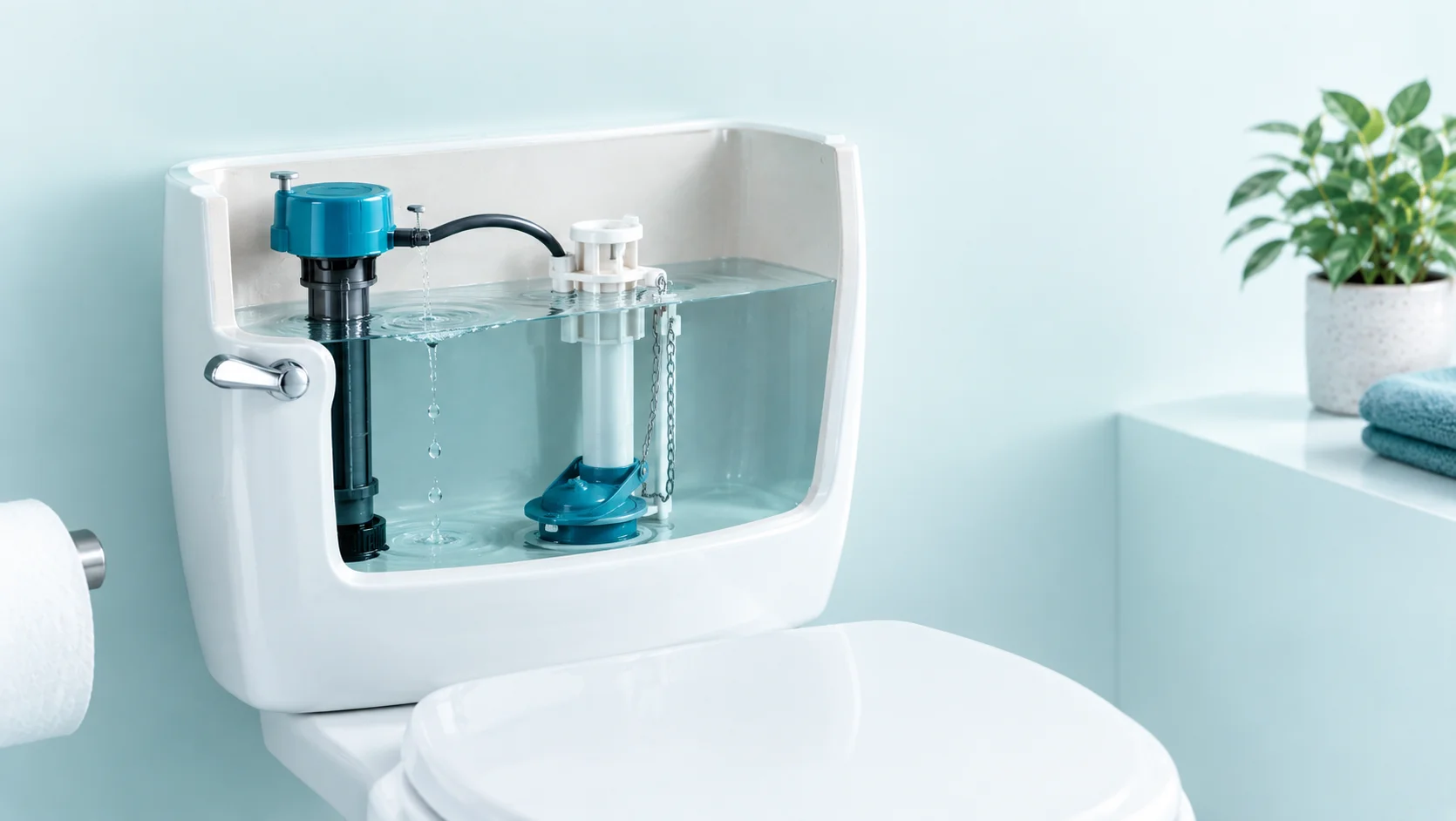
A running toilet typically costs about $9 to $60 a month in wasted water and sewer charges, and one that runs flat out can top $100 a month. The exact figure depends on two things: how many gallons leak through per day, and what your utility charges per 1,000 gallons. Multiply the two and you have your answer. Below, you'll find the cost for four common leak sizes, a way to measure your own, and a clear view of when a repair beats the waste.
Skip the math Running Toilet Cost Calculator Open →Running toilet cost at a glance
Toilet leaks come in every size, so the table below uses four illustrative scenarios. Costs assume a combined water and sewer rate of $10 per 1,000 gallons and a 30-day month. These are our own estimates, not measured averages.
| Leak size | Flow (gal/min) | Gallons per day | Gallons per month | Cost per month | Cost per year |
|---|---|---|---|---|---|
| Slow silent leak | 0.02 | 30 | 900 | $9 | $110 |
| Moderate leak | 0.08 | 120 | 3,600 | $36 | $438 |
| Steady trickle | 0.14 | 200 | 6,000 | $60 | $730 |
| Running flat out | 0.28 | 400 | 12,000 | $120 | $1,460 |
Even the smallest leak here wastes around 11,000 gallons a year, while the largest wastes well over 100,000. For comparison, EPA puts the average home's leaks of every kind at nearly 10,000 gallons a year, so a single toilet can easily outweigh the rest of a home's leaks combined.
Cost by water rate, quick reference
Water and sewer prices vary a lot from one utility to the next, so here is the same set of leaks at three combined rates. Find the column closest to your bill:
| Leak size | Month at $5 | Month at $10 | Month at $15 | Year at $5 | Year at $10 | Year at $15 |
|---|---|---|---|---|---|---|
| Slow silent leak (30 gal/day) | $4.50 | $9 | $13.50 | $55 | $110 | $164 |
| Moderate leak (120 gal/day) | $18 | $36 | $54 | $219 | $438 | $657 |
| Steady trickle (200 gal/day) | $30 | $60 | $90 | $365 | $730 | $1,095 |
| Running flat out (400 gal/day) | $60 | $120 | $180 | $730 | $1,460 | $2,190 |
Rates are per 1,000 gallons, water and sewer combined. Many bills list usage in CCF instead: 1 CCF is 100 cubic feet, or about 748 gallons. Convert before you compare.
Use your combined rate. Water that runs through a toilet goes down the drain, so many utilities bill sewer service on it as well. Add your water rate and your sewer rate per 1,000 gallons, and use the total. Using the water rate alone will understate the cost.
Why a running toilet costs more than you expect
The problem is time. A faucet drips a little; a toilet leak is usually a steady, invisible stream that runs 24 hours a day until someone fixes it. A leak of just 0.08 gallons per minute sounds trivial, yet over a day it adds up to about 120 gallons, and over a month it adds up to about 3,600.
The toilet is also the biggest water user indoors to begin with. EPA reports that toilets account for nearly 30 percent of an average home's indoor water use, so it is the fixture where a fault does the most damage. A modern WaterSense toilet uses 1.28 gallons per flush or less, against a federal standard of 1.6, but older toilets can use as much as 6 gallons per flush. A running toilet turns even an efficient fixture into a constant drain.
Most running toilets fail quietly. A worn flapper lets water seep from the tank into the bowl with no sound at all, which is why many homeowners only notice when the bill climbs. EPA notes that an old or worn flapper can silently leak thousands of gallons a year.
Work out your own running toilet cost
If you know roughly how many gallons the toilet loses each day, the cost takes one line:
Don't know the gallons per day? Measure it with a water meter test, covered in the next section. Once you have the gallons lost over a known time, scale it up to a full day:
This works best for steady leaks. If yours runs only now and then, take a longer test, such as overnight, and scale from that. The running toilet cost calculator runs the same arithmetic and lets you change the rate and the leak size.
How to measure how much yours is leaking
You can get a good estimate in under an hour without any tools beyond food coloring and your water meter.
- Run the dye test. Add a few drops of food coloring (or a dye tablet) to the tank and do not flush. If color shows in the bowl after 10 minutes, EPA says you have a leak. Flush when you are done to clear the dye.
- Look and listen. A hiss, repeated short refills, or water trickling down the overflow tube points to a leak that the dye test may not size correctly. If the water level sits at the top of the overflow tube, the fill valve is not shutting off.
- Read your meter. Stop all water use in the house, record the meter reading (many meters also have a small low-flow dial that spins when water moves), and check again after an hour. If you see movement, close the toilet's supply valve and repeat. If the movement stops, the toilet is the source.
- Convert and price it. If your meter reads in cubic feet, multiply by 7.48 to get gallons. Scale to a full day, then apply the formula above.
What makes a toilet run, and what each fix costs
Almost all running toilets trace back to a handful of parts inside the tank. Each is cheap compared with a few months of wasted water. The prices below are rough estimates for the part alone.
- Worn or warped flapper. The most common silent leak. The rubber stops sealing against the valve seat and water slips into the bowl. A replacement is typically one of the cheapest plumbing parts, often $5 to $15.
- Fill valve or float set too high. The tank overfills and water spills continuously into the overflow tube. Adjusting the float is free; replacing the fill valve is often $10 to $30.
- Chain too tight or tangled. A chain with no slack holds the flapper slightly open. Adjusting it costs nothing.
- Mineral buildup on the valve seat. Scale or corrosion stops even a new flapper from sealing. Cleaning the seat often helps; a badly pitted seat may call for a new flush valve.
If the toilet is an older model using several gallons per flush, repair may not be the end of the story. EPA says replacing old, inefficient toilets with WaterSense labeled models can cut the water used by toilets by 20 to 60 percent, which it puts at nearly 13,000 gallons a year for the average home. That is a separate decision from stopping a leak, but worth weighing if you are already facing a larger repair.
Common real-world examples
Here is what each leak looks like in dollars, again at $10 per 1,000 gallons:
Slow silent flapper leak
$9 / month
About 30 gallons a day. Easy to miss on a bill, and about $110 over a year.
Meter test: 5 gallons in 1 hour
$36 / month
120 gallons a day, or 3,600 gallons a month. A typical result when a flapper has clearly failed.
Steady audible trickle
$60 / month
About 200 gallons a day, roughly 6,000 gallons a month, or $730 a year left unfixed.
Fill valve stuck open
$120 / month
About 400 gallons a day, or 0.28 gallons a minute, running nonstop until the valve is repaired.
What else changes the bill
Tiered rates. Some utilities charge more per gallon as usage climbs. If yours does, leaked water can land in a higher tier, so the real cost may exceed the flat-rate figures above.
How sewer is billed. Utilities calculate sewer charges in different ways. Where sewer is based on metered water use, a leak raises that part of the bill too. Check your statement to see how yours is set.
Wells and septic systems. If you are not on a public supply, there is no per-gallon charge, but a leak still costs you: the well pump runs more, and a septic system takes on extra water it was never sized for.
Time. Leaks rarely stay the same size. A mineral-crusted seat or a wearing flapper tends to get worse, so a $9 leak this month can become a $36 leak later.
The bottom line
A running toilet costs roughly $9 to $120 a month at a combined rate near $10 per 1,000 gallons, with most noticeable leaks landing between $30 and $60. Check for it with a 10-minute dye test, size it with your meter, and price it with one formula. Because the usual fixes are inexpensive parts, nearly every running toilet is cheaper to repair than to ignore. If you want to see how your own rate changes the picture, the calculator below does the work.
Frequently asked questions
How much does a running toilet cost per month?
Roughly $9 to $120 a month at a combined water and sewer rate near $10 per 1,000 gallons: about $9 for a slow silent leak (30 gallons a day), about $36 for a moderate leak (120 gallons a day), and about $120 for a toilet running flat out (400 gallons a day). Your own rate changes the result, so multiply the gallons wasted by what your utility charges per 1,000 gallons.
How many gallons does a running toilet waste per day?
It depends on the leak. A slow flapper leak may lose around 30 gallons a day, while a toilet that runs continuously can lose 400 or more. For context, EPA says household leaks of all kinds can waste 180 gallons per week, and that the average home's leaks account for nearly 10,000 gallons a year.
How can I tell if my toilet is leaking silently?
Put a few drops of food coloring in the tank, do not flush, and wait 10 minutes. If any color appears in the bowl, water is leaking past the flapper. Flush afterward to clear the dye.
Why does my toilet refill by itself every few minutes?
That is usually called a phantom flush. Water slowly leaks from the tank into the bowl, the tank level drops, and the fill valve opens briefly to top it up. A worn or dirty flapper is the most common cause.
Is it worth fixing a running toilet myself?
Usually, yes. A replacement flapper or fill valve is often a low-cost part, commonly under $30, and many people fit one in under half an hour. Against a leak costing $36 a month, the part pays for itself within days.
Will my water utility adjust my bill for a toilet leak?
Some utilities offer a one-time leak adjustment or allowance once the leak is repaired, but policies vary widely. Contact your utility, keep your repair receipt, and ask what documentation it needs.
Sources & references
The leak scenarios and dollar figures above are our own illustrative estimates, built from the formula in this guide. The reference figures come from the U.S. Environmental Protection Agency:
- U.S. EPA WaterSense — Residential Toilets. Toilets account for nearly 30 percent of indoor water use; WaterSense toilets use 1.28 gallons per flush or less against a 1.6-gallon federal standard; household leaks can waste 180 gallons per week.
- U.S. EPA WaterSense — Fix a Leak Week. The food-coloring test for toilet leaks and the effect of worn flappers.
- U.S. EPA — WaterSense Program Encourages Homeowners to Join Fix a Leak Week and Save Water. The average household's leaks account for nearly 10,000 gallons wasted every year.

Water Quality & Sustainability Specialist · Portland, Oregon
Sarah is a water quality and sustainability specialist who leads the water treatment, usage, cost and conservation guides on Water Calculator. Read full bio
MS · Specializes in water quality, usage and sustainability