Tiered Water Rates Explained
Why the price per gallon climbs as you use more, how each tier is billed, and how to work out what your own water bill really costs.
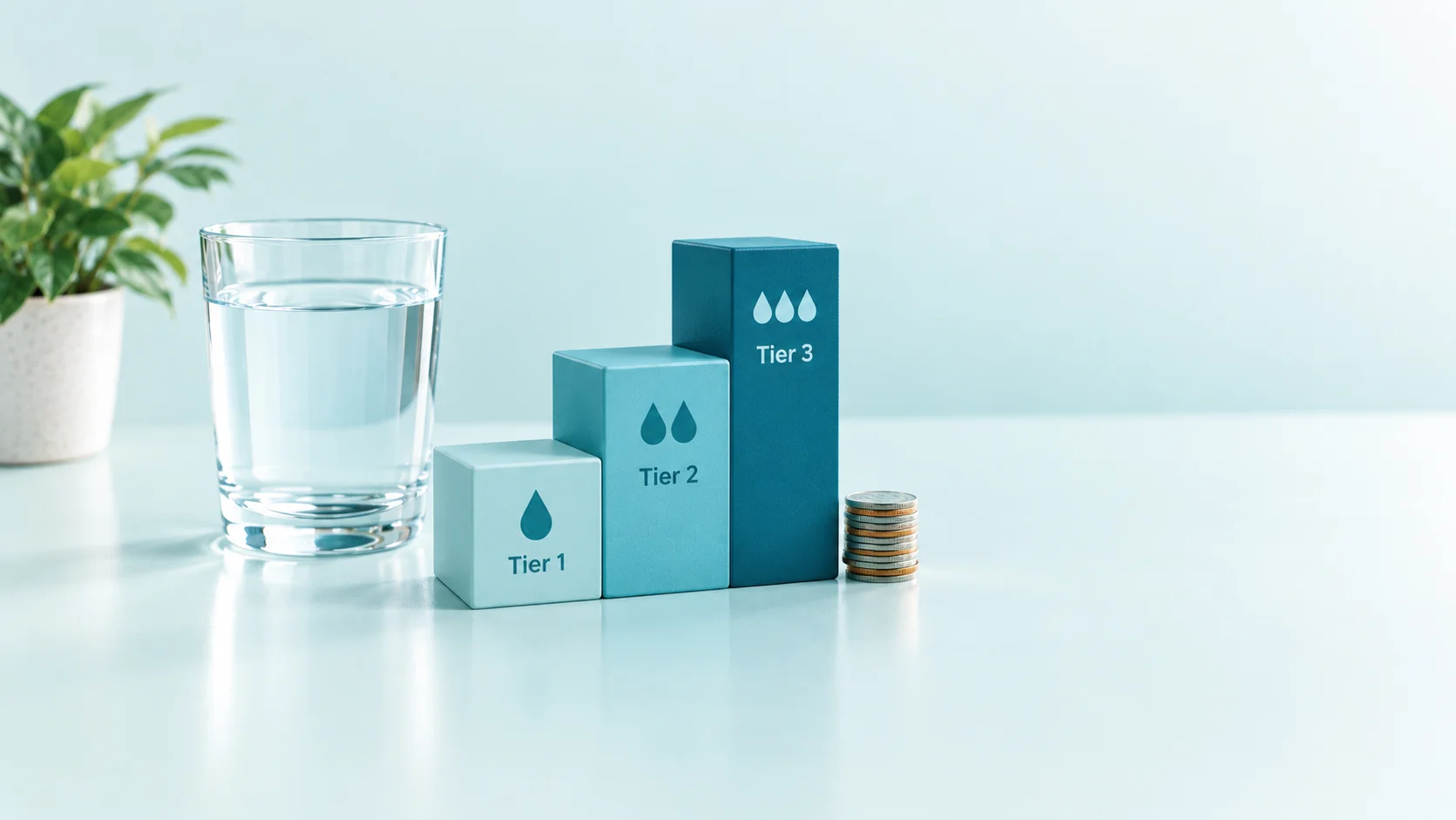
Tiered water rates (also called block rates) charge a different price per unit of water depending on how much you use in a billing period. Each tier covers a range of usage. Under the most common structure, the increasing block rate, every higher tier costs more per gallon than the one below it. You pay the higher price only on the water that falls inside that tier, not on everything you use. Here is how the tiers work, how to calculate a bill by hand, and why your average cost per gallon can differ from the rate printed on the schedule.
Skip the math Water Rate Tier Calculator Open →Tiered rates at a glance
Tiers are one of several ways a utility can price the water that passes through your meter. Seeing them next to the alternatives makes clear what is, and isn't, special about a tiered bill:
| Rate structure | Price per unit as use rises | Main purpose |
|---|---|---|
| Flat rate | Not metered; fixed fee | Simple billing |
| Uniform rate | Stays the same | Predictable pricing |
| Increasing block (tiered) | Steps up at each tier | Conservation, affordability |
| Decreasing block | Steps down at each tier | Favors high-volume users |
| Water budget | Rises past your allotment | Tiers fitted to each customer |
| Seasonal | Higher in peak months | Managing summer demand |
The increasing block rate is the one most people mean by "tiered." The EPA notes that increasing block rates are designed to promote conservation and are most often found in urban areas and areas with limited water supplies. In its 2024 report to Congress on water affordability, the agency describes the volumetric charge as either uniform or, more commonly, tiered and increasing with use.
Why utilities use tiers
A water system is built for its busiest days, not its average ones. The pipes, pumps and treatment capacity all have to cover peak demand, and peak demand is driven largely by discretionary use such as lawn irrigation. Tiers price that peak-driving use higher, and they do three jobs at once:
- Send a price signal. The more you use, the more the next gallon costs, which gives heavy users a reason to cut back.
- Protect essential use. The first tier is usually sized to cover basic indoor needs such as drinking, cooking, bathing and laundry, and is priced low.
- Match cost to demand. Customers who push the system hardest at peak times pay more toward the capacity that serves them.
Tiers are not a precise record of what each gallon costs to deliver. They are a policy tool, and how steep they are is a local decision. A utility with a large price gap between tiers sends a strong signal; one with a small gap sends almost none.
How a tiered water bill is calculated
A typical bill has a fixed service charge, which you pay no matter how much water you use, plus a volume charge built tier by tier. The volume charge is the part that changes with usage:
To see it work, take a made-up rate schedule. These numbers are illustrative only and do not come from any real utility: a $15.00 fixed charge, then $4.00 per 1,000 gallons for the first 5,000 gallons, $6.00 for the next 10,000, and $9.00 for everything above 15,000. Here is a month with 12,000 gallons of use:
| Tier | Tier range (gal) | Rate per 1,000 gal | Gallons billed | Charge |
|---|---|---|---|---|
| Tier 1 | 0–5,000 | $4.00 | 5,000 | $20.00 |
| Tier 2 | 5,001–15,000 | $6.00 | 7,000 | $42.00 |
| Tier 3 | Over 15,000 | $9.00 | 0 | $0.00 |
| Fixed service charge | $15.00 | |||
| Total | 12,000 | $77.00 |
The first 5,000 gallons cost $20, the next 7,000 cost $42, and the fixed charge adds $15. At no point does the tier 2 rate reach back and reprice the first 5,000 gallons.
Marginal rate vs. average cost per gallon
Tiered bills involve two different prices, and mixing them up is the most common mistake. The marginal rate is the price of your next gallon, which is the rate of the tier you are currently in. The average cost is your total bill divided by total usage, and it is what you actually paid per 1,000 gallons.
The marginal rate is the one that matters for decisions. If you cut your use by 2,000 gallons, you save 2 × $6.00 = $12.00, because those are the gallons at the top of your usage. Here is how the same schedule plays out across a range of usage:
| Monthly use (gal) | Marginal rate (per 1,000) | Total bill | Average cost (per 1,000) |
|---|---|---|---|
| 3,000 | $4.00 | $27.00 | $9.00 |
| 5,000 | $4.00 | $35.00 | $7.00 |
| 8,000 | $6.00 | $53.00 | $6.63 |
| 12,000 | $6.00 | $77.00 | $6.42 |
| 15,000 | $6.00 | $95.00 | $6.33 |
| 20,000 | $9.00 | $140.00 | $7.00 |
| 30,000 | $9.00 | $230.00 | $7.67 |
The average cost falls at first because the fixed charge is spread over more gallons, then climbs once you enter the upper tiers. The point where it turns around depends on how large the fixed charge is relative to the tier rates.
Tiers work like tax brackets. Reaching tier 3 does not make all of your water cost the tier 3 price. Only the gallons above the tier 3 threshold are billed at that rate.
How to read your own rate schedule
Every utility sets its own tiers, so the quickest way to a reliable number is to work from your utility's published schedule. Here is the order I would go in:
- Find the schedule. It is usually on your utility's website under rates or fees, and your bill may summarize it.
- Check the billing unit. Rates may be per 1,000 gallons, per CCF or per cubic meter. The next section covers the conversions.
- Note the tier limits and their period. Confirm whether limits apply per month or per billing period. If you are billed every two months, the limits may be set differently.
- Find the fixed charge. It may vary by meter size.
- Look for add-ons. Sewer, stormwater and drought surcharges can sit outside the tiers. Some utilities also base sewer charges on your water use, so the tiers can affect more of your bill than the water line alone. Our sewer bill calculator covers that part.
- Work out your tier. Compare your recent usage with the limits to see which tier your last gallon fell in. The University of Arizona Cooperative Extension suggests checking your latest bill to see which block you use in and which rate applies.
Units: gallons, CCF and cubic meters
Rate schedules often mix units, which makes tiers look more confusing than they are. These conversions cover most schedules in the US:
| Billing unit | US gallons |
|---|---|
| 1,000 gallons (kgal) | 1,000 |
| 1 cubic foot | about 7.48 |
| 1 CCF (100 cubic feet) | about 748 |
| 1 cubic meter | about 264 |
A tier that runs to "6 CCF" therefore covers roughly 4,500 gallons. If your schedule is in CCF and your tier limits are in gallons elsewhere in your records, convert before comparing.
Variations you may run into
Seasonal tiers
Some utilities apply tiers only in summer, or set higher tier rates in the warmer months. If your bill jumps in July, the cause may be the schedule as well as your sprinkler.
Water budgets
In a water-budget system, the tier limits are set for each customer based on household size, lot size or weather rather than being the same for everyone. Water inside your budget is billed at a lower rate, and water above it costs more. The calculation is the same; the difference is that your first tier is custom-built.
Customer classes
Residential, commercial and irrigation accounts frequently have separate schedules. Make sure you are reading the schedule for your own class.
Drought surcharges
During shortages, a utility may add temporary surcharges or tighten its tiers. These are usually listed separately from the base schedule.
What the tiers mean in practice
The same illustrative schedule, applied to four situations:
Essentials only
$35.00
5,000 gallons, all in tier 1. The fixed charge still pushes the average to $7.00 per 1,000 gallons, even with no use above tier 1.
Typical month
$77.00
12,000 gallons, mostly tier 1 and tier 2. Your last gallon is billed at $6.00 per 1,000.
Summer irrigation
$230.00
30,000 gallons. That is $153 more than the typical month for 18,000 extra gallons, because most of them land in tier 3.
Trimming 2,000 gallons
$12.00 saved
Going from 12,000 to 10,000 gallons removes the most expensive gallons first, at the tier 2 rate.
Keeping your use in the lower tiers
Because the top gallons carry the highest price, savings in the upper tiers are worth more than savings at the bottom. The practical priorities are:
- Look at outdoor use first. Irrigation is the biggest reason a household crosses into the upper tiers. Watering only as much as the landscape needs trims the priciest gallons.
- Chase leaks. A running toilet or a leaking line adds gallons all month, and in a heavy-use month they are billed at the top rate. Our water leak cost calculator shows what a leak adds up to.
- Know your thresholds. If you are 500 gallons shy of a higher tier, a small change can keep you under it.
- Read your meter between bills. It lets you adjust mid-cycle instead of finding out afterward.
The bottom line
Tiered water rates split your usage into blocks and price each block separately, usually with a higher rate for each successive tier. You pay a tier's rate only on the gallons inside it, so your average cost per gallon sits between the tier rates, while your marginal rate (the price of your next gallon) is what decides how much you save by cutting back. To get an exact figure, take your utility's rate schedule, confirm the units and billing period, and run your usage through it tier by tier.
Frequently asked questions
What are tiered water rates?
Tiered water rates, also called block rates, charge a different price per unit of water depending on how much you use in a billing period. Under the most common version, the price per gallon rises at each higher tier, and each price applies only to the water used within that tier.
Do I pay the highest rate on all my water once I reach a higher tier?
No. Tiers work like tax brackets. Only the gallons that fall inside a tier are billed at that tier's rate. Crossing into tier 3 raises the price of the next gallon, not the price of the gallons you already used.
Why is my water bill so much higher in summer?
Outdoor watering is the usual reason. Irrigation can push usage well past the cheap first tier and into the upper tiers, so each extra gallon costs more than the gallons you use indoors. Some utilities also set higher rates for the summer months.
Do tiered water rates actually reduce water use?
They are designed to, and the EPA describes increasing block rates as a conservation tool. The real effect depends on how large the price gap between tiers is and how visible the tiers are on your bill. Small gaps between tiers send a weak signal.
What is a CCF on my water bill?
CCF stands for hundred cubic feet. One CCF is 100 cubic feet of water, which is about 748 US gallons. Many utilities meter and bill in CCF, so convert to gallons if you want to compare your usage with tier limits quoted per 1,000 gallons.
How do I find my utility's tier limits and rates?
Look for the rate schedule on your utility's website, usually under customer service or rates and fees. Your bill may also show the tier breakdown. Check the billing unit, whether the tier limits are per month or per billing period, and the fixed service charge.
Sources & references
Rate-structure definitions follow US EPA material. The dollar figures and bills in the worked examples are illustrative calculations, not figures from any source or utility:
- U.S. Environmental Protection Agency, WaterSense — Understanding Your Water Bill. Describes uniform and increasing block rates and why increasing blocks are used to promote conservation.
- U.S. Environmental Protection Agency, Water Finance Center — Water Affordability Resources for Utilities. Defines increasing block, uniform and decreasing block rate structures.
- U.S. Environmental Protection Agency — Water Affordability Needs Assessment: Report to Congress (December 2024). Notes that the volumetric charge may be uniform or, more commonly, tiered and increasing with use.
- University of Arizona Cooperative Extension — Publication AZ1614: increasing block rate structures. Explains increasing block rate structures and how to find your block on your bill.

Water Quality & Sustainability Specialist · Portland, Oregon
Sarah is a water quality and sustainability specialist who writes the usage, cost and conservation guides on Water Calculator. Read full bio
MS · Specializes in water quality, treatment, sustainability and water usage