Bath vs Shower: Which Uses More Water?
The honest answer depends on your shower — its flow rate and how long you stand under it. Here's the real gallon count for both, and the exact point where a shower stops saving water.
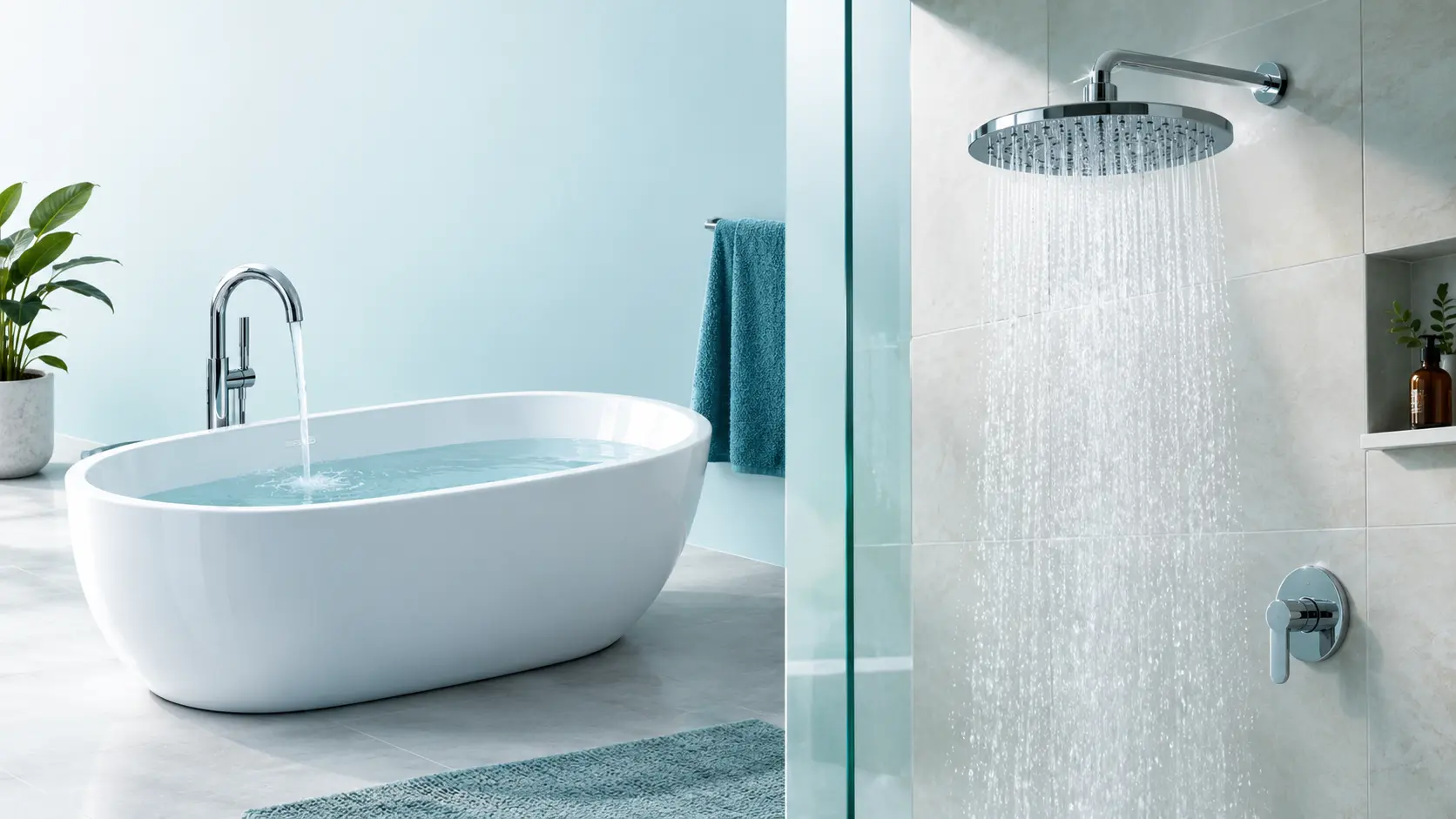
A short shower almost always beats a bath on water use — but a long one doesn't. A typical bath uses about 30 to 50 gallons of water once you're actually in the tub. A shower's total depends entirely on two things you control: your showerhead's flow rate and how many minutes you run it. A brisk five-minute shower with a water-efficient head uses around 10 gallons; a lingering fifteen-minute shower with an older, high-flow head can use 75 gallons or more — well past even a generous bath. The real comparison isn't bath-versus-shower, it's your bath versus your shower.
Skip the math Bath vs Shower Water Calculator Open →Bath vs. shower, at a glance
Before getting into flow rates and formulas, here's what the two options actually cost in gallons for a range of common cases:
| Activity | Water use (gallons) | Water use (liters) |
|---|---|---|
| Typical bath (water actually used) | 30–50 gal | 114–189 L |
| 5-min shower, WaterSense head (2.0 gpm) | 10 gal | 38 L |
| Average U.S. shower (7.8 min, 2.1 gpm) | ~16 gal | 61 L |
| 10-min shower, standard head (2.5 gpm) | 25 gal | 95 L |
| 15-min shower, older high-flow head (5.0 gpm) | 75 gal | 284 L |
The spread is the whole story: a quick, efficient shower uses a fraction of a bath's water, while a long shower with an old showerhead can use nearly double. Nothing about "shower" or "bath" as categories decides the winner — the specifics do.
How much water a bath uses
A bathtub's brim capacity — how much it would hold filled to the overflow drain — is usually 40 to 80 gallons, more for a deep soaking or freestanding tub. But that's not what actually gets used. Once you factor in that nobody fills a tub to the rim and that your body displaces several gallons once you get in, the water actually drawn for a typical bath runs about 30 to 50 gallons, a range consistent with EPA benchmarks for residential water-use planning.
Tub style changes that range at both ends. A compact or corner tub can use closer to 25–30 gallons filled to a normal bathing depth. A large soaking or whirlpool tub, filled deep, can push well past 50 gallons — sometimes 70 or more. And because the relationship between fill depth and volume is roughly linear, filling any tub only halfway uses roughly half the water of a normal fill.
Brim capacity isn't bath water use. Marketing specs for a tub often quote its full-to-overflow capacity, which overstates what a bath actually consumes. The gallon figures that matter for a water bill are always the partial-fill numbers.
How much water a shower uses
A shower has no fixed volume — it's a rate multiplied by time. That makes the math simple:
The flow-rate side of that equation has changed a lot over the decades. Showerheads sold in the US have been capped at 2.5 gallons per minute since the Energy Policy Act of 1992, but showerheads made before that could run as high as 5 gpm. Since 2010, the EPA's voluntary WaterSense label has marked showerheads that do the job at 2.0 gpm or less — at least 20% below the federal cap — while still meeting spray-force and coverage standards.
Put real numbers on it: the average American shower lasts about 7.8 minutes at an average flow rate of 2.1 gallons per minute, for roughly 16 gallons per shower, according to the Alliance for Water Efficiency's national end-use research. Swap in a WaterSense head and that same shower length drops to about 15–16 gallons even at a slightly longer duration, simply because the rate is lower. You can check your own numbers with the shower water usage calculator using your showerhead's rated flow.
Shower duration vs. a full bath
Because a shower's total scales directly with time, it's easy to see exactly where it crosses a bath's water use. The table below runs the math for common shower lengths at three flow rates: a WaterSense-labeled head, a standard federal-maximum head, and an old high-flow head.
| Shower length | 2.0 gpm (WaterSense) | 2.5 gpm (standard) | 5.0 gpm (older head) |
|---|---|---|---|
| 5 minutes | 10 gal | 12.5 gal | 25 gal |
| 8 minutes | 16 gal | 20 gal | 40 gal |
| 10 minutes | 20 gal | 25 gal | 50 gal |
| 15 minutes | 30 gal | 37.5 gal | 75 gal |
| 20 minutes | 40 gal | 50 gal | 100 gal |
Set that against a typical 30–50 gallon bath and the pattern is clear. At either efficient flow rate, anything under about 10 minutes stays comfortably below even the low end of a bath's range. Past 15 minutes with a standard head, a shower is already inside — or beyond — typical bath territory.
The break-even point
If you want one number to remember, it's the break-even shower length — the point where a shower stops saving water compared with your bath. It's just the bath's gallons divided by the showerhead's flow rate:
So for a mid-range 40-gallon bath, a WaterSense shower has about 20 minutes of runway before it uses as much water; a standard-flow shower has about 16 minutes. Take a smaller, 30-gallon bath and those numbers drop to 15 and 12 minutes. Fill a large soaking tub to 60 gallons and a standard shower gets 24 minutes before it catches up. The bath vs shower calculator will work out your own break-even point from your tub size and showerhead.
What changes the answer
Showerhead flow rate. This is the single biggest lever you control directly. Swapping an old 5.0-gpm head for a 2.0-gpm WaterSense-labeled one cuts every shower's water use by more than half, regardless of how long you stay in.
Shower duration. Because gallons scale linearly with minutes, duration matters just as much as flow rate — and it's the easiest thing to change without buying anything. Cutting a shower from 15 minutes to 8 saves close to half its water use at any flow rate.
Tub size and fill depth. A compact tub filled to a normal bathing depth uses meaningfully less than a deep soaking tub filled almost to the brim. Filling any tub to half its usual level roughly halves its water use.
Warm-up time. Running the tap to get hot water before you step in, or before the tub is at temperature, adds a couple of gallons on either side of the comparison — small, but not zero for a low-flow fixture.
Multiple uses. A bath is typically a single fill; a shower can be interrupted and restarted, or shared by rinsing off after a bath, which changes the totals for that particular case.
Energy and cost track water use closely
Whichever option uses less water also tends to cost less to run, because heating water is usually the larger share of a bath or shower's expense, not the water itself. A 40-gallon bath and a 20-minute standard-flow shower use about the same water — and about the same energy to heat it. If you want the dollar side of this comparison for your own water heater and rates, the bath cost calculator and shower cost calculator break down water, energy and combined cost per session.
The bottom line
A shower under about 10 minutes with a standard or WaterSense-labeled head reliably uses less water than a typical bath. Push a shower past 15 to 20 minutes, or leave an old high-flow head running, and it can use just as much water as filling the tub — sometimes more. The category doesn't decide the outcome; your showerhead's flow rate and your clock do.
Frequently asked questions
Which uses less water, a bath or a shower?
A shower usually uses less water than a bath, as long as it's kept under about 10 minutes with a standard or water-efficient showerhead. A typical bath uses roughly 30 to 50 gallons, while a 10-minute shower at a WaterSense-rated 2.0 gallons per minute uses only about 20 gallons. Once a shower runs past 15 to 20 minutes, though, it can use as much water as a full bath or more.
How many gallons does a bath use?
A typical bath uses about 30 to 50 gallons of water, based on EPA benchmarks for residential water use — this is the water actually in the tub once you're in it, not the tub's total brim capacity. Filling the tub only halfway roughly halves that figure.
How many gallons does the average shower use?
The average American shower lasts about 7.8 minutes at a flow rate of 2.1 gallons per minute, using roughly 16 gallons of water, according to the Alliance for Water Efficiency's Home Water Works data. A shorter shower with a WaterSense-labeled showerhead can use half that or less.
How long can a shower be before it uses as much water as a bath?
For a typical 30-to-50-gallon bath, the break-even point is roughly 12 to 25 minutes, depending on the showerhead's flow rate. With a 2.0-gallon-per-minute WaterSense showerhead, a 40-gallon bath breaks even at about 20 minutes; with an older 2.5-gallon-per-minute standard head, it breaks even closer to 16 minutes.
Does a low-flow showerhead really cut water use?
Yes. A WaterSense-labeled showerhead uses no more than 2.0 gallons per minute, at least 20% less than the 2.5-gallon-per-minute federal standard, and far less than older showerheads that ran as high as 5 gallons per minute. Over an 8-minute shower, that's the difference between about 16 gallons and up to 40 gallons.
Does filling the tub only halfway save much water?
Yes. Since bath water use scales directly with fill depth, filling a tub halfway instead of to a typical bathing level cuts its water use roughly in half, often bringing a bath below the 20-gallon mark and closer to what a short, efficient shower uses.
Sources & references
The figures in this guide follow current government and industry benchmarks for residential water use:
- U.S. EPA, WaterSense Program — Showerheads. Standard showerhead flow rate (2.5 gpm) and the WaterSense specification (2.0 gpm or less).
- U.S. EPA, Water Conservation Plan Guidelines, Appendix B — Benchmarks Used in Conservation Planning. Typical bath volume (30–50 gallons per cycle) and shower duration/flow-rate ranges.
- Alliance for Water Efficiency, Home Water Works — Showers. Average U.S. shower duration, flow rate and volume, from the 2016 Residential End Uses of Water study.

Water Quality & Sustainability Specialist · Portland, Oregon
A water quality and sustainability specialist based in Portland, Oregon, Sarah leads the usage, cost and conservation guides on Water Calculator. Read full bio
Specializes in water usage, treatment and household conservation