How Much Water Does a Dishwasher Use?
From a 2-gallon compact cycle to a 15-gallon relic from the 1980s — here's exactly how much water a dishwasher uses, how that compares with washing by hand, and how to work out your own household's number.
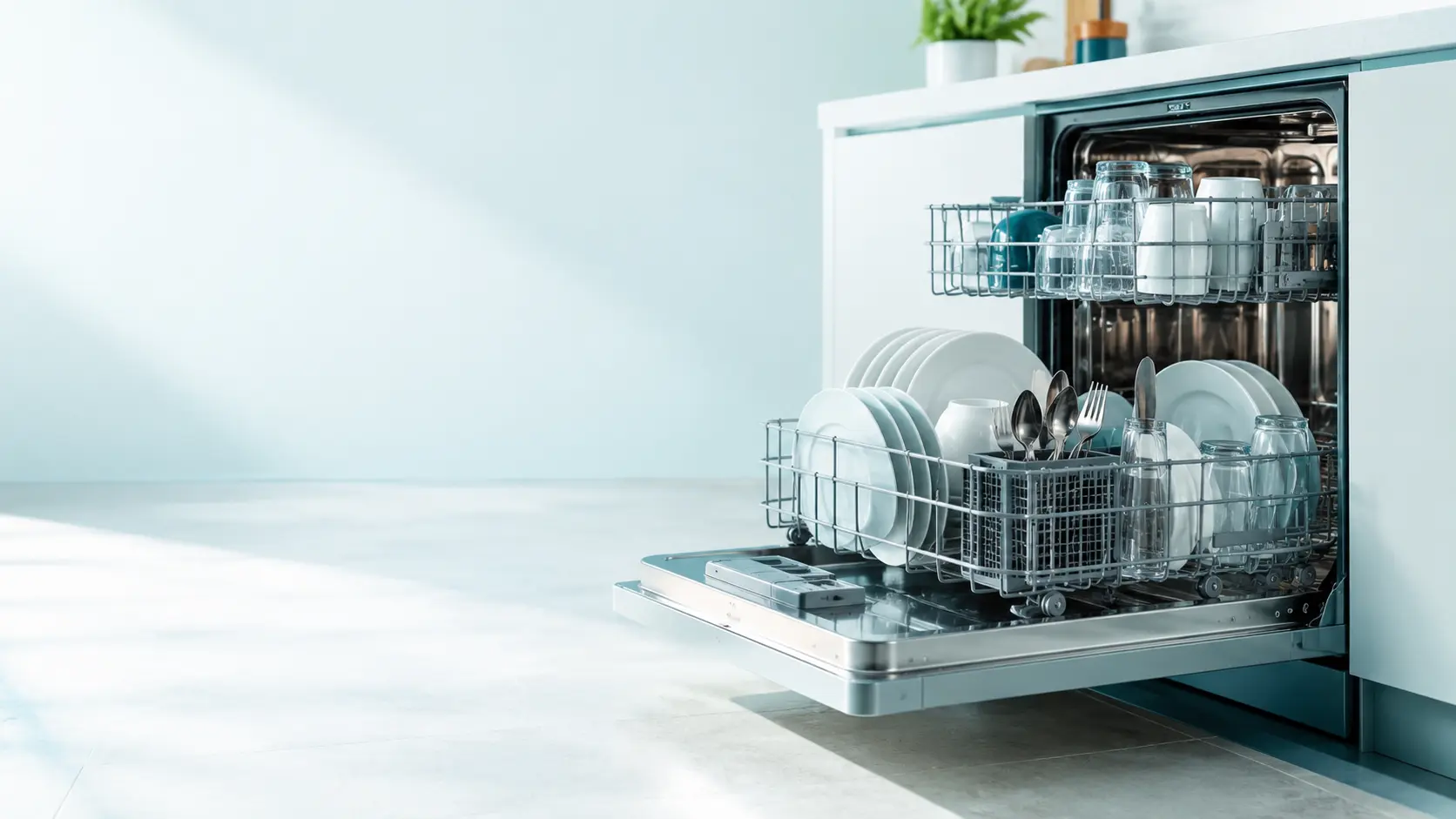
A modern dishwasher uses about 3 to 6 gallons of water per cycle. Certified ENERGY STAR models use less still — up to 3.2 gallons for a standard-size machine and up to 2.0 gallons for a compact one, under the criteria that took effect July 19, 2023. That's a fraction of what a dishwasher built before the mid-1990s commonly used (often 10 to 15 gallons), and it's usually far less than washing the same load by hand. The exact figure for your machine depends on its certification, age, size and the cycle you choose — here's how each of those adds up.
Skip the math Dishwasher Water Usage Calculator Open →Dishwasher water use at a glance
Water use per cycle varies more by certification and age than by anything else. These are the figures to know:
| Dishwasher type | Water per cycle | Notes |
|---|---|---|
| ENERGY STAR certified, standard size | ≤3.2 gal (12.1 L) | 8+ place settings; criteria effective July 2023 |
| ENERGY STAR certified, compact | ≤2.0 gal (7.6 L) | Fewer than 8 place settings |
| Typical model on the market today | 3–6 gal (11–23 L) | Certified and non-certified models combined |
| Current federal minimum standard | ≤5.0 gal (18.9 L) | Baseline every new U.S. dishwasher must meet |
| Built before the mid-1990s | commonly 10–15 gal (38–57 L) | Pre-efficiency-standard machines; estimate |
The gap between "ENERGY STAR certified" and "federal minimum" is bigger than it looks: a certified standard-size machine uses at least 30% less water than the current federal floor, and roughly two-thirds less than a decades-old machine still doing daily duty in some kitchens.
Dishwasher vs. hand washing
This is the comparison most people actually want, and the dishwasher wins it for anything but a few plates. Filling a sink and running the tap to rinse a full load of dishes by hand commonly uses well into double digits of gallons — the running tap, not the wash itself, is what drives the total up. ENERGY STAR estimates that a certified dishwasher saves about 8,400 gallons of water a year compared with washing the equivalent dishes by hand.
ENERGY STAR standard
≤3.2 gal
Per cycle, for a full load of 8+ place settings.
ENERGY STAR compact
≤2.0 gal
Per cycle, for smaller households or kitchens.
Federal minimum machine
≤5.0 gal
The least any new U.S. dishwasher can legally use.
Hand washing, full load
9–27 gal
Wide range — driven mostly by how long the tap runs.
If you're curious exactly where the break-even point sits for your own habits — how many dishes, how long the water runs, which method you use — the dishwasher vs. hand washing calculator runs the comparison for your numbers instead of the averages above.
Why hand washing loses. A dishwasher heats and reuses a small, fixed amount of water through several short spray-and-drain stages. A running kitchen tap, by contrast, keeps delivering water for as long as the faucet is open — so total use scales with time at the sink, not with how many dishes are actually being cleaned.
What changes how much water a dishwasher uses
Four things account for almost all the variation between one dishwasher's water use and another's:
Certification and age. This is the biggest factor by far — an ENERGY STAR standard machine from the current criteria uses a third of what a pre-1994 model used, for the same size load.
Size. Compact dishwashers (under 8 place settings) are built to use less water per cycle than standard ones, in line with their smaller tub.
Cycle selected. A heavy or "pot and pan" cycle runs more fill-and-drain stages than a normal or eco cycle, so it uses more water for the same machine. Soil-sensing dishwashers adjust automatically, using only as much water as a sensor determines the load actually needs.
Pre-rinsing. Rinsing dishes at the sink before loading them adds water on top of whatever the cycle itself uses — and it's largely unnecessary. ENERGY STAR's own guidance is to scrape food scraps into the trash instead of rinsing, since modern detergents and sensors are designed to handle it.
Work out your own annual usage
Once you know your dishwasher's gallons-per-cycle figure — on the yellow EnergyGuide label, in the manual, or from the ENERGY STAR product finder — annual use is a single multiplication:
The same daily habit with a machine right at the 5.0-gallon federal minimum comes to about 1,825 gallons a year — over 650 gallons more, just from the certification gap. Here's how the totals scale at a few common run frequencies (figures below are calculated estimates, rounded to the nearest gallon):
| Cycles per week | ENERGY STAR (3.2 gal/cycle) | Federal minimum (5.0 gal/cycle) |
|---|---|---|
| 1 | 166 gal/yr | 260 gal/yr |
| 3 | 499 gal/yr | 780 gal/yr |
| 5 | 832 gal/yr | 1,300 gal/yr |
| 7 (daily) | 1,165 gal/yr | 1,820 gal/yr |
| 10 | 1,664 gal/yr | 2,600 gal/yr |
Older, less efficient dishwashers
If your dishwasher predates federal water-efficiency requirements — commonly a machine from the 1980s or early 1990s — it's likely using somewhere in the range of 10 to 15 gallons per cycle, several times what a current ENERGY STAR model needs to do the identical job. Replacing a machine like that is one of the more straightforward efficiency upgrades a kitchen can make: over its lifetime, a standard-size ENERGY STAR dishwasher is estimated to save around 3,800 gallons of water compared with a non-certified model of similar size, on top of the annual comparisons above.
Even among dishwashers still being sold new, there's a real gap: any machine can be sold as long as it meets the federal minimum of 5.0 gallons per cycle, but only the more efficient ones earn ENERGY STAR certification at 3.2 gallons or less. Checking a model's EnergyGuide label before buying is the only way to know which side of that line it falls on.
Ways to cut dishwasher water use further
- Scrape, don't rinse. Knock food scraps into the trash rather than rinsing plates under the tap before loading — ENERGY STAR notes this is one of the largest avoidable additions to a load's total water use.
- Run full loads. A dishwasher uses roughly the same amount of water whether it's half-empty or full, so consolidating into fewer, fuller loads cuts total water use directly.
- Choose the normal or eco cycle when you can. Reserve heavy or pot-and-pan cycles for genuinely heavy soil, since they run more fill-and-drain stages.
- Look for ENERGY STAR when replacing a machine. It's the clearest signal that a model meets the 3.2 gal/cycle (or 2.0 gal/cycle compact) water-use ceiling rather than just the federal minimum.
The bottom line
For most households, a dishwasher uses somewhere between 2 and 6 gallons per cycle, with the low end reserved for ENERGY STAR certified machines and the high end for older or non-certified ones. That's dramatically less water than hand washing the same load at a running tap, and the gap only widens as certification standards improve. If you want the exact number for your own machine and habits rather than these averages, the calculator below does the math for you.
Frequently asked questions
How much water does a dishwasher use per cycle?
Most dishwashers on the market today use about 3 to 6 gallons per cycle. ENERGY STAR certified standard-size models are capped at 3.2 gallons per cycle, and certified compact models at 2.0 gallons, under the criteria that took effect July 19, 2023.
Is it more water-efficient to hand wash dishes or use a dishwasher?
For a full load, a dishwasher almost always wins. Hand washing a sink full of dishes commonly runs into double digits of gallons once the tap has run for several minutes, while an ENERGY STAR certified dishwasher does the same job on 3.2 gallons or less. ENERGY STAR estimates a certified dishwasher saves about 8,400 gallons of water a year compared with hand washing.
How much water does an older dishwasher use?
Dishwashers built before the mid-1990s commonly used around 10 to 15 gallons per cycle — roughly three to five times what a current ENERGY STAR model uses. Even a dishwasher that just meets today's federal minimum standard, at up to 5.0 gallons per cycle, uses noticeably more than a certified model.
Does pre-rinsing dishes before loading the dishwasher waste water?
Yes. ENERGY STAR specifically recommends scraping food off dishes instead of rinsing them, since modern detergents and soil sensors are designed to handle scraps, and rinsing at the sink first adds water and time without improving the wash.
How much water does a dishwasher use in a year?
It depends on how often you run it. A household running an ENERGY STAR standard dishwasher once a day uses roughly 1,150 to 1,200 gallons a year; the same routine with a machine at the 5.0-gallon federal minimum uses closer to 1,800 gallons. Fewer cycles per week scale the total down proportionally.
What's the difference between a standard and a compact ENERGY STAR dishwasher?
Standard dishwashers hold 8 or more place settings plus six serving pieces and are capped at 3.2 gallons per cycle to qualify for ENERGY STAR. Compact dishwashers hold fewer than 8 place settings and are capped at 2.0 gallons per cycle.
Sources & references
The figures in this guide follow current federal and ENERGY STAR reference values for dishwasher water use:
- ENERGY STAR — Dishwashers: Key Product Criteria. Certification thresholds of 3.2 gallons/cycle (standard) and 2.0 gallons/cycle (compact), effective July 19, 2023.
- ENERGY STAR — Dishwashers. Estimated 8,400-gallon annual water savings versus hand washing, and the scrape-don't-rinse best practice.
- U.S. EPA WaterSense — Homes Technical Reference Manual: Dishwashers Tech Sheet. Federal minimum standard of 5.0 gallons/cycle and estimated 3,800-gallon lifetime savings for ENERGY STAR certified models.

Water Quality & Sustainability Specialist · Portland, Oregon
Sarah covers water usage, treatment and conservation for Water Calculator, focusing on the everyday choices — appliances, fixtures, habits — that add up to a household's water footprint. Read full bio
Specializes in water quality, usage and sustainability