How to Read Your Water Meter
Find the meter, check the units, read the digits, and turn two readings into gallons used — plus how to use the same meter to catch a hidden leak.
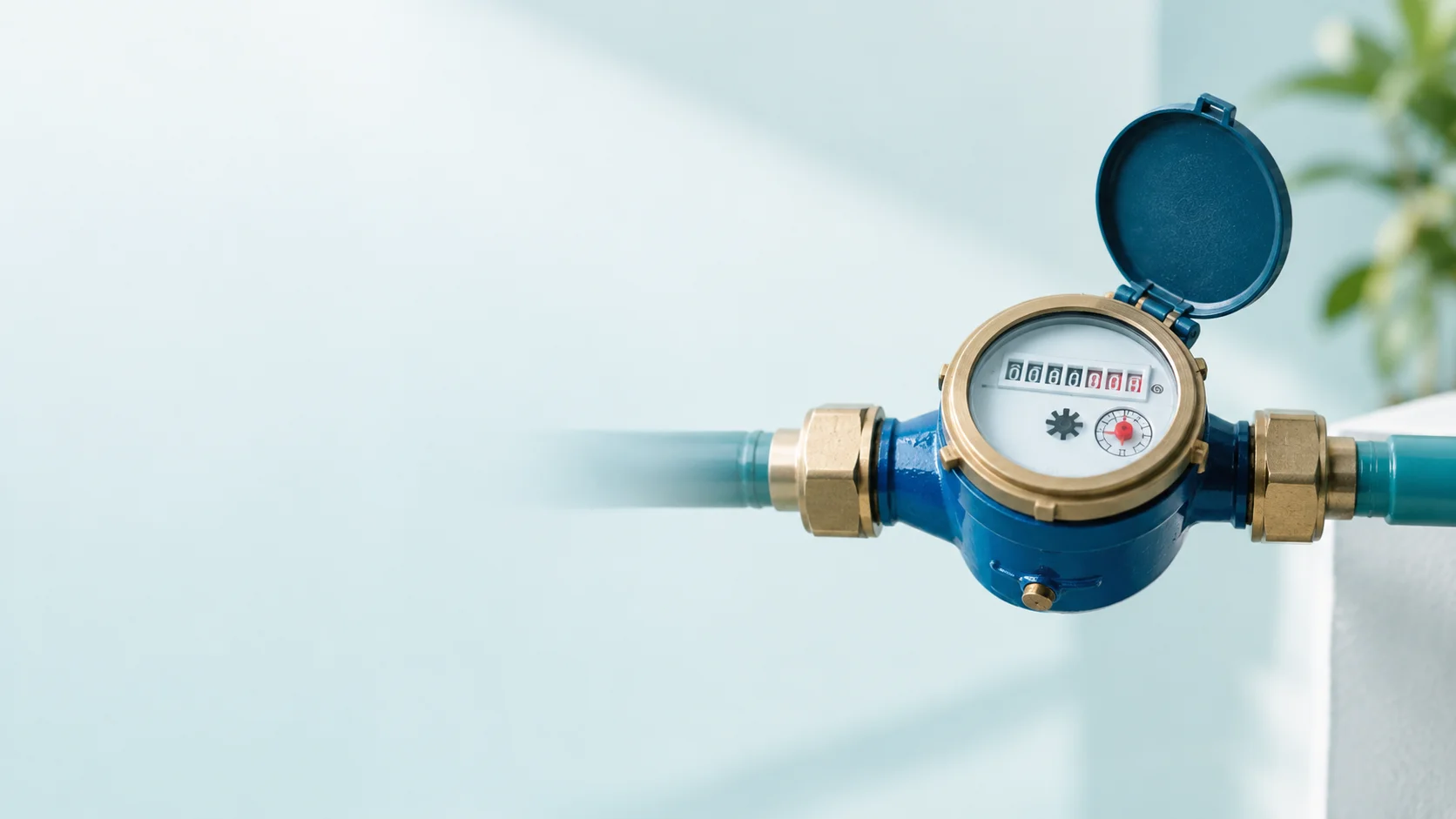
To read your water meter, find it — usually in a covered box near the curb, or indoors near where the main line enters the house — lift the lid, and read the odometer-style digits from left to right in the units printed on the dial, typically cubic feet or gallons. Your water use over any period is the current reading minus the earlier reading. Leave the sweep hand and the low-flow indicator out of the total: they show water moving right now, not the running count. One cubic foot is 7.48 gallons, and 100 cubic feet (1 CCF, a common billing unit) is 748 gallons. The steps below cover every common meter type, then show how to turn two readings into gallons and how to use the same meter to catch a hidden leak.
Skip the math Monthly Water Usage Calculator Open →Where to find your water meter
The meter belongs to your utility and sits at the point where the utility's pipe meets yours. Where it lives depends mostly on climate.
Outdoors, in a meter box. In most of the country the meter is in an in-ground box, often called a curb box or meter pit, near the street, the sidewalk or the property line. The lid is usually marked "water" or "meter" and may be plastic, metal or concrete.
Indoors, on the main line. Where winters freeze the ground, the meter is normally inside — in a basement, crawl space, garage or utility room — on the main line close to where it enters the building.
Can't find it? Your bill often lists a meter number, and your utility can tell you where the meter is installed.
Open the box carefully. Lift the lid with a large flat screwdriver or the tool your utility recommends, and look before you reach in — meter boxes attract spiders, ants and debris, and can fill with water. Read the meter; don't adjust it, break its seals or turn the utility's valve. If the lid is stuck, damaged or the box is flooded, call the utility instead of forcing it.
What's on the meter face
Every meter does the same job — it tallies the volume of water that passes through it — but the faces differ between manufacturers. These are the parts to look for:
- Register (odometer). The row of digits showing total volume since the meter was installed. This is the number you read, and it only ever counts up.
- Unit label. Words such as "CUBIC FEET," "CU FT," "GAL" or "m³" beside the digits. They tell you what one count means.
- Sweep hand. The long hand that circles the dial while water flows. On many meters one full revolution equals one cubic foot (7.48 gallons), but check your dial or your utility's guide.
- Low-flow indicator. A small triangle, star or pinwheel that turns with even a trickle. It is often red or blue.
- Multiplier or fixed zero. Some meters print a multiplier such as ×10, or show a zero that never moves at the right end of the digits. Either one is part of the reading and scales the number up.
- Size and serial number. Printed on the dial or the body. Quote the serial number when you talk to the utility.
Check the units first
Read the unit label before you read the digits. Utilities across the US meter and bill in different units, and mixing them up is the fastest way to end up with a wildly wrong answer. This table converts the common ones:
| Unit | US gallons | Cubic feet |
|---|---|---|
| 1 cubic foot (ft³) | 7.48 | 1 |
| 10 cubic feet | 74.8 | 10 |
| 1 CCF (100 cubic feet) | 748 | 100 |
| 1,000 gallons | 1,000 | about 134 |
| 1 cubic meter (m³) | about 264 | about 35.3 |
CCF stands for "centum cubic feet," a fancy way of saying 100 cubic feet; some utilities write it HCF. Your bill states the billing unit. If your meter counts cubic feet but the bill charges per CCF, divide the cubic feet by 100.
The one conversion to remember. Gallons = cubic feet × 7.48. It comes from the size of the units: a cubic foot is a box one foot on every side, and it holds a little under seven and a half US gallons.
Read a straight (odometer) meter
Most US homes have a straight-reading meter: a row of digits that works like a car's odometer. Here's the routine:
- Clear the lens. Wipe away dirt or condensation with a cloth or your hand. A flashlight helps in a dark box or basement.
- Confirm the unit. Find the label near the digits: cubic feet, gallons or something else.
- Read the digits left to right. Include every digit in the row. On many meters the digits below your billing unit are printed in a different color; ignore the color and go by position — the rightmost digit is the smallest unit, and each step left is ten times larger.
- Handle a rolling digit. If a digit is partway between two numbers, take the lower one.
- Apply any multiplier. If the dial prints ×10, add a zero to the reading; if it prints ×100, add two.
- Record the reading with the date and time. Write down the full number, not a shortened version.
As an example, say the register shows 018690 under the words "cubic feet." That means 18,690 cubic feet have passed through the meter since it was installed. A utility that bills in CCF would read it as 186, dropping the last two digits — so your own full reading is more precise than a bill built on whole hundreds.
Read a dial meter
Older meters, less common today, have four to six small dials in a row or ring, each numbered 0 to 9 and labeled with what one full turn represents (10, 100, 1,000 and so on). They read like a set of clocks, with one twist:
- Start with the dial that has the largest value and work toward the smallest.
- On each dial, write down the number the pointer has most recently passed. If it sits between 9 and 0, write 9.
- Follow the direction of the numbers on each dial. On many dial meters neighboring dials turn in opposite directions, so don't assume everything runs clockwise.
- If a pointer looks like it's sitting right on a number, check the dial to its right. If that pointer has already passed 0, use the number as it appears; if it hasn't, use the number one lower.
- String the digits together in order, then add any fixed zero or multiplier.
Digital and smart meters
Newer meters replace the mechanical digits with an LCD register. Many alternate between two screens: the running total and the current flow rate. Some need a button press or a flashlight to wake the display, and some show icons for a suspected leak or reverse flow, though the symbols differ by manufacturer.
Some digital meters also transmit readings by radio, so your utility may not need to visit at all — and it may offer an online account or app that shows your usage history. The math stays the same: the total is cumulative, the unit is shown on the screen, and your usage is still one reading minus the last. If you can't tell which number is which, the total is the larger figure and it only climbs.
Work out how much water you used
Take a reading at the start and end of the period you care about, at about the same time of day, and note the dates. Then subtract and convert:
Divide by the number of days to get a daily average. If those 238 cubic feet were used over 30 days, that's roughly 59 gallons a day for the whole household — an estimate that smooths out heavy and light days. Comparing your own readings with your bill also shows whether the utility read the meter correctly or estimated. To check your monthly totals in gallons, try our monthly water usage calculator.
One sweep-hand turn
7.48 gal
On many meters a full revolution equals 1 cubic foot. Check your dial to confirm.
1 CCF
748 gal
100 cubic feet — a common billing unit on utility statements.
A month's use
1,780 gal
238 cubic feet between two readings, as worked out above.
1,000 gallons
≈ 134 ft³
Some utilities bill per 1,000 gallons. On a cubic-foot meter that's about 134 cubic feet.
Use your meter to find leaks
Because a meter counts every drop that passes through it, it's the quickest way to confirm a leak. According to the EPA, household leaks waste nearly 1 trillion gallons of water a year across the US. Here's the test:
- Stop all water use. Close every tap and pause the dishwasher, washing machine, ice maker, irrigation timer and any automatic humidifier or softener cycle.
- Check the low-flow indicator. If it's turning, water is moving through the meter right now.
- Record the full reading and the time, or note the position of the sweep hand.
- Wait. The EPA suggests checking again after two hours with no water use; if the reading changed at all, you probably have a leak. For a faster check, some utilities have you watch the sweep hand for 15 to 30 minutes.
- Compare. Any movement with everything off means water is escaping somewhere.
Once you know there's a leak, narrow it down. The most common culprit is a toilet: put a few drops of food coloring in the tank and wait 10 minutes without flushing. If color shows up in the bowl, the flapper is leaking (flush afterward to avoid staining). Next, close your home's main shutoff valve and watch the meter. If it still moves, the leak is on the supply line between the meter and your shutoff; if it stops, the leak is inside — close individual fixture valves one at a time until it does. Also check hose bibs and irrigation zones outdoors.
After a repair, run the test again to confirm the meter is still. Some utilities offer a bill adjustment for a verified leak, so ask yours.
Common mistakes
- Adding the sweep hand to the total. It shows current flow; the odometer holds the total.
- Mixing units. Cubic feet, gallons and CCF differ by factors of 7.48 and 100. Check the label every time.
- Missing a multiplier or fixed zero. A ×10 that you skip turns 5,000 gallons into 500.
- Rounding a rolling digit up. A digit between two numbers is always read as the lower one.
- Testing for leaks with something running. A dishwasher cycle, ice maker, softener regeneration or irrigation timer will move the meter and give a false alarm.
- Writing down a partial reading. Record every digit, plus the date and time; otherwise the subtraction can't be trusted.
The bottom line
Reading a water meter comes down to four things: find it, read the unit label, read the digits left to right, and subtract the earlier reading from the current one. Remember that 1 cubic foot is 7.48 gallons and 1 CCF is 748 gallons, and you can convert any reading to gallons in seconds. Then use the meter for what it does best: run a two-hour test with the water off, and any movement tells you a leak is costing you money.
Frequently asked questions
How do I read my water meter?
Find the meter, wipe the lens clean, and read the odometer digits from left to right in the units printed on the dial. Subtract your earlier reading from the current one to get your usage for the period. Ignore the sweep hand and the low-flow indicator when you take the total.
How many gallons is one CCF?
One CCF is 100 cubic feet, which equals about 748 gallons. Multiply CCF by 748 to get gallons, or multiply cubic feet by 7.48.
What is the small triangle or star on my water meter?
It's the low-flow indicator. It turns with even a trickle of water, so if it moves while every tap and appliance is off, water is leaking somewhere — often a toilet, a fixture or an irrigation line. Its shape and color vary by manufacturer.
How long should I wait when checking for a leak with my meter?
The EPA recommends a two-hour period with no water use: if the reading changes at all, you probably have a leak. For a quicker check, watching the sweep hand or low-flow indicator for 15 to 30 minutes with everything off can reveal larger leaks.
Why doesn't my reading match my water bill?
Bills cover a service period that ends on the utility's read date, so readings you take on other dates won't line up exactly. Many utilities also bill in whole hundreds of cubic feet and drop the last two digits, and some estimate a reading when they can't reach the meter. Compare readings taken on the same dates, and ask your utility if a gap remains.
Is it safe to open the water meter box?
Yes, with care. Use a proper tool to lift the lid, look before you reach in — spiders, insects and debris are common — and don't touch or adjust the meter, its seals or the utility's valve. If the lid is stuck or the box is flooded, call your utility instead of forcing it.
Sources & references
The conversion factors and test procedures in this guide follow standard government and utility guidance:
- U.S. Environmental Protection Agency, WaterSense — Fix a Leak Week. Check the meter before and after two hours of no water use; a food-coloring toilet test; household leaks waste nearly 1 trillion gallons of water a year nationwide.
- Covington Water District (Washington) — Reading Your Water Meter. Reading the odometer digits in cubic feet, 100 cubic feet (one CCF) equal to 748 gallons, and how the sweep hand and low-flow indicator show a leak.
- Home Water Works — How to Read Your Water Meter. Meters typically measure gallons or cubic feet; 1 cubic foot equals 7.48 gallons; straight-reading versus round-reading meters.

Water Quality & Sustainability Specialist · Portland, Oregon
Sarah is a water quality and sustainability specialist with an MS, based in Portland, Oregon. She writes the water usage, cost and treatment guides on Water Calculator. Read full bio
MS · Specializes in water quality, water usage and sustainability