How Much Water Does a Running Faucet Use?
From a quick hand rinse to a tap left on overnight, here is what a running faucet actually uses, why the number varies, and how to measure your own.
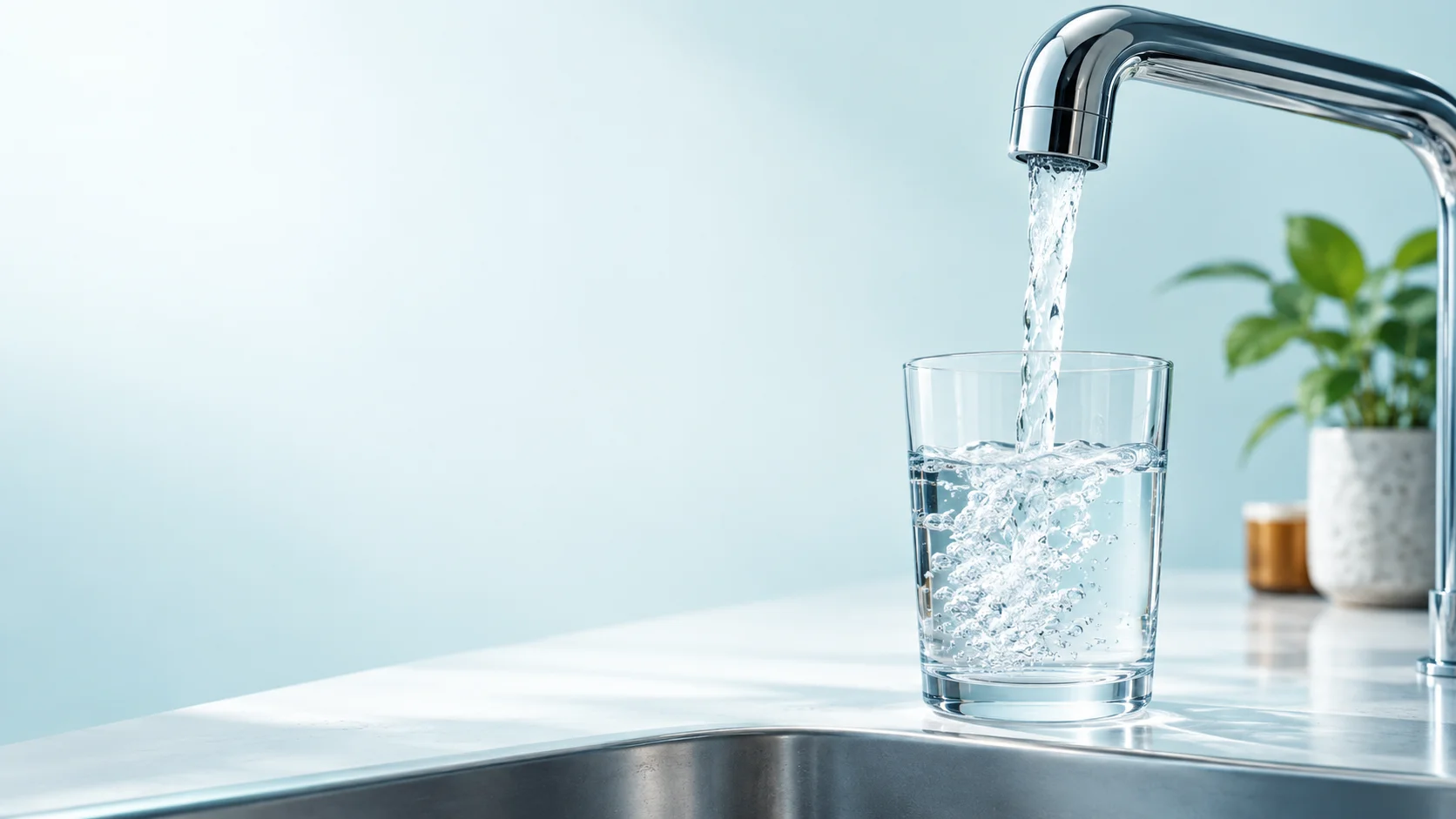
A running faucet uses about 1.5 to 2.2 gallons of water per minute (5.7 to 8.3 liters). That is the ceiling for nearly every faucet sold in the US today, so a tap left on for an hour moves roughly 90 to 130 gallons. Older fixtures can push 3 gallons a minute or more. Your actual number depends on the faucet's rating, your water pressure and how far you open the handle. Here is how to read those numbers, what everyday tasks use, and how to measure your own sink in under a minute.
Skip the math Faucet Water Usage Calculator Open →Running faucet water use at a glance
Everything here comes from one relationship: water used = flow rate × time. The flow rate is the only variable that differs from sink to sink, so this table shows what the common flow rates deliver over the durations people actually run a tap.
| Flow rate | Liters per minute | 30 seconds | 1 minute | 5 minutes | 10 minutes |
|---|---|---|---|---|---|
| 1.2 gpm (very efficient bathroom faucet) | 4.5 L | 0.6 gal | 1.2 gal | 6 gal | 12 gal |
| 1.5 gpm (WaterSense limit) | 5.7 L | 0.75 gal | 1.5 gal | 7.5 gal | 15 gal |
| 2.2 gpm (federal maximum) | 8.3 L | 1.1 gal | 2.2 gal | 11 gal | 22 gal |
| 3.0 gpm (older faucet) | 11.4 L | 1.5 gal | 3.0 gal | 15 gal | 30 gal |
| 5.0 gpm (older, high-flow) | 18.9 L | 2.5 gal | 5.0 gal | 25 gal | 50 gal |
The spread is the point. Run the same tap for ten minutes and a 1.5 gpm faucet uses 15 gallons while a 5 gpm relic uses 50. Doubling the flow rate doubles the water, every time.
Rated flow is measured at 60 psi of supply pressure. Your real flow will differ if your pressure does, as explained below.
What sets your faucet's flow rate
The fixture rating. Federal standards have capped kitchen and bathroom faucets at 2.2 gpm since 1994. Bathroom sink faucets and aerators that earn the EPA WaterSense label are held to 1.5 gpm, roughly 30% less than a standard faucet. Before those rules, faucets commonly ran 3 to 7 gpm, and plenty of them are still installed.
The rating is a ceiling, not a measurement. The number stamped on a faucet or aerator is the maximum flow the manufacturer may sell it at, tested under set conditions. Your sink can run below it, and sometimes above it.
Supply pressure. A faucet without a built-in flow regulator behaves like an orifice, and flow through an orifice rises with the square root of pressure. Moving from the 60 psi test condition to 80 psi lifts flow by about 15% in that case. Many modern aerators include a regulator that holds flow steady, which is why two homes with different pressure can still see similar flow at the tap.
Handle position. Few people open a faucet all the way for routine tasks. A half-open handle delivers less than the rated flow, though the relationship is not linear, so the only reliable number is one you measure.
Kitchen versus bathroom. The WaterSense faucet specification covers bathroom sinks, not kitchen faucets. Kitchen faucets fall under the 2.2 gpm federal cap and are more likely to sit near it, especially models with pull-down sprayers.
Aerator condition. Mineral scale can clog an aerator and cut flow, which lowers water use but also means the faucet is not delivering what you paid for. A clogged aerator is a repair item, not a conservation plan.
How much water everyday tasks use
Faucets account for more than 15% of indoor residential water use in the US, according to EPA. Most of that is not the water you need. It is water running while you do something else. Here is what common habits use at two typical flow rates:
| Task | Run time | At 1.5 gpm | At 2.2 gpm |
|---|---|---|---|
| Rinsing hands | 20 seconds | 0.5 gal | 0.7 gal |
| Waiting for hot water | 1 minute | 1.5 gal | 2.2 gal |
| Brushing teeth, tap on | 2 minutes | 3.0 gal | 4.4 gal |
| Shaving, tap on | 3 minutes | 4.5 gal | 6.6 gal |
| Kitchen prep, tap on | 5 minutes | 7.5 gal | 11 gal |
| Hand-washing dishes, tap on | 10 minutes | 15 gal | 22 gal |
Toothbrushing is the classic case because the water does nothing for most of the two minutes. At 1.5 gpm, brushing twice a day uses roughly 2,200 gallons a year per person if the tap runs the whole time. Wet the brush, turn the tap off, and turn it back on to rinse, and you use a small fraction of that. The same logic applies to shaving and to scrubbing dishes.
What a faucet left running really costs
Short habits are small. A tap left on by accident is not. Here is what a faucet at 1.5 gpm delivers over longer stretches, with the 2.2 gpm figure for comparison:
One hour
90 gal
132 gal at 2.2 gpm. About $0.90 at an illustrative $10 per 1,000 gallons.
Overnight (8 hours)
720 gal
1,056 gal at 2.2 gpm. About $7.20 at the same illustrative rate.
One day
2,160 gal
3,168 gal at 2.2 gpm. About $21.60, or roughly 8,200 liters.
One week
15,120 gal
22,176 gal at 2.2 gpm. About $151 at the illustrative rate.
The $10 per 1,000 gallons figure is a round number for illustration, meant to represent water plus sewer charges. US rates vary widely, so use the rate on your own bill.
For scale, EPA estimates the average family wastes 9,400 gallons a year from household leaks. By my arithmetic, a single 1.5 gpm tap left fully open would use that much in about four and a half days. EPA also notes that 5 to 10 percent of US homes have leaks that waste 90 gallons a day or more, which equals one hour of that same faucet running every day. A slow leak looks harmless, but it never stops.
How to measure your own faucet
The rating on the box is not your flow rate. The bucket test is, and it takes a minute. All you need is a container of known volume and a timer.
- Open the faucet the way you normally use it, or fully open for the maximum.
- Time how long it takes to fill a one-gallon jug or a measuring pitcher.
- Divide 60 by the seconds it took to get gallons per minute.
- Repeat on hot and cold. Flow can differ between the two.
Then multiply by how long you run the tap. The faucet water usage calculator does that step for any flow rate, run time and number of uses per day.
The hidden cost of running hot water
Water use is only half the story when the tap is hot. Raising one gallon of water by 60 °F takes about 500 BTU, because a gallon weighs roughly 8.34 pounds and each pound needs about one BTU per degree. As electricity at 100% efficiency, that is about 0.15 kWh per gallon. A minute of hot water at 1.5 gpm therefore carries roughly 0.22 kWh of heating energy, and a longer run adds up on both the water bill and the energy bill. These are estimates. Your heater's efficiency and your incoming water temperature shift the real figure.
How to cut faucet water use
- Measure first. If the bucket test shows more than about 1.5 gpm on a bathroom sink, you have room to improve.
- Fit an efficient aerator. EPA says replacing old, inefficient faucets and aerators with WaterSense-labeled models can save about 700 gallons a year. It costs little and takes a few minutes.
- Turn it off during the task. Brushing, lathering hands, shaving and scrubbing dishes need water at the start and the end, not the middle.
- Fill the basin for rinsing. A stoppered sink for dishes or shaving uses a set volume instead of a continuous flow.
- Fix drips and leaks. Worn washers and cartridges are a common cause and cheap to replace.
- Keep a pitcher of drinking water in the fridge. It saves running the tap until the water turns cold.
The bottom line
A running faucet uses 1.5 to 2.2 gallons per minute in most US homes, and up to 3 or more in older ones. That means about 90 to 130 gallons for every hour it runs, and the amount doubles when the flow does. The most useful number is the one you measure at your own sink, which takes a jug and a timer. Once you have it, the fix is usually simple: a better aerator, a shorter run time, and a tap that is off whenever the water is not doing something.
Frequently asked questions
How much water does a running faucet use per minute?
Most faucets sold in the US use 1.5 to 2.2 gallons per minute (5.7 to 8.3 liters), because 2.2 gpm is the federal cap and 1.5 gpm is the WaterSense limit for bathroom faucets. Older faucets can run 3 gpm or more.
How much water does a faucet use in an hour?
About 90 gallons (roughly 340 liters) at 1.5 gpm and 132 gallons (about 500 liters) at 2.2 gpm. Overnight, an 8-hour run works out to roughly 720 to 1,056 gallons.
How much water do I waste leaving the tap on while brushing my teeth?
A two-minute brush with the tap running uses about 3 to 4.4 gallons. Brushing twice a day for a year that adds up to roughly 2,200 gallons at 1.5 gpm. Turning the tap off between wetting and rinsing removes nearly all of it.
How much water is wasted waiting for hot water?
About 1.5 to 2.2 gallons for every minute you wait, at typical flow rates. Longer pipe runs between the water heater and the faucet mean a longer wait and more water. Catching the cold water in a pitcher for plants or cooking puts it to use.
How can I measure how much water my faucet uses?
Run the faucet fully open into a one-gallon container while timing it. Divide 60 by the seconds it took to fill and you have gallons per minute. A jug that fills in 40 seconds means 1.5 gpm.
Does a low-flow aerator really save water?
Yes, on faucets that flow above the aerator's rating. EPA says replacing old, inefficient faucets and aerators with WaterSense-labeled models can save about 700 gallons of water per year. The savings are smaller if your faucet already runs near 1.5 gpm.
Sources & references
Regulatory limits and EPA figures in this guide come from these sources. Figures labeled as estimates or arithmetic are my own calculations from flow rate and time.
- U.S. Department of Energy, Federal Energy Management Program — Best Management Practice #7: Faucets and Showerheads. Federal standards cap kitchen and bathroom faucets at 2.2 gpm; high-efficiency lavatory faucets are rated 1.5 gpm.
- U.S. EPA WaterSense — About WaterSense. Replacing old faucets and aerators with WaterSense-labeled models can save 700 gallons per year; 5 to 10 percent of homes have leaks that waste 90 gallons a day or more.
- U.S. EPA WaterSense — Statistics and Facts. The average family can waste 9,400 gallons of water a year from household leaks.
- U.S. EPA WaterSense (archived newsletter) — WaterSense faucet specification announcement, fall 2007. Faucets account for more than 15 percent of indoor residential water use; older faucets can flow 3 to 7 gpm.

Water Quality & Sustainability Specialist · Portland, Oregon
Sarah covers water quality, treatment, usage and conservation on Water Calculator, with a focus on turning household water numbers into practical decisions. Read full bio
MS · Specializes in water quality, treatment and usage