How Much Water Does a Sprinkler Use?
From a hose-end sprinkler to an in-ground zone, here's how many gallons a sprinkler really uses per minute, per hour and per week — and how to work out the number for your own yard.
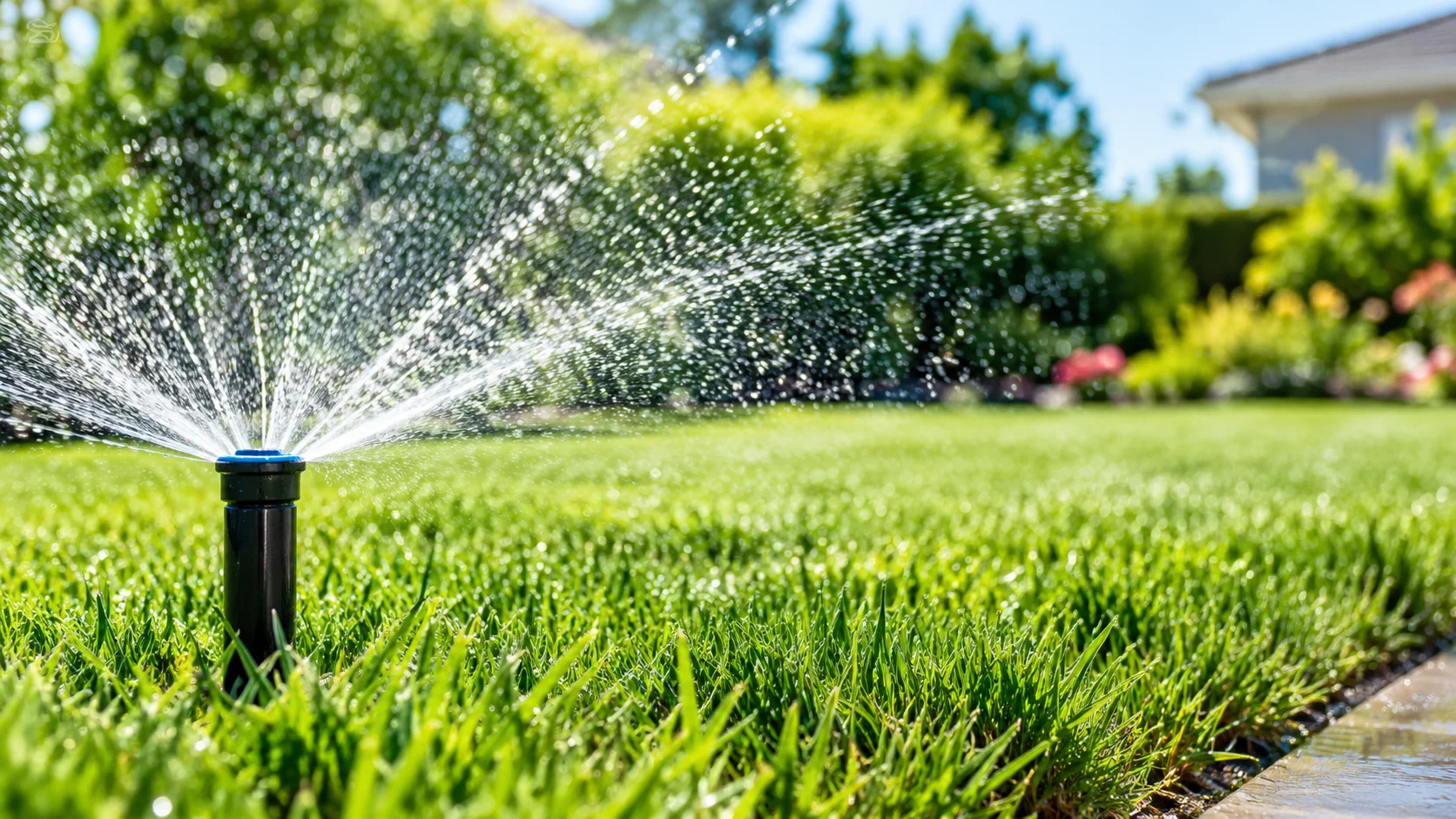
A garden-hose sprinkler typically uses roughly 3 to 8 gallons per minute — about 180 to 480 gallons in an hour. A single in-ground zone often runs at about 6 to 15 gallons per minute, which works out to roughly 180 to 450 gallons in a 30-minute cycle. For a lawn, the benchmark that matters is depth: every inch of water applied over 1,000 square feet takes about 623 gallons. Your exact number depends on the sprinkler type, your water pressure and how many heads share a zone — so below you'll find typical ranges, the formulas, and a simple way to measure your own system.
Skip the math Sprinkler Water Cost Calculator Open →Sprinkler water use at a glance
These are the ranges most homeowners will land in. Flow is what the sprinkler delivers while it runs, so multiply by run time to get gallons:
| Setup | Flow (gal/min) | Per 30 minutes | Per hour |
|---|---|---|---|
| Hose-end sprinkler (oscillating or impact) | 3 to 8 | 90 to 240 gal | 180 to 480 gal |
| One in-ground zone (spray or rotor heads) | 6 to 15 | 180 to 450 gal | 360 to 900 gal |
| Drip zone with 50 emitters (0.5 to 2 gal/hr each) | 0.4 to 1.7 | 13 to 50 gal | 25 to 100 gal |
Ranges are rounded estimates for planning, not figures from a single study. Measure your own system (see below) for an exact number.
The range is wide because a "sprinkler" can mean very different hardware. A hose-end unit is limited by your hose and spigot. An in-ground zone adds up the output of every head on that valve. Drip is a different category entirely: it delivers water in gallons per hour to the root zone, not gallons per minute across the surface.
Water use by sprinkler type
Two numbers describe an in-ground head: how much water it uses (flow, in gallons per minute) and how fast it applies water to the ground (application rate, in inches per hour). They are related but not the same, and the second one decides how long you need to run the zone.
| Head type | Flow per head (gal/min) | Application rate (in/hr) | Water per hour, per 1,000 sq ft |
|---|---|---|---|
| Fixed spray (pop-up) | 0.5 to 2.5 | 1 to 2.5 | about 620 to 1,560 gal |
| Rotor | 1 to 5 | 0.25 to 0.75 | about 160 to 470 gal |
| Multi-stream rotator | 0.2 to 0.6 | roughly 0.4 | roughly 250 gal |
| Drip emitter | 0.01 to 0.03 (0.5 to 2 gal/hr) | n/a (point source) | n/a |
Application rates for spray and rotor heads follow Colorado State University Extension. Flow-per-head ranges, the multi-stream figure and the last column are rounded estimates.
Notice what the table says: a spray head can apply water three times faster than a rotor, or more. That doesn't make it wasteful or efficient by itself — it just means a spray zone needs a much shorter run time to deliver the same depth. Run both for the same 30 minutes and the spray zone puts down far more water, often faster than the soil can absorb it.
Gallons per minute and inches per hour measure different things. Flow tells you what your water meter will record. Application rate tells you how deep a layer lands on the lawn. You need the second to set run times, and the first to predict your bill.
How much water a lawn gets, by area
If you think in terms of lawn size rather than sprinkler flow, the conversion is fixed. One square foot covered by one inch of water holds 144 cubic inches, and a US gallon is 231 cubic inches, so each square foot needs about 0.623 gallons per inch of water applied. Multiply that by your area and your target depth:
| Lawn area | 0.5 inch | 1 inch | 1.5 inches |
|---|---|---|---|
| 1,000 sq ft | 312 gal | 623 gal | 935 gal |
| 2,500 sq ft | 779 gal | 1,558 gal | 2,338 gal |
| 5,000 sq ft | 1,558 gal | 3,117 gal | 4,675 gal |
| 7,500 sq ft | 2,338 gal | 4,675 gal | 7,013 gal |
| 10,000 sq ft | 3,117 gal | 6,234 gal | 9,351 gal |
How many inches does a lawn need? It changes with grass type, climate and season, and rainfall counts toward the total. Colorado State Extension's example schedule for cool-season turf, for instance, runs from 0.75 to 1.5 inches per week between spring and fall. Your local extension office will have a more precise target for your region.
Calculate your own sprinkler's water use
There are two routes, and they should agree. Start from your zone's flow if you know it:
Or work from the lawn and the depth you want to apply, using your application rate to find the run time:
Worked example. A 4,000 sq ft lawn watered by rotors that apply 0.5 in/hr, with a target of 1 inch per week:
- Water needed: 4,000 × 1 × 0.623 ≈ 2,492 gallons per week.
- Run time: 1 ÷ 0.5 × 60 = 120 minutes per week, for example three 40-minute sessions.
- Cross-check: at 0.5 in/hr the zone uses 4,000 × 0.5 × 0.623 ≈ 1,246 gallons per hour, so two hours is the same 2,492 gallons.
Stretch that over a 20-week watering season and the lawn takes roughly 50,000 gallons. At an illustrative $5 per 1,000 gallons, that's about $12.46 a week, or about $250 for the season — plug in your own rate with the sprinkler water cost calculator.
Measure what your system really applies
Catalog numbers describe a perfect setup. Your pressure, nozzle wear and head spacing are not perfect, so a quick test beats any estimate. Three approaches work well:
- Catch-can test (application rate). Scatter several straight-sided containers, such as tuna cans, across one zone, run it for 15 minutes, and measure the average depth in inches. Multiply by 4 to get inches per hour. Colorado State Extension recommends repeating this for each zone, because rates differ by head type, pressure and spacing.
- Water-meter test (flow). With everything else in the house off, note the meter reading, run one zone for a set time, and read it again. The difference divided by minutes is that zone's gallons per minute.
- Bucket test (hose-end sprinklers). Time how long the hose takes to fill a 5-gallon bucket, then divide 5 by the minutes. This gives an upper limit, since a running sprinkler adds some resistance. The GPM calculator does the conversion if you time a different volume.
For a hose-based setup, the garden hose water usage calculator is a quick way to turn a measured flow into gallons for a given watering time.
What changes how much water a sprinkler uses
Water pressure. Flow through a fixed nozzle rises with the square root of pressure, so doubling the pressure increases flow by roughly 40%. Too much pressure also turns spray into fine mist that drifts away.
Nozzle size and head spacing. Bigger nozzles pass more water, and heads spaced too far apart leave dry spots that tempt people to run the zone longer.
Wind, heat and evaporation. The EPA notes that as much as 50% of outdoor water use can be lost to wind, evaporation and runoff from inefficient irrigation methods and systems. Watering in the early morning, when it's cool and calm, keeps more water on the lawn.
Soil and slope. Clay soil and slopes absorb water slowly. If your application rate is higher than the soil's intake rate, the extra runs off. Splitting one long run into shorter cycles with a soak period between them (often called cycle and soak) puts the same water where it can be used.
Leaks and misaligned heads. The EPA estimates that an automatic irrigation system that isn't properly maintained and operated can waste up to 25,000 gallons of water a year. A broken head or a sprinkler watering the driveway is the usual culprit.
Controls and climate. The EPA reports that replacing a clock-based controller with a WaterSense labeled irrigation controller can cut an average home's irrigation water use by up to 30%. Climate matters even more: outdoor use is over 30% of household water on average and can reach 60% in arid regions.
Common real-world examples
Illustrative figures built from the formulas above:
Hose-end sprinkler, 1 hour
300 gal
At 5 gal/min — a steady flow that adds up quickly over a long watering session.
Spray zone, 15 minutes
135 gal
Six heads at 1.5 gal/min each. Short runs add up fast when spray heads run on a daily schedule.
Rotor zone, 30 minutes
360 gal
Four rotors at 3 gal/min each, 12 gal/min for the zone. Rotors need longer runs to apply the same depth.
Drip zone, 1 hour
50 gal
Fifty emitters at 1 gal/hr each, delivered right at the roots with little lost to wind or evaporation.
The bottom line
A hose-end sprinkler uses roughly 180 to 480 gallons an hour, an in-ground zone commonly uses 360 to 900, and a drip zone far less. For the lawn itself, plan on about 623 gallons per inch per 1,000 square feet. The most useful number is your own: run a catch-can test, check your meter, and set run times from measured output instead of guesswork. Do that and fix leaks, and you'll cut the waste before it reaches your bill. When you're ready to turn gallons into dollars, the calculator below does it for you.
Frequently asked questions
How many gallons per hour does a sprinkler use?
A hose-end sprinkler typically uses about 180 to 480 gallons per hour (3 to 8 gallons per minute). A single in-ground zone with several heads commonly uses about 360 to 900 gallons per hour. Drip zones use far less, often 25 to 100 gallons per hour.
How much water does a sprinkler use in 30 minutes?
Roughly 90 to 240 gallons for a hose-end sprinkler and 180 to 450 gallons for an in-ground zone. For a quick estimate, multiply the sprinkler's gallons per minute by 30. A sprinkler flowing 5 gallons per minute uses about 150 gallons in half an hour.
How much water should I put on my lawn per week?
Many lawns need roughly 1 inch per week in the growing season, counting rainfall, though it varies by grass, climate and season. One inch over 1,000 square feet takes about 623 gallons, so a 5,000 square foot lawn needs about 3,117 gallons for that inch.
How long should I run my sprinkler to apply 1 inch of water?
Divide 1 by your application rate in inches per hour, then multiply by 60. A spray zone applying 1.5 inches per hour needs about 40 minutes, while a rotor zone applying 0.5 inches per hour needs about 120 minutes. A catch-can test tells you your actual rate.
Do in-ground sprinklers use more water than a hose sprinkler?
Per hour, usually yes, because an in-ground zone combines several heads. But total use depends on run time and how well the system is maintained. The EPA estimates an improperly maintained automatic system can waste up to 25,000 gallons a year, so a tuned system often uses less than a neglected one.
How much sprinkler water is wasted?
The EPA says as much as 50 percent of outdoor water use is lost to wind, evaporation and runoff caused by inefficient irrigation methods and systems. Watering in the early morning, fixing leaks and using cycle-and-soak runs on slopes or clay soil all reduce that loss.
Sources & references
Reference figures in this guide come from the following. Gallons-per-inch conversions, run times and cost examples are calculated from them and from standard unit definitions.
- U.S. Environmental Protection Agency, WaterSense — Statistics and Facts. Outdoor water use share, estimated losses from inefficient irrigation, and savings from WaterSense labeled controllers.
- Colorado State University Extension — Methods to Schedule Home Lawn Irrigation. Typical application rates for spray and rotor heads, and the catch-can (precipitation rate) test.

Water Quality & Sustainability Specialist · Portland, Oregon
Sarah is a water quality and sustainability specialist who leads the water usage, conservation and treatment guides on Water Calculator. Read full bio
MS · Specializes in water usage, water quality and sustainability