Boiling Point of Water at High Altitude (With Chart)
From 212 °F at sea level to well under 160 °F on Everest — here's exactly how much altitude lowers water's boiling point, why it happens, and what it means in the kitchen.

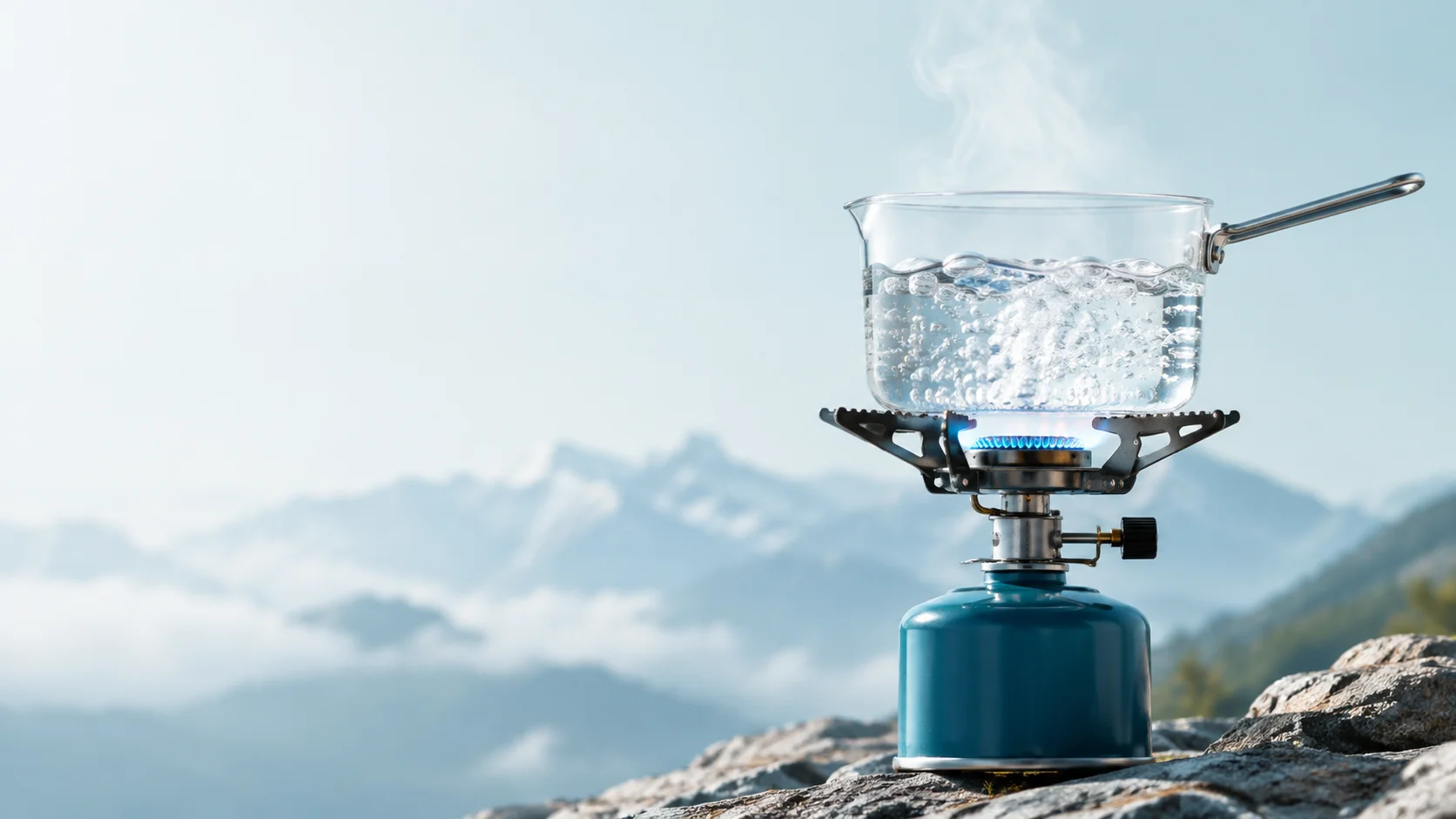
At sea level, water boils at 212 °F (100 °C). Climb higher and that number drops steadily — to about 203 °F (95 °C) around 5,000 ft, near 193 °F (89.6 °C) at 10,000 ft, and to roughly 161.5 °F (72 °C) at the summit of Mount Everest. The cause is air pressure, not temperature itself: water boils the moment its vapor pressure equals the pressure of the air pushing down on it, and there's simply less air overhead the higher you go. Here's the full chart, the physics behind it, and what it actually changes at the stove.
Skip the math Boiling Point at Altitude Calculator Open →Boiling point at altitude, at a glance
These are the numbers worth remembering — the boiling point at a few common reference elevations:
| Altitude | Boiling point (°F) | Boiling point (°C) |
|---|---|---|
| Sea level (0 ft) | 212.0 °F | 100.0 °C |
| 2,000 ft (610 m) | 208.1 °F | 97.8 °C |
| 5,000 ft (1,524 m) | 202.4 °F | 94.7 °C |
| 7,500 ft (2,286 m) | 197.8 °F | 92.1 °C |
| 10,000 ft (3,048 m) | 193.2 °F | 89.6 °C |
| Everest summit (29,032 ft) | ~161.5 °F | ~72 °C |
Figures are for pure water and the standard atmosphere. Local weather, humidity, and dissolved minerals shift the exact number by a fraction of a degree.
Why altitude lowers the boiling point
Boiling isn't really about a fixed temperature — it's about a pressure match. Every liquid has a vapor pressure that rises as it heats up: the tendency of molecules at the surface to escape into the air as gas. A liquid boils, rather than just evaporates from its surface, at the exact temperature where that vapor pressure becomes strong enough to overcome the weight of the atmosphere pressing down on it, letting bubbles of vapor form and rise from within the liquid itself.
At sea level, standard atmospheric pressure is about 14.7 psi (101.3 kPa), and water's vapor pressure reaches that figure at 212 °F. Go up a mountain and there's a shorter, thinner column of air above you, so atmospheric pressure is lower. Water's vapor pressure now only needs to climb to that lower number, which happens at a lower temperature. Nothing about the water changes — the air simply pushes back less.
It helps to picture the atmosphere as a stack of air sitting on top of the water. At sea level, that entire stack is bearing down; at 10,000 ft, roughly a third of it is already below you, so what remains overhead weighs less. Heat water enough at that elevation and its molecules only have to work hard enough to shove aside the thinner remaining air — a lower bar than at sea level, which is exactly why the boiling point comes down with it.
Boiling faster isn't cooking faster. At altitude, water reaches its (lower) boiling point sooner, so it looks like it's "boiling faster." But once it's boiling, it's cooler than sea-level boiling water — so food actually takes longer to cook through, not less.
Full reference table, sea level to 29,000 ft
For a more granular look, here's the boiling point in 1,000-foot steps up to 10,000 ft, then at wider intervals up to the top of Mount Everest:
| Altitude (ft) | Altitude (m) | Boiling point (°F) | Boiling point (°C) |
|---|---|---|---|
| 0 | 0 | 212.0 | 100.0 |
| 1,000 | 305 | 210.1 | 98.9 |
| 2,000 | 610 | 208.1 | 97.8 |
| 3,000 | 914 | 206.2 | 96.8 |
| 4,000 | 1,219 | 204.3 | 95.7 |
| 5,000 | 1,524 | 202.4 | 94.7 |
| 6,000 | 1,829 | 200.6 | 93.6 |
| 7,000 | 2,134 | 198.7 | 92.6 |
| 8,000 | 2,438 | 196.9 | 91.6 |
| 9,000 | 2,743 | 195.0 | 90.6 |
| 10,000 | 3,048 | 193.2 | 89.6 |
| 15,000 | 4,572 | 184.4 | 84.7 |
| 20,000 | 6,096 | 175.9 | 79.9 |
| 29,032 (Everest summit) | 8,849 | ~161.5 | ~72 |
The relationship isn't perfectly straight — the drop per 1,000 ft is slightly steeper at very high elevations than close to sea level, because air pressure itself thins out in a curve, not a straight line, as you climb. For everyday elevations, though, the difference is small enough to ignore.
A quick rule of thumb, and its limits
You don't need the full table for a fast estimate. Over the elevations most people actually live and cook at, the boiling point drops in a fairly predictable, near-linear way:
This shortcut is exactly why the classic kitchen guidance you've probably heard — "subtract about 2 °F for every 1,000 ft" — works reasonably well for most home cooks in the US, without needing to memorize a chart. The approximation breaks down at extreme elevation because atmospheric pressure itself doesn't fall in a straight line as you climb — it thins out faster near sea level than it does higher up, following a roughly exponential curve. Climbing from sea level to 8,000 ft drops the boiling point by about 15 °F, but climbing a similar 8,000 ft higher, from 21,000 ft to the Everest summit, drops it by only around 13 °F — the same elevation gain, a slightly smaller effect.
Real-world examples
Numbers land better with a place attached to them. Here's roughly where the boiling point sits in a few well-known high-elevation locations, based on their approximate elevation and the reference table above:
Denver, Colorado
~202 °F
The "Mile High City" sits around 5,280 ft, right at the 5,000 ft mark — about 10 °F below sea-level boiling.
Mexico City
~198 °F
At roughly 7,350 ft, water there boils close to the 7,000 ft reference figure of 198.7 °F.
La Paz, Bolivia
~190 °F
One of the highest capital cities on Earth, at roughly 11,900 ft — over 20 °F below the sea-level figure.
Everest summit
~161.5 °F
At 29,032 ft, water boils about 50 °F cooler than at sea level — barely hot enough for a decent cup of tea.
What it means for cooking
Because boiling water at altitude is genuinely cooler, anything cooked in it — pasta, rice, boiled eggs, blanched vegetables, beans — takes longer to finish, even though it starts boiling sooner. The lower the boiling point, the more pronounced the effect, which is why cookbooks and package directions usually only bother calling out "high-altitude" adjustments above about 3,000–5,000 ft.
Baking is affected differently: it isn't governed by boiling water, but by faster evaporation and lower air pressure acting on rising batter, which is why high-altitude baking advice typically involves adjusting oven temperature, leavening, and liquid rather than just cooking time. That's a separate topic from boiling itself, though the underlying cause — thinner air — is the same.
Undoing it with a pressure cooker
A pressure cooker sidesteps the whole problem. By sealing in steam, it raises the pressure inside the pot well above the surrounding air pressure — so water inside has to reach a higher temperature before its vapor pressure matches that higher internal pressure. In practice, that pushes the effective boiling point back up toward, or even above, the standard 212 °F, regardless of how high up the kitchen itself sits. It's the same reason pressure cookers cook food faster at any elevation, and it's especially valuable in mountain towns where an open pot never gets hot enough to boil efficiently.
What else changes the boiling point
Day-to-day weather. Barometric pressure shifts a little with passing weather systems even at a fixed elevation — high pressure pushes the boiling point up slightly, low pressure (like an approaching storm) pushes it down. The swing is typically well under half a degree Fahrenheit, so it's not something a home cook needs to track, but it's why a scientific-grade thermometer calibrated by boiling water can drift slightly day to day.
Dissolved salt and minerals. Adding solutes to water raises its boiling point slightly — this is why the ocean boils a bit hotter than fresh water. But the amount used in cooking is tiny compared to seawater's salt load, so the effect on a pot of pasta water is negligible next to the multi-degree swing caused by elevation.
Pot, lid, and stirring. None of these change the temperature at which water boils. A lid traps steam and helps water reach boiling faster by cutting heat loss, and a heavier pot distributes heat more evenly, but neither raises the boiling point itself — only pressure can do that, which is exactly why a sealed pressure cooker works and an ordinary lid doesn't.
The bottom line
Water's boiling point is not a fixed 212 °F — it's a moving target set by atmospheric pressure, and atmospheric pressure falls steadily with elevation. At a mile above sea level it's already down to around 202 °F; by the summit of Everest it's barely above 160 °F. For most home cooking below about 3,000 ft the difference is negligible, but above that, longer cooking times — or a pressure cooker — make up for the cooler boil. When you need an exact figure for a specific elevation, the calculator below has it.
Frequently asked questions
Why does water boil at a lower temperature at high altitude?
Water boils when its vapor pressure equals the pressure of the air pushing down on it. At higher elevations there is less air overhead, so atmospheric pressure is lower, and water's vapor pressure catches up to that lower number at a lower temperature.
What temperature does water boil at in Denver?
Denver sits at about 5,280 ft, close to the 5,000-foot mark, where water boils at roughly 202 °F (94 °C) instead of the sea-level 212 °F (100 °C).
What temperature does water boil at on top of Mount Everest?
At the summit of Mount Everest (29,032 ft / 8,849 m), water boils at roughly 161.5 °F (72 °C) — about 50 °F below the sea-level boiling point.
Does water boil faster at high altitude?
Yes, it reaches boiling sooner because it needs less heat to get there, but that's not the same as cooking faster. The water is cooler once it's boiling, so food set to boil at altitude actually takes longer to cook through.
Does a pressure cooker fix the altitude problem?
Yes. A pressure cooker seals in steam and raises the pressure inside the pot well above the surrounding air pressure, which pushes the boiling point back up — often close to or above the standard 212 °F (100 °C) — regardless of elevation.
Does adding salt raise the boiling point enough to matter at altitude?
Not meaningfully. A typical amount of salt in a pot of cooking water raises the boiling point by only a small fraction of a degree — far too little to offset the many-degree drop caused by elevation.
Sources & references
The figures in this guide follow standard reference data on water's boiling point and atmospheric pressure:
- U.S. Geological Survey, Water Science School — Facts About Water. Sea-level and 5,000 ft boiling-point figures.
- The Engineering ToolBox — Water: Boiling Points vs. Altitude. Detailed boiling-point table by elevation, including the Everest summit example.
- HyperPhysics, Georgia State University — Saturated Vapor Pressure / Boiling Point. Physics of vapor pressure equaling atmospheric pressure at the boiling point.
Water Systems Specialist · Austin, Texas
A Texas-licensed Professional Engineer with 13+ years in residential water systems, John leads the science, flow and pressure guides on Water Calculator. Read full bio
Licensed Professional Engineer (PE) · Specializes in water density, flow and pressure