The Chemistry of Water (H₂O) Explained Simply
Two hydrogen atoms, one oxygen atom and an uneven sharing of electrons — here's how that simple structure gives water its bent shape, its hydrogen bonds, its pH and its power as a solvent.

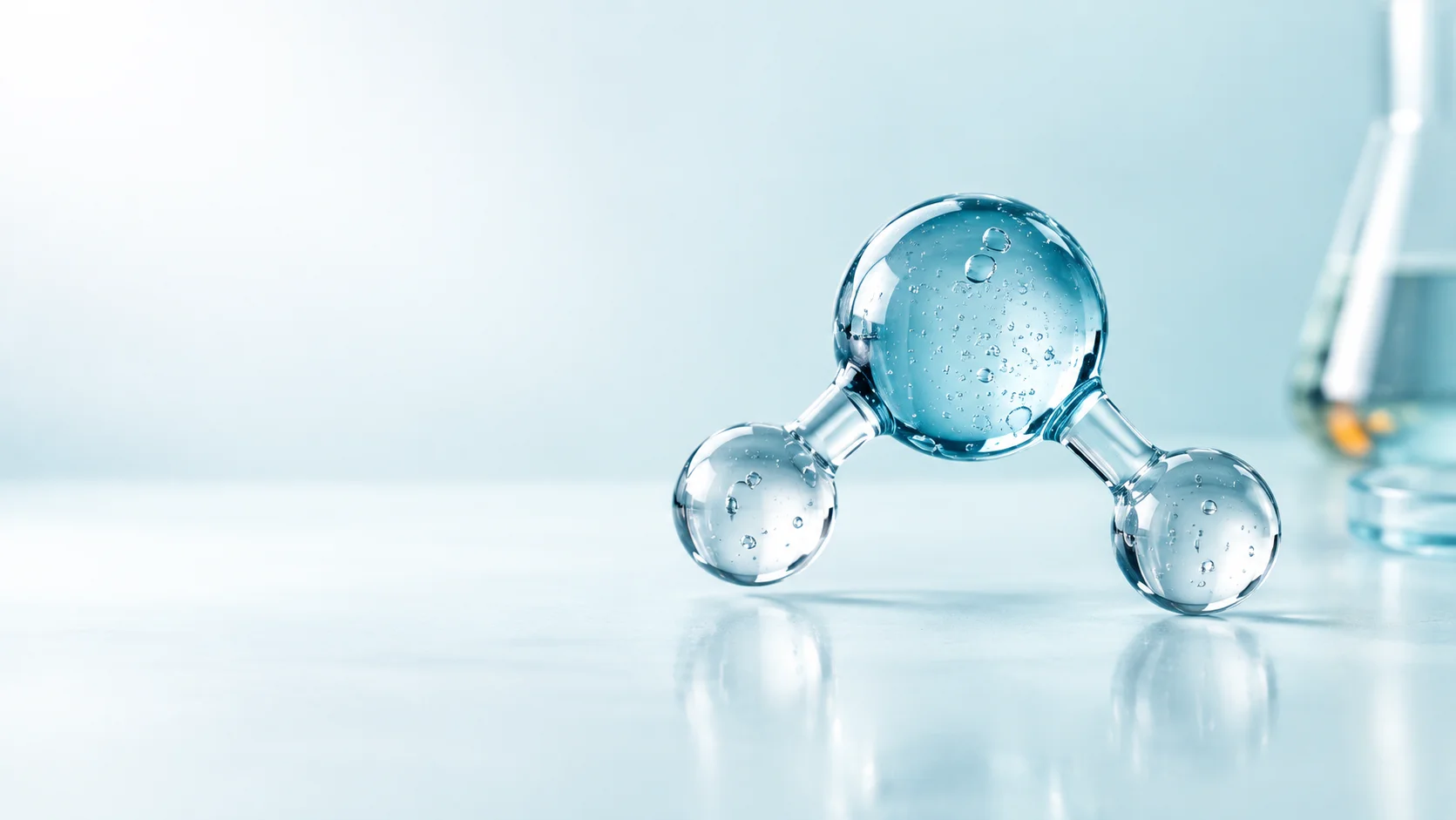
Water (H₂O) is a molecule of one oxygen atom bonded to two hydrogen atoms in a bent, V-shaped arrangement. Oxygen pulls the shared electrons harder than hydrogen does, so the oxygen side of the molecule carries a slight negative charge and the hydrogen side a slight positive one. That built-in polarity lets water molecules cling to each other through hydrogen bonds, and it explains almost everything unusual about water: a high boiling point, a huge appetite for dissolving salts and sugars, ice that floats, and a neutral pH of 7 at 25 °C. Here's how it all fits together, one step at a time.
Skip the math Molar Mass of Water Calculator Open →Water chemistry at a glance
These are the reference values worth knowing. The rest of this guide explains where each one comes from:
| Property | Value |
|---|---|
| Chemical formula | H₂O |
| Molar mass | 18.015 g/mol |
| Molecular shape | Bent (V-shaped) |
| H–O–H bond angle | About 104.5° |
| Bonds inside the molecule | Polar covalent |
| Attraction between molecules | Hydrogen bonds |
| Freezing / boiling point | 0 °C / 100 °C |
| Densest at | About 4 °C |
| Neutral pH | 7.0 at 25 °C |
Values are rounded. Dissolved minerals and gases shift them slightly in real-world water.
Inside a single water molecule
Start with the atoms. Oxygen has six electrons in its outer shell and wants two more to fill it; each hydrogen has one and wants one more. So they share. Each hydrogen pairs its electron with one from oxygen, forming two covalent O–H bonds. That leaves oxygen with two further electron pairs that aren't shared with anyone — the lone pairs.
The four electron pairs around oxygen (two bonding, two lone) repel each other and spread out in a roughly tetrahedral arrangement. Lone pairs take up more room than bonding pairs, so they squeeze the two O–H bonds closer together. The result is a bent molecule with an H–O–H angle of about 104.5° — not the 109.5° of a perfect tetrahedron and nowhere near a straight line.
Now the charge. On the Pauling scale, oxygen's electronegativity (its pull on shared electrons) is 3.44 and hydrogen's is 2.20. The shared electrons therefore spend more time near oxygen, giving it a partial negative charge (written δ⁻) and each hydrogen a partial positive charge (δ⁺). Because the molecule is bent, those charges don't cancel: one side is negative and the other positive. Compare carbon dioxide, which also has polar bonds but is perfectly straight, so its charges cancel and the molecule is nonpolar. Water's shape is what makes it polar.
Composition by mass. Working from atomic masses (oxygen 15.999, hydrogen 1.008), a water molecule is about 88.8% oxygen and 11.2% hydrogen by mass. That's why 9 g of water holds only about 1 g of hydrogen, even though there are two hydrogen atoms for every oxygen.
Hydrogen bonding: why water is unusual
The slightly positive hydrogen on one molecule is attracted to a lone pair on the oxygen of a neighbor. That attraction is a hydrogen bond. Each molecule can donate up to two and accept up to two, so it can link to as many as four neighbors, which is how liquid water forms a constantly shifting network.
A single hydrogen bond is weak — roughly a twentieth as strong as an O–H covalent bond — and in liquid water they break and re-form within trillionths of a second. But there are so many of them that their combined effect is large. It's why water stays liquid at temperatures where similar small molecules are gases.
A telling comparison. Hydrogen sulfide (H₂S) has the same bent shape as water but is nearly twice as heavy, at about 34 g/mol against 18 g/mol. Yet it boils at about −60 °C, while water boils at 100 °C. That gap of roughly 160 °C is hydrogen bonding at work.
The same network is behind these familiar properties:
| Property | Water | For comparison |
|---|---|---|
| Boiling point | 100 °C | H₂S: about −60 °C |
| Specific heat | 4.18 J/(g·°C) | Copper: about 0.39 J/(g·°C) |
| Heat of vaporization | About 2,260 J/g | Ethanol: about 840 J/g |
| Surface tension (20 °C) | About 72 mN/m | Ethanol: about 22 mN/m |
| Density, ice vs. liquid | 0.917 vs. about 0.998 g/cm³ | Most solids are denser than their liquid |
Heat. Before molecules can move faster, hydrogen bonds have to stretch and break, so water soaks up a lot of energy per degree of temperature rise. That's why oceans moderate climate and why heating water takes real energy — the specific heat of water calculator puts numbers on it.
Ice floats. When water freezes, hydrogen bonds lock the molecules into an open hexagonal lattice with more empty space than the liquid has. Ice is therefore less dense than liquid water, and freezing expands the volume by about 9%. Liquid water is densest near 4 °C, which is why lakes freeze from the top down — and why a frozen pipe can burst.
Why water dissolves so much
Water dissolves ionic compounds and other polar substances because its polar molecules can surround and stabilize them. Drop table salt into water: the negative oxygen ends of water molecules crowd around sodium ions (Na⁺), the positive hydrogen ends crowd around chloride ions (Cl⁻), and the crystal is pulled apart ion by ion. Chemists call the shell of water molecules around each ion hydration.
Sugar dissolves by a different route. It isn't ionic, but its –OH groups form hydrogen bonds with water. Oil is the opposite case: its molecules are nonpolar, so water has nothing to grip, and water molecules would rather bond with each other. The oil gets pushed out into its own layer. Chemists sum it up as “like dissolves like.”
This is why water earns the nickname universal solvent. It overstates things — water doesn't dissolve everything — but it explains why every natural water source carries dissolved material. Dissolved calcium and magnesium are what make water “hard,” and you can convert hardness between units with the hardness ppm to gpg calculator. Dissolved oxygen, a gas held in water in small amounts, is what fish breathe; the dissolved oxygen calculator covers that side.
Self-ionization, pH and why “neutral” isn't always 7
Water also reacts with itself, a little. Now and then a hydrogen ion (a proton) hops from one water molecule to a neighbor, leaving a hydronium ion and a hydroxide ion:
The product of the two ion concentrations is a constant called the ion product of water:
That is where pH 7 comes from. The pH scale runs from 0 to 14 and measures hydronium concentration: below 7 is acidic, above 7 is basic. Add an acid and hydronium rises; add a base and hydroxide rises. Either way, the product of the two stays fixed at a given temperature.
Neutral isn't always 7. Kw grows as water gets hotter, because more molecules ionize. In pure water at 100 °C the neutral pH is about 6.1. That water isn't acidic — hydronium and hydroxide are still equal — the neutral point has simply moved.
Few ions also means pure water is a poor conductor of electricity. Tap water conducts well because dissolved minerals supply ions, which is what the conductivity to TDS calculator uses to estimate dissolved solids.
Making and splitting water
Burn hydrogen in oxygen and you get water, plus energy — about 286 kJ for every mole (18 g) of liquid water formed:
Run it backward with electricity and water splits into its elements. This is electrolysis:
By mass the split is different: about 1 part hydrogen to 8 parts oxygen, because each oxygen atom is roughly sixteen times heavier than a hydrogen atom. The water electrolysis calculator works out the gas volumes for a given amount of water.
Chemistry by the numbers
Chemists count in moles. One mole is 6.022 × 10²³ molecules, and a mole of water has a mass equal to its molar mass, about 18.015 g. To convert any mass of water into moles:
A liter of water has a mass of very close to 1,000 g, so it holds roughly 55.5 mol — about 3.3 × 10²⁵ molecules. The molar mass of water calculator and the moles of water calculator do these conversions for any amount.
One mole
18.015 g
About 18 mL of liquid water — the volume of a tablespoon and a half — contains 6.022 × 10²³ molecules.
One liter
≈ 55.5 mol
Roughly 3.3 × 10²⁵ molecules in a single liter bottle.
250 g glass
≈ 13.9 mol
Around 8.4 × 10²⁴ molecules in one ordinary cup of water.
9 g of water
1 g H₂ + 8 g O₂
What electrolysis would yield from 9 g of water: the 1:8 mass split in practice.
Common misconceptions
Boiling doesn't break water apart. The bonds inside each molecule are covalent and strong. Boiling only overcomes the hydrogen bonds between molecules, which is why steam is still H₂O. Ice, liquid water and steam are one substance in three arrangements.
Hydrogen bonds aren't the bonds inside H₂O. The O–H bonds in a molecule are covalent. “Hydrogen bond” names the much weaker attraction between separate molecules.
Not every water molecule is identical. A small share of natural hydrogen is deuterium, a heavier isotope, roughly 1 atom in 6,400. Water made with it is called heavy water (D₂O). At natural levels the effect on everyday properties is negligible.
The bottom line
Water's chemistry follows from one simple structure. Two hydrogens and one oxygen form a bent molecule; oxygen's stronger pull on electrons makes it polar; polarity produces hydrogen bonds; and hydrogen bonds account for the high boiling point, the large heat capacity, the strong surface tension, floating ice and the ability to dissolve salts and sugars. A tiny fraction of molecules ionize, which sets neutral pH at 7 at 25 °C. Keep the structure in mind and the properties stop looking like a list of trivia.
Frequently asked questions
What is the chemical formula of water?
The formula is H₂O: two hydrogen atoms bonded to one oxygen atom. One mole of water has a mass of about 18.015 g, which is its molar mass.
Why is water a polar molecule?
Two things combine. Oxygen pulls shared electrons more strongly than hydrogen does, so oxygen carries a partial negative charge and the hydrogens a partial positive charge. And because the molecule is bent (about 104.5°) rather than straight, those charges don't cancel, leaving one negative side and one positive side.
What is a hydrogen bond in water?
It's the attraction between a slightly positive hydrogen on one water molecule and a lone pair on the oxygen of a neighboring molecule. Each molecule can form up to four of them. They're individually weak but collectively responsible for water's high boiling point, surface tension and floating ice.
Why does ice float on water?
In ice, hydrogen bonds lock molecules into an open hexagonal lattice that takes up more space than the liquid does. Ice has a density of about 0.917 g/cm³ versus roughly 1.0 for liquid water, so freezing expands the volume by about 9% and the ice floats.
Is pure water acidic, basic or neutral?
Neutral. In pure water the hydronium and hydroxide ion concentrations are equal, which gives a pH of 7.0 at 25 °C. The neutral pH shifts with temperature — it falls to about 6.1 at 100 °C — but the water is still neutral, because the two ions remain equal.
Why is water called the universal solvent?
Its polar molecules surround and separate ions and other polar substances, so it dissolves more materials than most liquids. The nickname is an exaggeration, though: water doesn't dissolve oils or other nonpolar substances well.
Is water an element, a compound or a mixture?
Pure water is a compound: hydrogen and oxygen chemically bonded in a fixed 2:1 ratio. Tap water is technically a mixture, because it also contains dissolved minerals and gases on top of the H₂O.
Sources & references
The figures in this guide follow standard reference values for the structure and properties of water:
- NIST Chemistry WebBook — Water. Lists the molecular weight of H₂O as 18.0153.
- U.S. Geological Survey, Water Science School — Adhesion and Cohesion of Water. Describes the partial charges on a water molecule and the hydrogen bonds between neighboring molecules.
- U.S. Geological Survey, Water Science School — pH and Water. Explains the 0–14 pH scale, with 7 as neutral.
Water Systems Specialist · Austin, Texas
A Texas-licensed Professional Engineer with 13+ years in residential water systems, John leads the science, flow and pressure guides on Water Calculator. Read full bio
Licensed Professional Engineer (PE) · Specializes in water density, flow and pressure