How Much Energy Does It Take to Heat Water?
From a cup of tea to a full water heater tank — here's the physics behind heating water, worked out in Btu and kWh, with real-world costs and the factors that move the number.

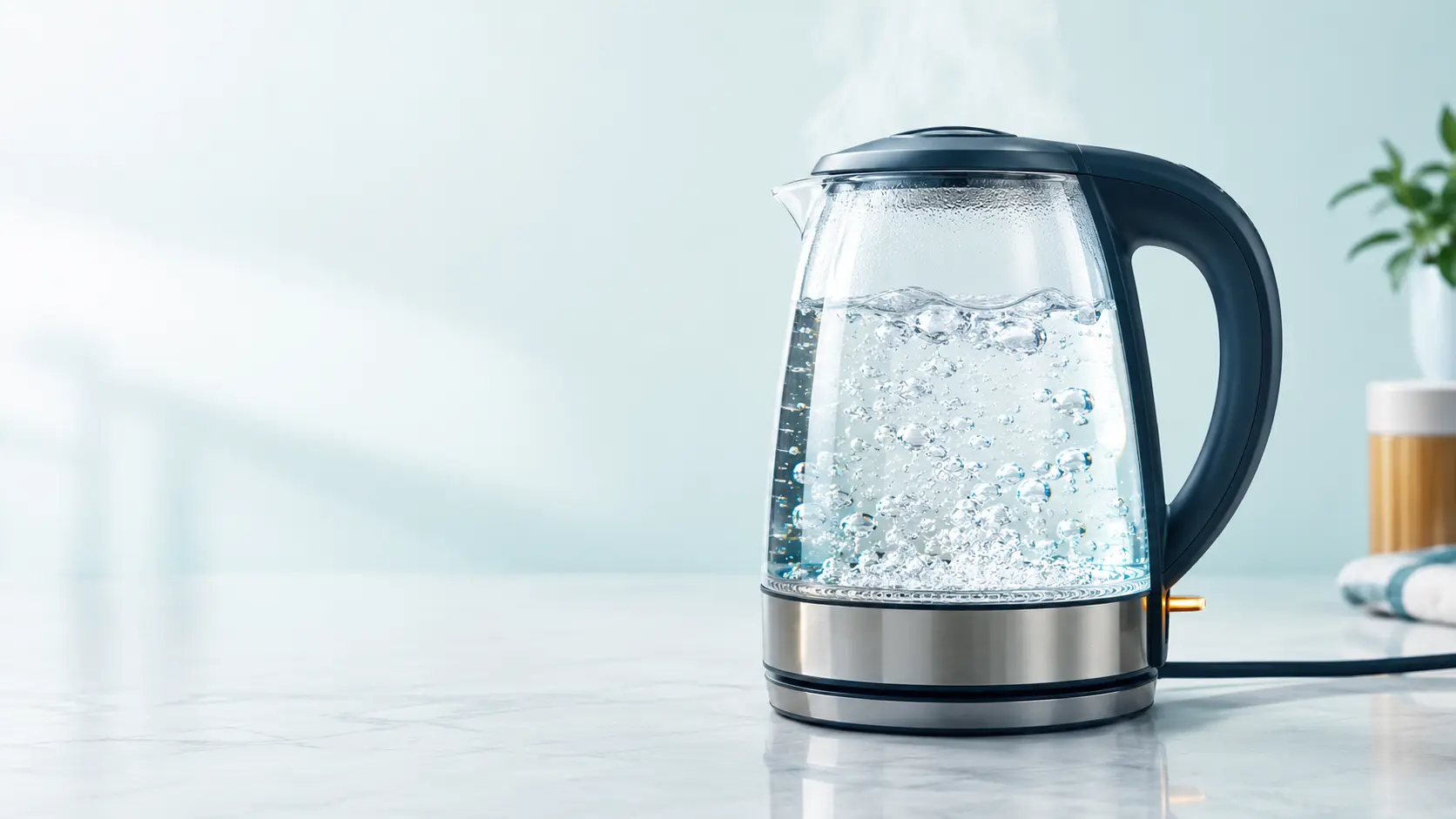
Heating water takes about 8.34 Btu per gallon for every 1 °F you raise it, or 4.186 kJ per liter for every 1 °C — roughly 0.00244 kWh and 0.00116 kWh respectively. That single relationship, weight (or mass) times a fixed constant times the temperature rise, is all the physics you need. It explains why a kettle takes a few minutes, why refilling a water heater tank costs real money, and why water is such a stubborn thing to warm up compared with almost anything else in your kitchen. Here's the full picture, with the formula, the real-world numbers, and what actually changes the answer.
Skip the math Energy to Heat Water Calculator Open →Energy to heat water, at a glance
These are the base figures everything else in this guide is built from — the energy needed to raise water by one degree, per unit of mass or volume:
| Amount of water | Temperature rise | Energy needed |
|---|---|---|
| 1 gram | 1 °C | 4.186 J (1 calorie) |
| 1 liter (1 kg) | 1 °C | 4.186 kJ ≈ 0.00116 kWh |
| 1 pound | 1 °F | 1 Btu ≈ 0.000293 kWh |
| 1 US gallon | 1 °F | 8.34 Btu ≈ 0.00244 kWh |
Those constants — 4.186 kJ per kg per °C, and 1 Btu per pound per °F — come from the same physical property: water's specific heat. Everything below is just that number applied to a bigger temperature rise or a bigger volume.
These figures describe the heat that must end up in the water. They don't include losses from an inefficient heater, an uninsulated pot, or a leaky tank — more on that below.
Common heating tasks, quick reference
Most real questions aren't about a single degree — they're about a cup, a shower, or a full tank. Here's the energy delivered to the water for tasks people actually do, using typical starting and ending temperatures:
| Task | Temperature rise | Energy (Btu) | Energy (kWh) |
|---|---|---|---|
| 1 cup of tea (tap to boil) | 60 → 212 °F | 79 Btu | 0.023 kWh |
| 1 liter kettle (tap to boil) | 20 → 100 °C | 317 Btu | 0.093 kWh |
| 10-minute shower (25 gal) | 55 → 105 °F | 10,425 Btu | 3.06 kWh |
| Bathtub fill (35 gal) | 55 → 104 °F | 14,303 Btu | 4.19 kWh |
| 40-gallon water heater, full tank | 50 → 120 °F | 23,352 Btu | 6.84 kWh |
Notice the pattern: energy scales directly with both the amount of water and the size of the temperature rise. Double either one and the energy doubles with it — there's no shortcut around that.
Why water takes so much energy to heat
The constant behind all of this is water's specific heat: about 4.186 joules per gram per degree Celsius, which is also where the calorie comes from — 1 calorie was originally defined as the energy to raise 1 gram of water by 1 °C. In imperial units, the same property works out to almost exactly 1 Btu per pound per degree Fahrenheit, which is itself the definition of the Btu.
What makes water notable is how high that number is. Most metals have a specific heat only a fifth to a quarter of water's — an empty steel pot heats up almost instantly compared with the water you then pour into it. Cooking oils run at roughly half of water's specific heat, and air is lower still. That's why a pot "feels" like it heats up fast, then seems to stall once the water goes in: you're now heating a substance that resists temperature change far more stubbornly than the metal around it.
Same idea, bigger scale. This is also why oceans and large lakes moderate coastal climates — a huge mass of high-specific-heat water absorbs or releases enormous amounts of energy for a comparatively small change in temperature.
Calculate it yourself
The underlying formula is the same in any unit system: energy equals mass times specific heat times temperature change.
To convert to kilowatt-hours, divide kilojoules by 3,600 or divide Btu by 3,412. That gives you the energy that has to end up in the water — the number an ideal, lossless heater would consume. The energy to heat water calculator runs this for any volume, unit set, and temperature range, and the specific heat of water calculator is handy if you're working with a mix of water and something else.
From energy to real-world cost
The Btu or kWh figures above are the energy that ends up in the water — what physics demands. What a water heater or kettle actually consumes depends on its efficiency, and that's where fuel type matters:
- Electric resistance heating (tank electric water heaters, kettles, immersion elements) converts almost all of its electricity into heat in the water — typically 95–100% efficient.
- Standard gas storage water heaters lose a meaningful share of their fuel energy up the flue and to standby losses, so their effective efficiency (Uniform Energy Factor) is often in the 55–65% range — they need more input fuel energy than the Btu figure delivered to the water.
- Heat pump water heaters move heat from the surrounding air rather than generating it directly, so they can deliver two to four times as much heat energy as the electricity they consume (a coefficient of performance, or COP, of roughly 2–4) — the most efficient way to hit a given Btu target.
For a rough cost estimate at a typical U.S. residential electricity rate of around $0.16 per kWh, a 40-gallon electric water heater refill (about 6.84 kWh delivered, closer to 7.2 kWh drawn once efficiency losses are counted) comes out to roughly $1.10–$1.20. A 10-minute shower's worth of hot water (about 3.06 kWh delivered) runs closer to $0.50. These are estimates for illustration, not fixed figures — actual electricity and gas rates vary widely by region and season.
Real-world examples
Numbers are easier to trust when you can picture the task behind them:
Cup of tea
0.023 kWh
Tap water to boiling for one 8-oz cup — a fraction of a cent's worth of energy.
1-liter kettle
0.093 kWh
Room temperature to a rolling boil — real kettles draw a bit more due to heat loss.
10-minute shower
3.06 kWh
25 gallons raised about 50 °F — the single biggest hot-water use in most homes.
40-gal tank refill
6.84 kWh
Groundwater at 50 °F brought up to a 120 °F setpoint, tank-full.
What else affects the answer
Incoming water temperature. The energy needed scales with the temperature rise, not the target temperature — water entering a home in a cold northern winter (often in the 40s °F) needs meaningfully more energy to reach a 120 °F setpoint than water entering in a warm southern summer (often 70s °F).
Heat loss during and after heating. An open pot on a stove, an uninsulated pipe run, or a tank with worn insulation all bleed heat to the surroundings continuously, so the real energy consumed is always somewhat higher than the theoretical mass × specific heat × ΔT figure.
Altitude. Water boils at a lower temperature at elevation, so the temperature rise needed to reach a boil is slightly smaller in the mountains than at sea level — a small energy saving, though food still cooks more slowly at the lower boiling point.
The bottom line
Two numbers cover almost every situation: it takes about 8.34 Btu to raise a gallon of water by 1 °F, and about 4.186 kJ to raise a kilogram (liter) by 1 °C. Multiply by your actual volume and temperature rise and you have the energy that must reach the water — then divide by your heater's efficiency to see what it will actually cost you. When you want an exact figure for a specific volume, temperature range, and fuel type, the calculator below does the full conversion for you.
Frequently asked questions
How much energy does it take to heat a gallon of water by 1°F?
About 8.34 Btu, which works out to roughly 0.00244 kWh. That figure comes from the weight of a US gallon of water (8.34 lb) multiplied by water's specific heat of about 1 Btu per pound per degree Fahrenheit.
How much energy does it take to boil a liter of water?
Taking a liter from room temperature (about 20 °C) to boiling (100 °C) requires roughly 335 kJ, or about 0.093 kWh, of heat delivered to the water. Because a kettle isn't perfectly efficient, the electricity it actually draws is closer to 0.10–0.12 kWh.
How much energy does a 40-gallon water heater use to heat a full tank?
Roughly 23,000 Btu, or about 6.8 kWh, to raise 40 gallons from a typical 50 °F incoming groundwater temperature to a 120 °F setpoint. That's the heat delivered to the water; how much fuel or electricity the heater actually consumes to deliver it depends on its efficiency.
Does water take more energy to heat than other substances?
Yes. Water's specific heat of about 4.186 joules per gram per degree Celsius is unusually high — roughly four to five times that of common metals and around double that of typical cooking oils — so it takes noticeably more energy to raise a pound of water by a degree than most everyday materials.
Is a gas water heater less efficient than an electric one?
In terms of energy actually delivered to the water versus fuel consumed, yes, typically. A standard electric resistance water heater converts nearly all of its electricity into heat in the tank, while a standard gas storage water heater loses a meaningful share of its fuel energy up the flue and to standby losses, so it needs more input energy per gallon heated.
Does the starting temperature of the water matter?
Yes — energy need scales directly with the temperature rise, not the target temperature alone. Water entering a home at 40 °F in a cold winter climate takes noticeably more energy to reach a 120 °F setpoint than water entering at 70 °F in a warm climate, even though the target is identical.
Sources & references
The figures in this guide follow standard reference values for the thermal properties of water and common energy units:
- U.S. Department of Energy, Energy Saver — Water Heating. Overview of residential water heater types and efficiency.
- The Engineering ToolBox — Water — Specific Heat. Specific heat capacity of water across temperature.
- U.S. Energy Information Administration — British Thermal Units (Btu). Definition of the Btu and standard energy-unit conversions.
- Georgia State University, HyperPhysics — Specific Heat. Physical definition of specific heat and the calorie.
Water Systems Specialist · Austin, Texas
A Texas-licensed Professional Engineer with 13+ years in residential water systems, John leads the science, flow and pressure guides on Water Calculator. Read full bio
Licensed Professional Engineer (PE) · Specializes in water density, flow and pressure