How Long Does It Take to Boil Water? (The Science)
From a cup in a kettle to a stockpot on the stove — here's the physics that sets boiling time, a formula you can use for any volume, and real timing examples.

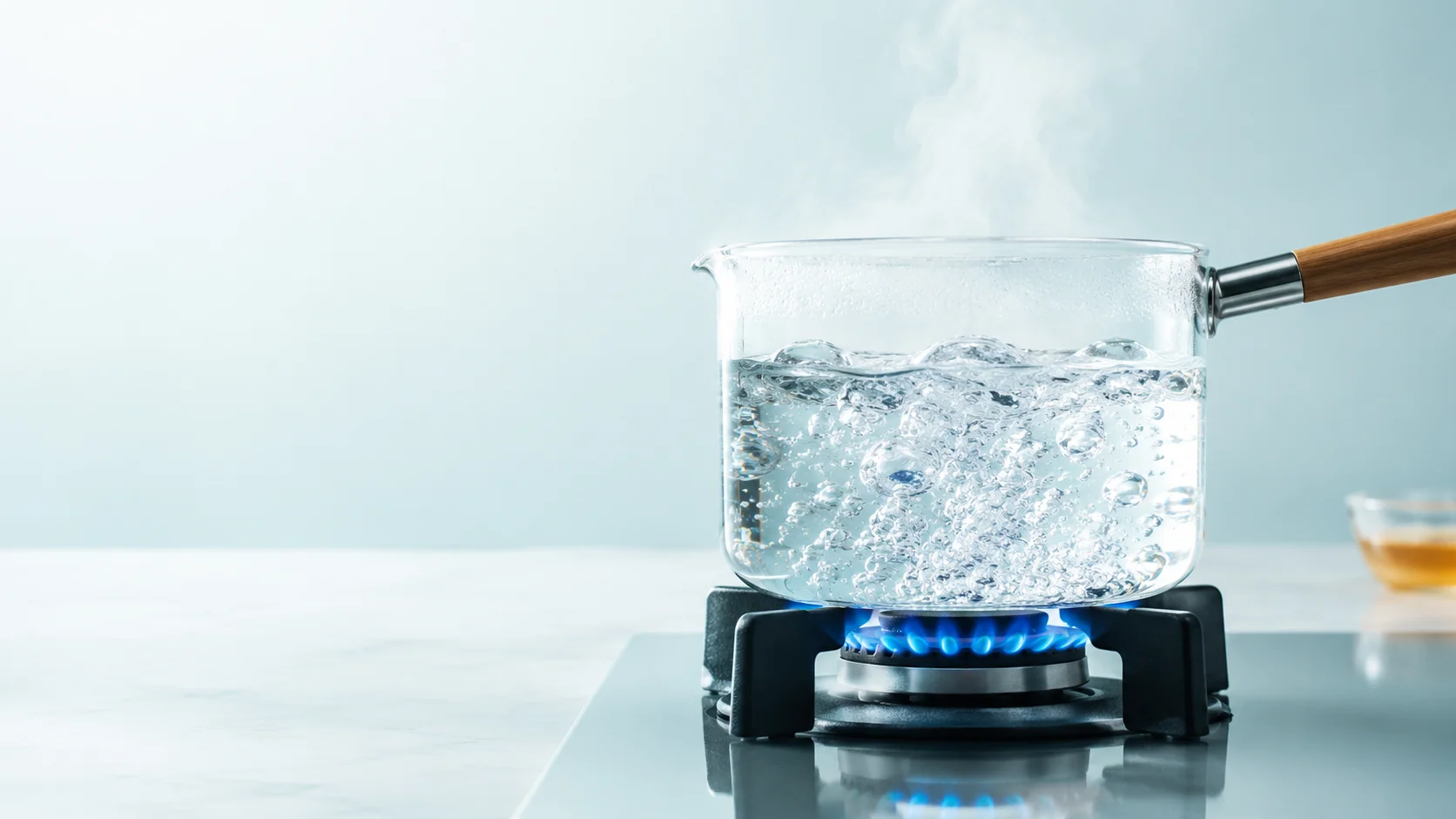
For a liter of room-temperature water on a standard 1,500-watt electric kettle, expect roughly 3.5 to 4 minutes. On a stovetop burner, plan for 5 to 6 minutes for the same amount, since more heat escapes around the pot. The real answer scales with three things: how much water you're heating, how far it has to warm up, and how fast your heat source can deliver energy. Change any one of those and the time changes with it — here's the physics, and the numbers for the volumes people actually ask about.
Skip the math Energy to Boil Water Calculator Open →Boiling time at a glance
These are theoretical minimums: room-temperature water (68 °F / 20 °C), sea level, and no heat lost to the pot, lid or surrounding air. Real kitchens run a bit slower — see the notes below the table.
| Volume of water | 1,500W electric kettle | Stovetop burner (~1,000W to the pot) |
|---|---|---|
| 1 cup (240 ml) | ~1 min | ~1.3 min |
| 2 cups (470 ml) | ~1.8 min | ~2.6 min |
| 1 quart (0.95 L) | ~3.5 min | ~5.3 min |
| 1 liter (1 L) | ~3.7 min | ~5.6 min |
| 0.5 gallon (1.9 L) | ~7 min | ~10.5 min |
| 1 gallon (3.8 L) | ~14 min | ~21 min |
In practice, kettles run close to this ideal because they're insulated and enclosed — most people find a liter takes about 4 minutes in a real kettle. Open stovetop pots lose more heat to the air, so the right-hand column tends to run a little long, especially on a weak burner or without a lid.
Common volumes, quick reference
The numbers above assume a fixed power level, but burners and kettles vary a lot. Here's the same physics expressed as a multiplier: minutes needed per cup of water, at a few typical heat-source powers, from a room-temperature start to a full boil.
| Heat source | Typical power to the water | Time per cup |
|---|---|---|
| High-power electric kettle | ~3,000 W | ~0.4 min |
| Standard US electric kettle | ~1,500 W | ~0.9 min |
| Induction cooktop, medium-high | ~1,800 W | ~0.7 min |
| Electric coil burner, medium-high | ~1,200 W | ~1.1 min |
| Gas burner, medium (efficiency losses included) | ~800 W | ~1.7 min |
| Microwave oven (typical countertop) | ~900–1,100 W, lower efficiency | ~2 min |
Multiply the "time per cup" figure by however many cups you're heating for a rough estimate — 8 cups (2 quarts) on a gas burner at roughly 1.7 minutes each lands around 14 minutes, which lines up with the gallon figure above once you account for the extra volume.
Why boiling time is about energy, not magic
Water doesn't boil on a timer — it boils once every part of it has absorbed enough heat energy to reach 212 °F (100 °C) at sea level. Two physical quantities govern exactly how much energy that takes.
The first is specific heat: the energy needed to raise the temperature of a given mass of water by one degree. Water's is unusually high — about 4,186 joules per kilogram per degree Celsius — which is also why oceans and lakes moderate the climate around them and why a pot of water takes real time and fuel to heat, compared with, say, a pan of oil. The second is mass: more water simply needs more total energy, in direct proportion to its weight.
Put those together and boiling time comes down to a straightforward relationship: energy needed ÷ power delivered = time. A more powerful burner or kettle delivers energy faster, so it wins the race; a bigger pot needs more total energy, so it loses time back.
Reaching a boil isn't the same as being "done." Water at a rolling boil has hit its ceiling temperature and won't get any hotter no matter how long you leave it on high heat — extra time past that point boils the water away rather than heating it further.
Work it out yourself
The formula behind every number on this page is simple enough to use on the back of an envelope. It needs the mass of water, the temperature change required, water's specific heat, and the power of your heat source:
Worked example: heating 1 liter (1 kg) of water from 68 °F (20 °C) in a 1,500-watt kettle:
For any other volume, scale the mass — 1 US gallon is about 3.78 kg, so the same kettle needs roughly 3.78 times the energy and, at the same power, roughly 3.78 times the time. The energy to boil water calculator runs this math for any volume, starting temperature, and power source.
What actually changes the time
Starting temperature. A smaller ΔT means less energy needed. Starting from warm tap water instead of cold can meaningfully shorten a large pot's boiling time, though most household water heaters don't get anywhere near boiling, so the water still has real work left to do.
Heat source power and efficiency. Not every watt a burner produces reaches the water. Enclosed, insulated kettles are highly efficient; open stovetop pots lose heat to the surrounding air, and gas flames that lick up the sides of a pot waste even more. That's the single biggest reason kettles consistently beat stovetops for the same volume.
A lid. Covering the pot traps rising steam and heat that would otherwise escape into the kitchen, so a larger share of the burner's output goes into the water instead of the room. It's one of the easiest ways to shave time off a stovetop boil.
Pot material and surface area. A wide, thin pot exposes more surface to open air and loses more heat than a narrower, heavier one — though the difference is smaller than starting temperature or lid use.
Vessel size versus burner size. A small pot on an oversized burner wastes heat around its edges; matching pot size to burner size keeps more energy where it belongs.
Altitude, boiling point and purification
Water's boiling point isn't fixed at 212 °F everywhere — it depends on air pressure. As elevation increases, air pressure drops, and water boils at a lower temperature. At sea level water boils at 212 °F, and with each 500-foot increase in elevation the boiling point drops by just under 1 °F — so a kitchen at 7,500 feet sees water boil around 198 °F rather than 212 °F.
That lower target temperature means slightly less energy is needed to reach a boil at altitude, but the effect on total time is modest — usually outweighed by whatever's happening with your starting temperature or burner power. The bigger practical consequence is that food simmers and cooks more slowly at altitude, because the water itself is cooler even while "boiling."
Boiling time also matters for water safety, and that guidance is separate from how long it takes water to first reach a boil. The CDC recommends bringing clear water to a rolling boil for 1 minute, extended to 3 minutes at elevations above 6,500 feet, to kill disease-causing germs. If you're purifying water — while camping, traveling, or under a boil-water advisory — that timer starts once the water is already boiling, on top of whatever time it took to get there.
Real-world examples
Numbers are easier to trust when you can picture them:
Cup of tea
~1 min
One cup in a 1,500W kettle, from room-temperature tap water.
Pot of pasta water
~9 min
About 3 quarts on a medium-high gas burner, uncovered.
Full kettle
~7 min
1.7 liters, a common kettle capacity, from a cold start.
1-gallon stockpot
~18–21 min
Room-temperature water on a typical home stovetop burner, uncovered.
The bottom line
Boiling time isn't fixed — it's the energy water needs divided by the power your kettle or burner can deliver. For most kitchen jobs, a cup takes about a minute in a kettle, a liter takes 3.5 to 6 minutes depending on your heat source, and a gallon takes 14 to 21 minutes. Starting from warmer water, using a lid, and matching your pot to your burner are the easiest ways to shave real time off the wait. When you need an exact figure for your own volume, temperature and power source, the calculator below does the math.
Frequently asked questions
How long does it take to boil a cup of water?
About 1 minute in an electric kettle, or roughly 1.5 minutes on a stovetop burner, starting from room-temperature tap water. Microwaves vary widely by wattage, but a cup typically takes 1.5 to 2.5 minutes.
How long does it take to boil a gallon of water?
Roughly 14 to 20 minutes on a standard stovetop burner, or about 14 minutes in a high-powered kettle, assuming room-temperature water at sea level. Weaker burners and cold tap water push that time higher.
Does covering the pot with a lid make water boil faster?
Yes, meaningfully. A lid traps rising steam and heat instead of letting it escape into the room, so more of the burner's energy goes into heating the water rather than the kitchen air.
Does adding salt make water boil faster?
No — salt very slightly raises water's boiling point, so salted water needs a touch more heat to boil, not less. The amount used in cooking is too small to notice in practice.
Why does water boil faster at high altitude?
Lower air pressure at altitude means water reaches its boiling point at a lower temperature, so there's a smaller temperature gap to climb. The effect on time is modest, and the water that results is cooler and less effective at cooking food.
Is boiling water for 1 minute enough to make it safe to drink?
Yes, for disinfection. The CDC recommends a full rolling boil for 1 minute to kill disease-causing germs, extended to 3 minutes above 6,500 feet elevation. That guidance is separate from the time it takes the water to first reach a boil.
Does starting with hot tap water boil faster than cold water?
Yes. The less the water has to warm up, the less energy and time it needs. Starting from hot tap water instead of cold can cut several minutes off a large pot, though most home water heaters don't get water hot enough to skip the boil entirely.
Sources & references
The figures in this guide follow standard reference values for the thermal properties of water and official public-health guidance:
- The Engineering ToolBox — Specific Heat Capacity of Water. Specific heat of water at varying temperatures.
- USDA Food Safety and Inspection Service — High Altitude Cooking. Boiling point of water by elevation.
- U.S. Centers for Disease Control and Prevention — Water Treatment Options When Hiking, Camping, or Traveling. Boiling time guidance for water disinfection.
Water Systems Specialist · Austin, Texas
A Texas-licensed Professional Engineer with 13+ years in residential water systems, John leads the science, flow and pressure guides on Water Calculator. Read full bio
Licensed Professional Engineer (PE) · Specializes in water density, flow and pressure