How Much Does Water Weigh? A Complete Guide by Volume
A gallon, a liter, a cubic foot — here's exactly what water weighs, why the number shifts a little with temperature, and how to work it out for any volume.

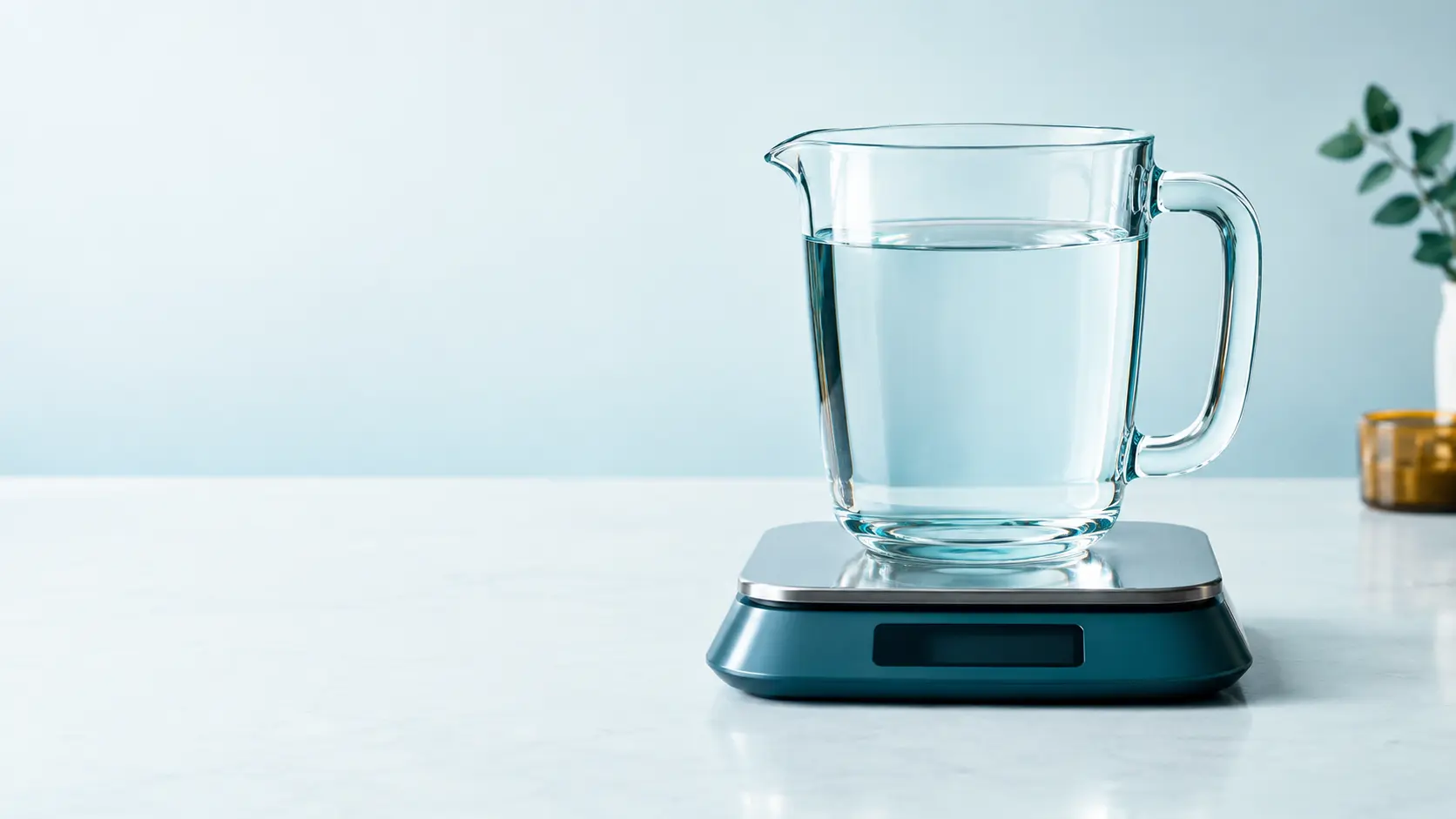
A US gallon of water weighs about 8.34 pounds (3.79 kg). A liter weighs almost exactly 1 kilogram, and a cubic foot comes in at roughly 62.4 pounds. Those are the numbers most people are after — but they shift slightly with temperature, and the "why" behind them is worth knowing if you're sizing a shelf, filling a tank, or just settling a bet. Here's the full picture, unit by unit.
Skip the math Water Weight Calculator Open →Water weight at a glance
For everyday purposes, at normal indoor temperatures, these are the figures to memorize:
| Volume of water | Weight (pounds) | Weight (kilograms) |
|---|---|---|
| 1 US gallon | 8.34 lb | 3.79 kg |
| 1 imperial (UK) gallon | 10.0 lb | 4.55 kg |
| 1 liter | 2.20 lb | 1.00 kg |
| 1 US cup | 0.52 lb | 0.24 kg |
| 1 cubic foot | 62.4 lb | 28.3 kg |
| 1 cubic meter | 2,205 lb | 1,000 kg |
Two things jump out. First, a liter of water weighing one kilogram is no coincidence — the kilogram was originally defined as the mass of a liter of water. Second, the imperial gallon is heavier than the US gallon simply because it's a larger volume (4.55 liters versus 3.79), not because the water itself is any different.
The classic "8.34 lb per gallon" and "62.4 lb per cubic foot" figures are quoted at roughly 39–60 °F. Warm the water to a hot 70 °F and a gallon reads closer to 8.33 lb — a difference too small to matter for most jobs.
Common volumes, quick reference
Most real questions aren't about a single gallon — they're about a jug, a tank or a delivery. Here's the weight of pure water for the volumes people look up most, at room temperature:
| US gallons | Weight (pounds) | Weight (kilograms) |
|---|---|---|
| 0.5 gallon | 4.17 lb | 1.89 kg |
| 1 gallon | 8.34 lb | 3.79 kg |
| 2 gallons | 16.7 lb | 7.57 kg |
| 2.5 gallons | 20.9 lb | 9.46 kg |
| 5 gallons | 41.7 lb | 18.9 kg |
| 10 gallons | 83.4 lb | 37.9 kg |
| 20 gallons | 167 lb | 75.7 kg |
| 50 gallons | 417 lb | 189 kg |
| 100 gallons | 834 lb | 379 kg |
Notice how quickly it adds up: water is heavier than most people expect, and a full 100-gallon tank weighs about as much as a grand piano. That's why weight, not just capacity, drives where a tank can safely sit.
Why water weight is really about density
Weight follows a simple rule: weight = volume × density. Volume is how much space the water takes up; density is how tightly its molecules are packed. Multiply the two and you get mass. So the only reason a gallon of water has a fixed weight is that water has a fixed density — about 998 kilograms per cubic meter at room temperature, or very close to 1 gram per cubic centimeter.
That single relationship is the whole story. Change the volume and the weight scales with it; change the density and the weight moves too. And the main thing that changes water's density is temperature.
Weight vs. mass, in one line. Kilograms and grams technically measure mass, while pounds measure weight (a force). On Earth's surface the two track each other exactly, so in everyday use we treat them as interchangeable — as this guide does.
Calculate water weight yourself
You don't need a calculator for a rough figure. For US gallons at room temperature, one multiplier does it:
For an exact answer at a specific temperature, work from density instead. Convert your volume to liters, then multiply by the density of water at that temperature (about 0.998 kg per liter at 70 °F), and convert to pounds if you need them:
Both routes land in the same place for everyday temperatures. The density method only pulls ahead when you're dealing with very hot water, salt water, or a job that needs to be exact — which is what the water weight calculator handles for you.
How temperature changes the answer
Heat a fixed amount of water and its mass doesn't change — but it expands, so each gallon holds slightly fewer molecules and weighs a touch less. Water is unusual here: it's densest at about 4 °C (39 °F), not at freezing. Above and below that point it becomes less dense, which is exactly why ice floats and why lakes freeze from the top down.
The effect is small across the temperatures you'll meet at home, but real:
| Temperature | Density (kg/m³) | Weight of 1 US gallon |
|---|---|---|
| 4 °C / 39 °F (densest) | 1,000.0 | 8.35 lb |
| 20 °C / 68 °F (room) | 998.2 | 8.33 lb |
| 100 °C / 212 °F (boiling) | 958.4 | 8.00 lb |
So a gallon of near-boiling water weighs about 4% less than a gallon of ice-cold water. For a glass of water it's irrelevant; for a large hot-water tank or a precise laboratory measurement, it matters — which is why our calculator lets you set the temperature.
Common real-world examples
Numbers are easier to trust when you can picture them:
5-gallon jug
41.7 lb
18.9 kg full — right at the edge of what most people carry comfortably in one hand.
40-gallon aquarium
333 lb
151 kg of water alone, before gravel, rock or the tank itself. Check what your stand and floor can hold.
55-gallon drum
458 lb
208 kg once filled — heavy enough that you'll want equipment, not muscle, to move it.
1 cubic foot
62.4 lb
28.3 kg — the figure plumbers and builders use for structural and drainage loads.
What else affects the weight
Dissolved salt. Seawater runs about 2–3% heavier than fresh water — roughly 1,025 kg/m³ versus 998 — because of the dissolved salt. So a gallon of seawater weighs closer to 8.6 lb.
Pressure. Water is nearly incompressible, so pressure has almost no effect on its weight outside deep-ocean or high-pressure industrial settings. For any household question, you can ignore it.
Impurities. Tap water carries tiny amounts of dissolved minerals and gas, but the effect on weight is well under a tenth of a percent — invisible for everyday purposes, which is why the standard figures assume pure water.
The bottom line
For nearly every practical purpose, a US gallon of water weighs 8.34 lb, a liter weighs 1 kg, and a cubic foot weighs 62.4 lb. Temperature nudges those figures by a few percent and salt adds a little more, but unless you're doing precise engineering or lab work, the round numbers are all you need. When you do need an exact figure for a specific volume and temperature, the calculator below has it.
Frequently asked questions
How much does a gallon of water weigh?
A US gallon of pure water weighs about 8.34 pounds (3.79 kg) at normal room temperature. A UK (imperial) gallon is a larger volume, so it weighs about 10.0 pounds (4.55 kg).
How much does 5 gallons of water weigh?
About 41.7 pounds (18.9 kg) for 5 US gallons of water. That's the water only — a filled 5-gallon jug plus the container itself usually comes to roughly 42–44 lb.
Does hot water weigh less than cold water?
Slightly. Heating water makes it expand, so a fixed volume holds a little less mass. A gallon of near-boiling water weighs about 4% less than a gallon just above freezing — negligible for a glass of water, but measurable for a large tank or a precise measurement.
Is a gallon of water heavier than a gallon of milk?
Milk is slightly heavier. Whole milk is roughly 3% denser than water because of dissolved proteins, sugars and minerals, so a US gallon of milk weighs about 8.6 lb versus 8.34 lb for water.
Why does a liter of water weigh one kilogram?
It's by design. When the metric system was created in 1795, the kilogram was defined as the mass of one liter of water. SI units were redefined around the Planck constant in 2019, so today the match is extremely close but no longer exact.
How much does a cubic foot of water weigh?
About 62.4 pounds (28.3 kg) at typical temperatures. Builders and plumbers use this figure when working out structural loads and drainage.
Sources & references
The figures in this guide follow standard reference values for the density and weight of water:
- U.S. Geological Survey, Water Science School — Water Density. Pure water reaches its maximum density (0.99984 g/mL) at about 4 °C.
- The Engineering ToolBox — Water: Density, Specific Weight and Thermal Expansion Coefficients. Density and specific-weight values across temperature.
- BIPM, The International System of Units (SI Brochure, 9th edition) — history and 2019 redefinition of the kilogram.
Water Systems Specialist · Austin, Texas
A Texas-licensed Professional Engineer with 13+ years in residential water systems, John leads the science, flow and pressure guides on Water Calculator. Read full bio
Licensed Professional Engineer (PE) · Specializes in water density, flow and pressure