Latent Heat: Why Boiling and Melting Take So Much Energy
Melting a kilogram of ice takes real energy — but turning that same kilogram of boiling water into steam takes about five and a half times more. Here's the physics behind latent heat, worked out in numbers you can check.

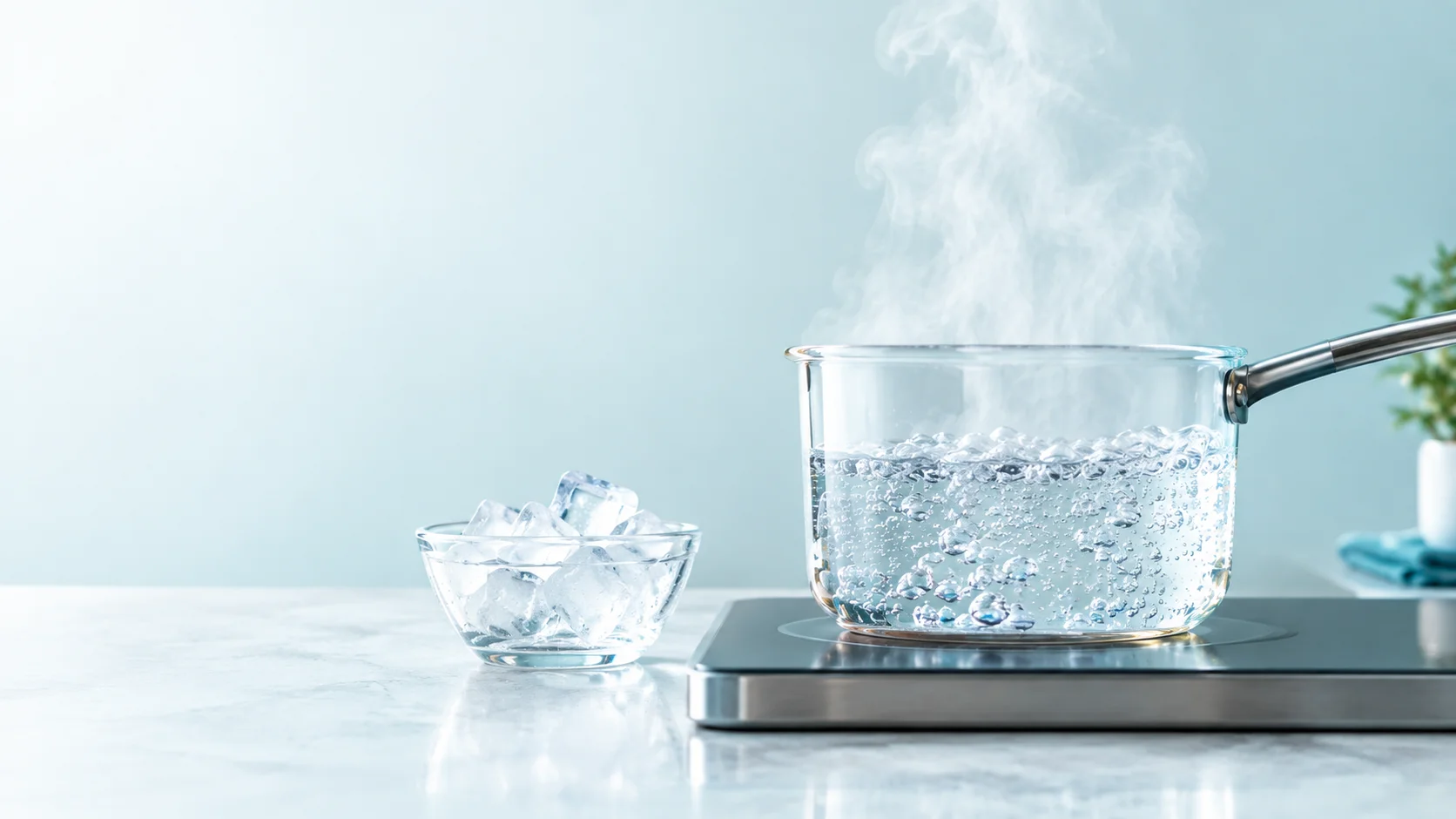
Water absorbs a huge amount of energy without getting any hotter whenever it changes state. Melting a kilogram of ice at 0 °C into water at the same temperature takes about 334 kilojoules. Turning a kilogram of water already at its 100 °C boiling point into steam takes about 2,256 kilojoules — roughly 5.4 times more. That energy is called latent heat, and it's the reason a pot on a hot burner will happily sit at a rolling boil for many minutes rather than flashing to steam instantly. Here's what latent heat is, why boiling costs so much more than melting, and how to work out the numbers for any amount of water.
Skip the math Heat of Vaporization Calculator Open →Latent heat at a glance
These are the reference figures the rest of this guide works from, all at standard atmospheric pressure:
| Quantity | Value | In everyday terms |
|---|---|---|
| Latent heat of fusion (melting, at 0 °C) | 334 kJ/kg | 79.7 cal/g |
| Latent heat of vaporization (boiling, at 100 °C) | 2,256 kJ/kg | 539 cal/g |
| Specific heat of liquid water | 4.186 kJ/kg·°C | 1 cal/g·°C |
Put another way: melting a kilogram of ice takes about as much energy as heating that same kilogram of liquid water by roughly 80 °C. Boiling it away at 100 °C takes as much energy as heating it by more than 500 °C — over five times the entire span from freezing to boiling.
What "latent" heat actually means
Heat energy added to water normally does one obvious thing: it raises the temperature. That's called sensible heat — you can sense it on a thermometer. But right at a phase change, something different happens. Heat a block of ice and its temperature climbs steadily toward 0 °C — then stalls. Keep adding heat and the ice keeps melting, but the thermometer doesn't move, not until every last crystal is liquid. The same stall happens at 100 °C while water boils away. That stalled, "hidden" energy is latent heat: it goes entirely into rearranging molecules, not into speeding them up.
Why this matters practically. It's why a drink stays cold as long as ice remains in it, why a pot of water won't overheat and boil dry in a flash, and why steam carries so much more punishing heat than the same amount of hot water.
Melting ice: the latent heat of fusion
Ice is a rigid crystal lattice held together by hydrogen bonds between water molecules. Melting it doesn't require breaking all of those bonds — just enough of them to let the molecules slide past one another as a liquid, while most of the short-range attraction between them survives. That's why the latent heat of fusion, at about 334 kJ/kg, is a real but comparatively modest energy cost.
This is also why ice is such an effective coolant. As long as ice is present in a drink or a cooler, virtually all the incoming heat goes into melting more ice rather than warming the liquid — which is exactly the mechanism keeping the temperature pinned near 0 °C until the ice is gone.
Boiling water: the latent heat of vaporization
Boiling is a far bigger job. To turn liquid water into vapor, nearly all of the hydrogen bonds holding neighboring molecules together have to be broken, so each molecule can fly off on its own into a gas that's roughly a thousand times less dense than the liquid it came from. That's a lot more disruption than sliding past a neighbor in a melting crystal, and it shows up directly in the number: the latent heat of vaporization is about 2,256 kJ/kg at 100 °C — close to 6.8 times the latent heat of fusion.
The heat of vaporization isn't a fixed constant — it decreases somewhat as temperature and pressure rise, and increases somewhat at lower boiling points, such as at high altitude.
Why boiling takes so much more energy than melting
The gap comes down to how far the molecules have to move apart. Melting loosens a solid into a liquid, but the molecules stay in close contact — most of the hydrogen-bond network survives, just less rigidly arranged. Vaporizing pulls molecules apart almost entirely, against the full pull of those bonds, until they're free to spread out as an independent gas. Overcoming that intermolecular attraction — not simply speeding the molecules up — is where nearly all of the latent heat of vaporization goes.
Water's hydrogen bonds are also unusually strong for such a small, light molecule. Without them, water would boil at around −68 °C, similar to chemically related molecules like hydrogen sulfide. Instead it stays liquid up to 100 °C at sea level, and that same bond strength is what makes both its heat of fusion and heat of vaporization far higher than most everyday liquids.
Calculate it yourself
The formula behind every number in this guide is the same one, just with a different constant for each phase change:
For example, melting 2 kg of ice at 0 °C takes 2 × 334 = 668 kJ. Boiling away 2 kg of water already at 100 °C takes 2 × 2,256 = 4,512 kJ.
Most real questions combine latent heat with ordinary sensible heat, since you're usually starting from ice below freezing or water below boiling. Here's the full journey for 1 kg of ice starting at 0 °C, all the way to steam at 100 °C:
Notice how the three steps split up: melting takes about 11% of the total, warming the water to boiling takes about 14%, and boiling it away takes the remaining 75%. Vaporization dominates the energy budget every time.
Real-world examples
These numbers show up constantly in ordinary situations:
Boiling a kettle
~335 kJ
To heat 1 L of water from 20 °C to 100 °C. A 2 kW kettle does this in under 3 minutes — but boiling that same liter completely dry would take roughly 7 times longer, since vaporizing it needs another 2,256 kJ.
An ice cube in a drink
~10 kJ
A 30 g ice cube absorbs about 10 kJ as it melts — heat pulled straight out of the drink, which is why the drink stays cold until the ice is gone rather than warming up gradually.
Steam vs. boiling water
2,256 J/g
That's the extra energy steam dumps into skin the instant it condenses — on top of the ordinary heat transfer a splash of boiling water gives off. It's the main reason steam burns are more severe.
Sweat evaporating
Cooling effect
Evaporating even a small amount of sweat carries away a disproportionate amount of body heat, since the liquid has to absorb its full latent heat of vaporization to turn to vapor.
The bottom line
Latent heat is the hidden cost of a phase change: about 334 kJ/kg to melt ice, and about 2,256 kJ/kg — nearly seven times as much — to boil water away, both without moving the thermometer at all. The gap exists because melting only loosens water's hydrogen-bond network, while boiling has to break it almost completely. For a specific mass, temperature range, or unit system, the calculator below handles the arithmetic.
Frequently asked questions
What is latent heat, in simple terms?
Latent heat is the energy a substance absorbs or releases when it changes state — solid to liquid, or liquid to gas — without any change in temperature. It's the energy spent rearranging molecules, not the energy spent speeding them up.
Why does boiling water take so much more energy than heating it?
Heating water just speeds up molecules that stay close together, which takes relatively little energy. Boiling it away means fully separating those molecules against the pull of hydrogen bonds so they can spread out into a gas — a much bigger job. That's why turning boiling water into steam takes about 5.4 times more energy than heating the same water all the way from freezing to boiling.
How much energy does it take to melt a kilogram of ice?
About 334 kilojoules (79.7 kilocalories) to melt 1 kilogram of ice at 0 °C into water at the same temperature — this is the latent heat of fusion of water.
How much energy does it take to boil away a liter of water?
About 2,256 kilojoules to turn 1 kilogram (roughly 1 liter) of water already at its 100 °C boiling point fully into steam. Getting a liter of room-temperature water up to boiling first takes roughly another 330 kilojoules on top of that.
Why do steam burns hurt more than boiling water?
When steam touches skin, it condenses back into liquid water and dumps its latent heat of vaporization — about 2,256 joules per gram — directly into the skin, on top of the ordinary heat a hot liquid would transfer. A splash of boiling water only gives up that second, smaller amount, so gram for gram, steam delivers far more energy.
Does the temperature stay the same while ice melts or water boils?
Yes. While a pure substance is changing state, all the added or removed heat goes into breaking or forming molecular bonds, not into raising or lowering temperature. Ice stays at 0 °C until every bit has melted, and boiling water stays at 100 °C until it has fully turned to steam.
What is the latent heat of vaporization of water in kJ/kg?
About 2,256 kJ/kg at 100 °C and normal atmospheric pressure (roughly 539 cal/g). The figure drops somewhat at higher temperatures and pressures, and rises somewhat at lower ones.
Sources & references
The figures in this guide follow standard thermodynamic reference values for water:
- The Engineering ToolBox — Water Properties: Vaporization Heat vs. Temperature. Latent heat of vaporization of 2,256 kJ/kg at atmospheric pressure and 100 °C.
- The Engineering ToolBox — Saturated Steam Properties. Energy required to heat 1 kg of water from 0 °C to its 100 °C evaporation temperature.
- Wikipedia — Enthalpy of Fusion. Latent heat of fusion of ice, 333.55 kJ/kg.
- Encyclopaedia Britannica — Heat of Vaporization. The role of hydrogen bonds in water's latent heat of vaporization.
Water Systems Specialist · Austin, Texas
A Texas-licensed Professional Engineer with 13+ years in residential water systems, John leads the science, flow and pressure guides on Water Calculator. Read full bio
Licensed Professional Engineer (PE) · Specializes in water density, flow and pressure