Specific Heat of Water: Why Water Heats and Cools Slowly
Water takes far more energy to warm up — and gives up far more energy cooling down — than almost anything else you'll touch. Here's the number behind that, why it's so high, and what it changes in practice.

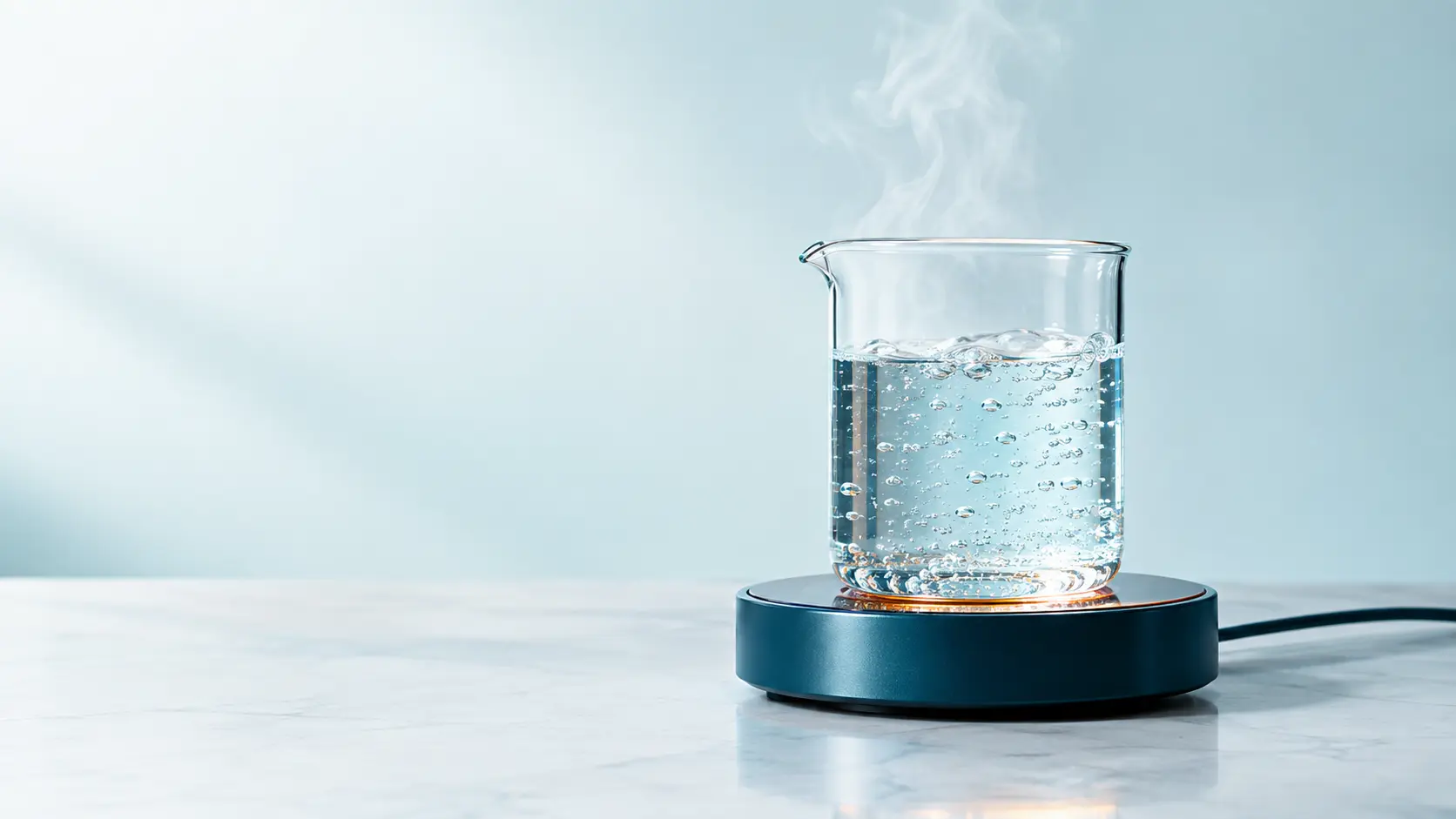
Water's specific heat is about 4.186 joules per gram per degree Celsius (4,186 J/kg°C) — around four times higher than dry air and roughly five times higher than dry sand or most metals. That single number explains a lot: why a pot of water takes so long to boil, why the ocean stays cool through a heat wave, and why coastal cities have milder weather than places just a few hundred miles inland. Here's what the number means, why it's so high, and how to put it to use.
Skip the math Specific Heat of Water Calculator Open →Specific heat of water, at a glance
"Specific heat" (formally specific heat capacity) is the amount of energy it takes to raise the temperature of one unit of mass by one degree. For water near room temperature, the standard reference values are:
| Unit system | Value |
|---|---|
| SI (joules) | 4.186 J/(g·°C) = 4,186 J/(kg·°C) |
| Calorie | 1.00 cal/(g·°C) |
| Imperial (BTU) | 1.00 BTU/(lb·°F) |
| Kilocalorie | 1.00 kcal/(kg·°C) |
The calorie and BTU figures rounding to almost exactly 1 isn't a coincidence — both units were originally defined using the energy needed to warm a fixed amount of water by one degree. That's also why chemistry classes still lean on the calorie: it was built around water's own thermal behavior.
A quick vocabulary check: specific heat (lowercase, per gram or per kilogram) is different from heat capacity (the property of one specific object, like "this tank's heat capacity"). This guide is about the per-unit-mass version, since that's what lets you compare water to other materials.
How water compares to other materials
Specific heat varies enormously between substances, and water sits near the top of the list — higher than every common liquid or solid except liquid ammonia. Here's how it stacks up against materials you'd actually touch:
| Material | Specific heat (J/kg°C) | Relative to water |
|---|---|---|
| Water (liquid, 20 °C) | 4,182 | 1.0× (reference) |
| Ethanol | 2,440 | 0.58× |
| Ice (0 °C) | 2,093 | 0.50× |
| Air, dry | 1,005 | 0.24× |
| Aluminum | 897 | 0.21× |
| Sand, quartz | 830 | 0.20× |
| Iron | 449 | 0.11× |
| Copper | 385 | 0.09× |
Read the right-hand column as "how many times more energy water needs, for the same mass and the same temperature rise." A kilogram of dry sand heats up roughly five times faster than a kilogram of water under identical sunlight — which is exactly why beach sand can be too hot to walk on while the ocean a few feet away still feels cool.
Why water's specific heat is so high
Temperature is a measure of how fast molecules are moving on average — the more kinetic energy, the higher the reading on a thermometer. For most substances, heat you add goes almost straight into that motion, so the temperature climbs quickly. Water is different because of hydrogen bonding: each water molecule forms multiple weak bonds with its neighbors, built from the attraction between the slightly positive hydrogen atoms on one molecule and the slightly negative oxygen atom on the next.
When you heat water, a large share of that energy is spent stretching and breaking these hydrogen bonds rather than speeding the molecules up. Only after bonds are disrupted does the leftover energy translate into faster molecular motion — the part a thermometer actually detects. That extra detour is the whole reason water can absorb so much energy while its temperature barely moves.
Same mechanism, opposite direction. Cooling works the same way in reverse: as water loses energy, hydrogen bonds re-form and release heat, which slows the temperature drop. That's why a body of water cools down gradually overnight instead of dropping with the air temperature.
Calculate it yourself
The relationship between heat, mass, specific heat and temperature change is one formula:
Worked example: how much energy does it take to heat 1 liter (1,000 g) of water from 20 °C to 100 °C?
That figure only covers sensible heat — raising the temperature. Turning that same liter of 100 °C water into steam takes a separate 2,257 kJ, called the latent heat of vaporization, because phase changes absorb energy without changing temperature at all. The specific heat of water calculator handles this kind of calculation directly, including for other volumes and temperature ranges.
Does specific heat change with temperature?
Slightly. Water's specific heat isn't perfectly constant — it dips to a minimum somewhere in the 35–40 °C range and rises a little on either side of that, both toward freezing and toward boiling:
| Temperature | Specific heat (J/g°C) |
|---|---|
| 0 °C (freezing) | 4.220 |
| 20 °C (room temp) | 4.184 |
| 40 °C | 4.180 |
| 60 °C | 4.185 |
| 100 °C (boiling) | 4.216 |
The whole range spans less than 1% — from about 4.18 to 4.22 J/g°C across the entire liquid range at normal pressure. For nearly every practical purpose, 4.186 J/g°C is close enough. Precise engineering work — steam systems, calorimetry, high-accuracy thermal modeling — is where the small variation actually matters, which is why it's tabulated in detail rather than treated as one flat number.
What this actually changes
A high specific heat isn't just a lab curiosity — it shows up in ordinary situations:
Coastal climate
Milder swings
Oceans and large lakes absorb huge amounts of solar energy with only a small temperature rise, then release it slowly. That's a major reason coastal areas run cooler in summer and warmer in winter than inland areas at the same latitude.
Cooling systems
Efficient coolant
Car radiators and industrial cooling loops use water (often with additives) because it can carry away large amounts of heat per liter without its own temperature spiking, which keeps the system stable.
Cooking & body heat
Slow, steady
A pot of water takes minutes to reach a boil even on high heat — that lag is specific heat at work. The human body, being roughly 60% water, relies on the same property to resist rapid internal temperature swings.
Thermal storage
Cheap energy buffer
Hot-water storage tanks in solar heating systems exploit water's capacity to bank a large amount of usable heat in a relatively small, inexpensive volume of liquid.
Specific heat vs. related terms
A few terms get mixed up often enough that they're worth separating clearly:
Specific heat vs. heat capacity. Specific heat is a property of the material itself, per unit mass. Heat capacity is a property of one particular object — a 200-liter tank has a much larger heat capacity than a 1-liter bottle, even though both hold water with the identical specific heat.
Specific heat vs. thermal conductivity. Specific heat is about how much energy a material stores per degree of change. Thermal conductivity is about how fast heat physically moves through that material. Water stores heat well (high specific heat) but conducts it comparatively slowly — metals are the opposite, storing little heat per degree but conducting it quickly, which is why a metal spoon in hot soup burns your hand faster than the soup itself feels dangerous to swallow.
Sensible heat vs. latent heat. The formula and table above describe sensible heat — energy that changes temperature. Melting ice or boiling water involves latent heat instead: energy that goes entirely into changing the water's phase, with the temperature held flat until the phase change finishes.
The bottom line
Water's specific heat, about 4.186 J/g°C, is unusually high because of hydrogen bonding between its molecules — energy goes into stretching those bonds before it shows up as a temperature change. That single property moderates coastal climates, makes water an effective coolant, and explains why a pot on the stove takes real time to heat. It shifts by less than 1% across the entire liquid range, so for almost any everyday calculation, 4.186 J/g°C is the number to use. For anything more precise, the calculator below works from the temperature-specific values directly.
Frequently asked questions
What is the specific heat of water?
About 4.186 joules per gram per degree Celsius (4,186 J/kg°C), or 1 calorie per gram per degree Celsius. In imperial units it's about 1 BTU per pound per degree Fahrenheit. The exact figure shifts slightly with temperature, but 4.186 J/g°C is the standard reference value near room temperature.
Why does water have such a high specific heat?
Because of hydrogen bonding. Water molecules are held together by a dense network of hydrogen bonds, and much of the energy you add goes into stretching and breaking those bonds rather than speeding up the molecules — and molecular speed is what a thermometer actually measures. That detour absorbs a lot of energy before the temperature moves at all.
Does the specific heat of water change with temperature?
Yes, slightly. It's about 4.22 J/g°C near freezing, dips to roughly 4.18 J/g°C around 35–40 °C, and climbs back to about 4.22 J/g°C near boiling. The swing is under 1% across that whole range, so 4.186 J/g°C is a safe constant for everyday calculations.
How is specific heat different from thermal conductivity?
Specific heat measures how much energy a material stores per degree of temperature change; thermal conductivity measures how fast heat moves through it. Water has both a high specific heat (slow to change temperature) and a low thermal conductivity compared to metals (slow to conduct heat through) — different properties doing different jobs.
How much energy does it take to boil a liter of water?
Roughly 335 kJ (about 0.093 kWh) to heat 1 liter from 20 °C to 100 °C, using Q = mcΔT. That's the sensible-heat step only; actually turning it into steam at 100 °C takes a further 2,257 kJ per liter, since vaporization is a separate latent-heat process.
Why does water heat and cool more slowly than air or land?
Water's specific heat is about four times that of dry air and roughly five times that of dry sand, so the same amount of sunlight raises water's temperature far less. It's also why oceans and lakes moderate the climate of nearby land, keeping coastal areas cooler in summer and warmer in winter than inland areas at the same latitude.
What is the specific heat of water in different units?
About 4.186 J/(g·°C) or 4,186 J/(kg·K) in SI units, 1.00 cal/(g·°C) in the older calorie system, and roughly 1.00 BTU/(lb·°F) in imperial units. Those last two round to almost exactly 1 by design — the calorie and BTU were originally defined using water's own heat capacity.
Sources & references
The figures in this guide follow standard reference values for the thermal properties of water:
- The Engineering ToolBox — Specific Heat Capacity of Water: Temperature-Dependent Data and Calculator. Isobaric specific heat (Cp) of liquid water from 0–360 °C, including the mid-range minimum near 35–40 °C.
- The Engineering ToolBox — Specific Heat of Common Materials. Reference values used for the comparison table (water, air, ethanol, aluminum, sand, iron, copper, ice).
- Climate Science Investigations, South Florida (NASA-affiliated K-12 education program, Florida Atlantic University) — Why Does Temperature Vary? Land and Water. Explanation of hydrogen bonding, water's high heat capacity, and its role in moderating coastal climate.
Water Systems Specialist · Austin, Texas
A Texas-licensed Professional Engineer with 13+ years in residential water systems, John leads the science, flow and pressure guides on Water Calculator. Read full bio
Licensed Professional Engineer (PE) · Specializes in water density, flow and pressure