The Three States of Water Explained
Ice, water and steam are the same molecule in three different arrangements. Here's what separates them, how water moves between them, and why a few of its habits — like ice floating — break the normal rules.

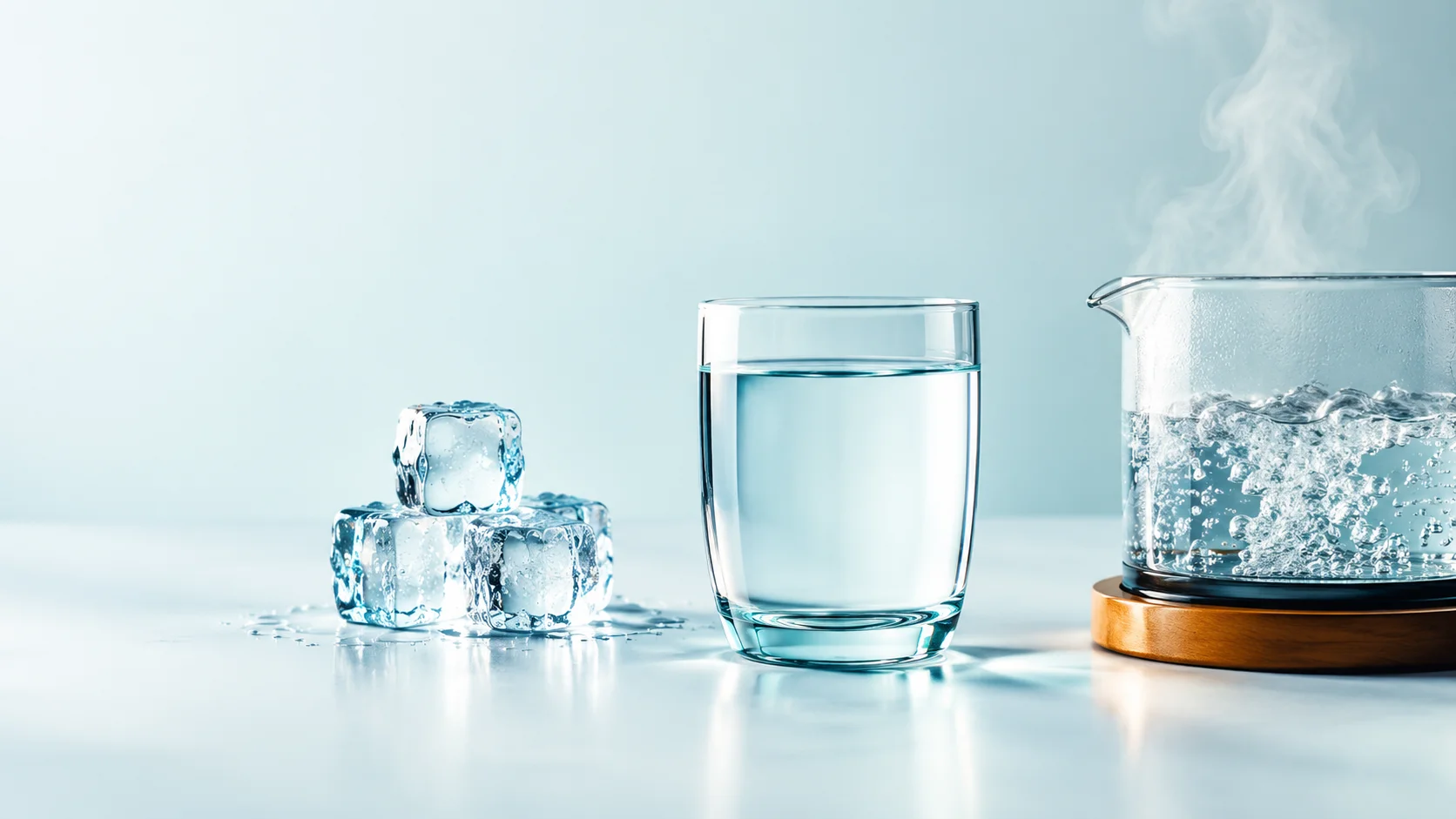
Water exists in nature in three states: solid ice, liquid water and gaseous water vapor. All three are the identical molecule, H₂O — what changes is how tightly the molecules are held together and how much energy they carry. Add heat and water moves toward a looser, more energetic state; remove heat and it locks down into a tighter one. At sea-level pressure, water freezes into ice at 0 °C (32 °F) and boils into vapor at 100 °C (212 °F), with everything in between being ordinary liquid water.
Explore the numbers Water Science Calculators Open →The three states of water
Every molecule of H₂O is identical, whether it's locked in a glacier, running from a tap or rising off a pot of soup. What differs is how those molecules are arranged and how much energy they have to move around. That arrangement is what scientists call a state of matter, and water is one of the few substances most people encounter in all three, often on the same day.
- Solid (ice). Molecules lock into a fixed, repeating crystal. They vibrate in place but don't travel, so ice holds its own shape and volume regardless of its container.
- Liquid (water). Molecules stay close together but slide past one another. Liquid water keeps a fixed volume but takes the shape of whatever it's poured into.
- Gas (water vapor). Molecules break free of each other almost entirely and spread out. Water vapor has neither a fixed shape nor a fixed volume — it expands to fill the space available to it.
The trigger that moves water from one state to the next is heat energy. Add enough and the molecules gain the energy to break free of their neighbors; remove enough and they settle back into a rigid structure. At typical sea-level pressure, ice turns to liquid water at 0 °C (32 °F), and liquid water turns to vapor at 100 °C (212 °F) — with the entire range in between simply being liquid.
Properties at a glance
The same molecule behaves very differently depending on its state. Here's how ice, liquid water and water vapor compare on the properties that matter most:
| Property | Ice (solid) | Water (liquid) | Vapor (gas) |
|---|---|---|---|
| Molecular arrangement | Fixed crystal lattice | Close but mobile | Widely dispersed |
| Shape | Fixed | Takes shape of container | Fills any space |
| Volume | Fixed | Fixed | Expands freely |
| Density (approx.) | 917 kg/m³ | 958–1,000 kg/m³ | <1 kg/m³ |
| Compressibility | Very low | Very low | High |
The density row is the one worth pausing on: ice is less dense than liquid water, which is unusual for a solid — most substances pack tighter, and therefore denser, as they freeze. Water does the opposite, and that single quirk is why ice floats. More on that below.
Why water changes state
Water molecules attract each other through hydrogen bonds — a relatively strong pull between the slightly positive hydrogen atoms on one molecule and the slightly negative oxygen atom on its neighbor. How much those bonds control the molecules' movement is what defines the state:
Think of it as a dance floor. In ice, everyone is holding hands in a fixed pattern and can only sway in place. In liquid water, people are still holding hands but constantly swapping partners and drifting around the room. In vapor, everyone has let go and is bouncing freely, rarely touching anyone else.
Heating water doesn't break the H₂O molecule itself — the oxygen and hydrogen atoms stay bonded together throughout. What breaks, or reforms, are the weaker hydrogen bonds between separate molecules. That's why water can freeze and boil repeatedly without ever changing what it's chemically made of.
The six phase changes
Water moves between its three states through six named transitions, each one either absorbing or releasing energy:
| Change | From → to | Energy |
|---|---|---|
| Melting | Solid → liquid | Absorbs |
| Freezing | Liquid → solid | Releases |
| Vaporization (boiling/evaporation) | Liquid → gas | Absorbs |
| Condensation | Gas → liquid | Releases |
| Sublimation | Solid → gas | Absorbs |
| Deposition | Gas → solid | Releases |
Boiling and evaporation are both vaporization, but they aren't the same thing. Boiling happens throughout the liquid once it reaches 100 °C at sea level, producing the bubbles you see in a pot. Evaporation happens only at the surface, at any temperature, which is why a puddle dries up on a warm day without ever coming close to boiling — some molecules at the surface always have enough energy to escape into the air.
Sublimation and deposition are the least familiar pair because they skip the liquid state entirely. Snow can slowly vanish on a cold, dry, sunny day even though the air never warms above freezing — the ice sublimates straight into vapor. Freeze-drying food uses the same principle deliberately, pulling ice out of frozen food under vacuum.
How much energy it takes
Changing state takes real, measurable energy, and it doesn't take the same amount each time. The energy needed is called latent heat — "latent" because the temperature holds steady while the change happens; all the added energy goes into rearranging molecules, not heating them further.
That gap is the reason a pot of water takes far longer to boil dry than it took to come to a boil in the first place, and why steam burns are so much worse than hot-water burns of the same temperature — steam releases all that extra latent heat the instant it condenses back to liquid on your skin.
How pressure and altitude change things
The 0 °C and 100 °C figures only hold at standard sea-level atmospheric pressure. Change the pressure and both transition points move — boiling is the more noticeable of the two:
| Altitude | Boiling point |
|---|---|
| Sea level | 212 °F (100.0 °C) |
| 5,000 ft (1,524 m) | 202 °F (94.7 °C) |
| 10,000 ft (3,048 m) | 193 °F (89.6 °C) |
| Mt. Everest summit, ~29,000 ft (8,848 m) | ~162 °F (72 °C) |
Lower air pressure at altitude means water molecules need less energy to escape into the surrounding air, so boiling starts at a lower temperature. That's why recipes and canning instructions often carry separate altitude adjustments — food simmering in "boiling" water at 8,000 feet is cooking at a noticeably lower temperature than the same pot at sea level. Freezing point moves too, but far less dramatically, and mainly shifts with dissolved solids: seawater, with its dissolved salt, freezes at about −2 °C (28 °F) instead of 0 °C, which is why road crews salt icy pavement.
Why ice floats
Water is one of the only common substances whose solid form is less dense than its liquid form. The reason traces back to those hydrogen bonds: as water cools toward freezing, its molecules arrange into an open, hexagonal crystal lattice that actually takes up more space than the same molecules jostling around as a liquid — about 9% more. Less mass in the same volume means lower density, so ice floats instead of sinking.
Water also has an unusual density curve on the way there. It reaches maximum density at about 4 °C (39 °F) — not at the freezing point, as you might expect. Cool it further and it starts expanding again right up until it freezes solid. That's why a lake freezes from the top down: the coldest water rises toward the surface and freezes there, insulating the liquid water and aquatic life underneath from the winter air above.
What this means in practice. Without this quirk, ice would sink, lakes would freeze from the bottom up, and most aquatic ecosystems in cold climates wouldn't survive winter. It's also why a sealed bottle of water can crack in the freezer — the same mass takes up more room as ice, and something has to give.
Real-world examples
The physics shows up constantly in ordinary situations:
Morning frost
Deposition
Water vapor in cold night air skips the liquid state entirely and turns straight into ice crystals on grass and windshields.
A boiling kettle
100 °C
Vaporization throughout the liquid, not just the surface — visible as vigorous bubbling once every part of the water hits the boiling point.
A steamy mirror
Condensation
Warm water vapor releases its latent heat the instant it touches the cooler glass and turns back into liquid droplets.
A shrinking ice cube tray
Sublimation
Forgotten ice cubes slowly shrink in the freezer over weeks, even well below freezing, as they sublimate directly into the dry air.
The bottom line
Ice, liquid water and water vapor are the same molecule arranged three different ways, moving between states as heat energy is added or removed. At sea level, water freezes at 0 °C (32 °F) and boils at 100 °C (212 °F), with pressure — especially altitude — shifting those points, and dissolved solids shifting them a little more. The one habit that sets water apart from most other substances is that its solid form floats: an open crystal structure makes ice less dense than the liquid it came from, a small quirk with an outsized effect on lakes, oceans and climate.
Frequently asked questions
What are the three states of water?
Solid (ice), liquid (water) and gas (water vapor). All three are the same H₂O molecule; only the arrangement and energy of the molecules differ. Ice holds a fixed crystal structure, liquid water flows but keeps its volume, and water vapor expands to fill whatever space it's in.
At what temperature does water freeze and boil?
Pure water freezes at 0 °C (32 °F) and boils at 100 °C (212 °F) at standard sea-level pressure (1 atmosphere). Both figures shift with pressure — boiling point drops at altitude, and freezing point drops slightly when the water contains dissolved salt or minerals.
Why does ice float instead of sinking?
Ice floats because it's less dense than liquid water. When water freezes, its molecules lock into an open hexagonal crystal that takes up about 9% more space than the same mass of liquid water, so ice ends up lighter per unit of volume and floats.
Can water go directly from solid to gas?
Yes — it's called sublimation. Ice and snow can turn straight into water vapor without melting first, which is why snow can slowly vanish on a cold, dry, sunny day and why freeze-drying works by removing ice from frozen food under vacuum.
Does water boil at a lower temperature at high altitude?
Yes. Lower air pressure at altitude means water reaches its boiling point sooner. At 5,000 feet, water boils around 202 °F (94.7 °C), and at 10,000 feet it boils around 193 °F (89.6 °C) — around 20 degrees Fahrenheit below the sea-level figure.
Why does boiling water take so much more energy than melting ice?
Melting ice only has to loosen the crystal structure holding molecules in place, which takes about 334 kJ per kilogram. Boiling water has to break the molecules free of each other entirely, which takes about 2,256 kJ per kilogram — roughly 6.75 times more energy for the same mass.
Sources & references
The figures in this guide follow standard reference values for the properties and phase behavior of water:
- U.S. Geological Survey, Water Science School — Water Density. Pure water reaches its maximum density (0.99984 g/mL) at about 4 °C.
- The Engineering ToolBox — Water Thermal Properties. Melting and boiling temperatures, latent heat of melting (334 kJ/kg) and latent heat of evaporation (2,256 kJ/kg).
- The Engineering ToolBox — Water: Boiling Points vs. Altitude. Boiling point of water at increasing elevation above sea level.
Water Systems Specialist · Austin, Texas
A Texas-licensed Professional Engineer with 13+ years in residential water systems, John leads the science, flow and pressure guides on Water Calculator. Read full bio
Licensed Professional Engineer (PE) · Specializes in water density, flow and pressure