Why Does Ice Float on Water?
Freezing doesn't just harden water — it makes it expand and become lighter. Here's the density story behind every floating ice cube, frozen lake and iceberg.

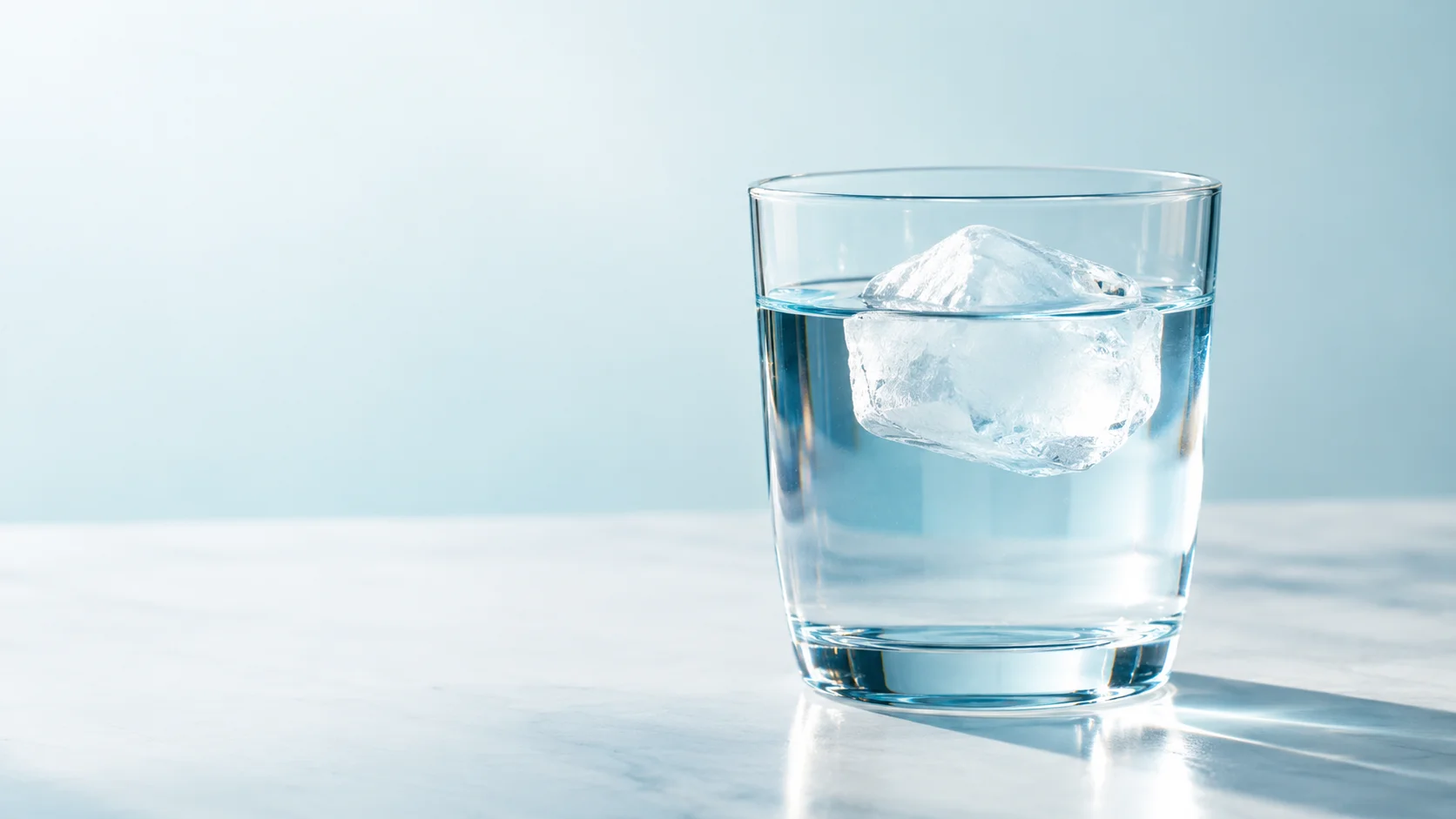
Ice floats because it is less dense than liquid water. When water freezes, its molecules lock into an open, hexagon-shaped lattice held apart by hydrogen bonds, so the same mass of water takes up about 9% more space as a solid than it did as a liquid. Less mass packed into more volume means lower density — and anything less dense than the liquid around it floats. That single fact, unremarkable as it sounds, is one of the more important quirks in nature: almost every other substance on Earth gets denser when it solidifies, and its solid form sinks. Water does the opposite, and life as we know it depends on it.
See it for a specific volume Water Freezing Expansion Calculator Open →Ice vs. water: the density comparison
Density is mass divided by volume — how much "stuff" is packed into a given amount of space. Liquid water reaches its maximum density, essentially 1.00 gram per cubic centimeter, at around 4 °C (39 °F). Ice, by contrast, has a density of about 0.917 grams per cubic centimeter — roughly 9% lower. That gap is small in absolute terms but decisive: it is the entire reason a solid can float on its own liquid.
| State | Density (g/cm³) | Density (kg/m³) |
|---|---|---|
| Liquid water at 4 °C / 39 °F (densest point) | 1.000 | 1,000.0 |
| Liquid water at 20 °C / 68 °F (room temperature) | 0.998 | 998.2 |
| Liquid water at 100 °C / 212 °F (boiling) | 0.958 | 958.4 |
| Ice at 0 °C / 32 °F | 0.917 | 917 |
Notice something odd in that table: liquid water is densest not at its freezing point, but a few degrees above it. That detail turns out to be the key to the whole story.
Why freezing makes water expand
A water molecule is small and bent, with two hydrogen atoms bonded to one oxygen atom at roughly a 104.5° angle. That shape gives each molecule a slightly negative side (near the oxygen) and a slightly positive side (near the hydrogens), which lets neighboring molecules link up through weak attractions called hydrogen bonds.
In liquid water, those bonds form and break billions of times a second as molecules tumble past one another, packing together fairly tightly and somewhat randomly. As water cools, molecules slow down and the bonds start to persist longer, which normally makes a liquid contract and get denser — and water does exactly that, all the way down to about 4 °C.
Below that point, something different happens. The hydrogen bonds begin locking molecules into a fixed, repeating hexagonal pattern — the crystal structure of ordinary ice. That pattern requires each molecule to keep specific neighbors at a specific angle and distance, which opens up small gaps that don't exist in the jumbled liquid. The molecules end up held slightly farther apart on average than they were in the liquid, so the same number of molecules occupies more space. Volume goes up, density goes down, and once the water fully freezes at 0 °C it is about 9% less dense than it was as a liquid.
Why 4 °C, not 0 °C? As water cools it contracts normally at first. But below about 4 °C, the hydrogen-bond network starts pre-forming the more open structure that becomes ice — so the water begins expanding again even before it freezes solid. That's why liquid water's maximum density sits at roughly 4 °C rather than right at the freezing point.
How much of an ice cube — or an iceberg — stays underwater
Once you know the two densities, you can work out exactly how high something floats using Archimedes' principle: a floating object displaces a weight of fluid equal to its own weight. For an object floating in equilibrium, that reduces to a simple ratio.
That ratio is also why the "tip of the iceberg" is such an apt metaphor. Icebergs float in seawater, which is denser than fresh water (about 1.025 g/cm³ because of dissolved salt), so slightly less of an iceberg needs to submerge to displace its own weight:
Ice cube in a drink
~92% submerged
Floating in fresh water, only a sliver of each cube breaks the surface — most of it is hidden below your drink line.
Iceberg at sea
~90% submerged
Denser seawater buoys ice slightly more than fresh water does, but the vast majority of an iceberg is still out of sight.
Lake ice in winter
~9% thicker
As a lake's surface freezes, that layer expands by roughly 9% by volume compared with the water it froze from.
Why this matters for lakes, oceans and life
Because liquid water is densest at 4 °C, the coldest water in a lake — right at 0 °C — is also the lightest water, so it stays at the surface instead of sinking. It's there that ice forms first, floating on top of the warmer, denser water beneath it. That floating ice sheet then acts as an insulating lid, slowing further heat loss from the water below.
The practical result: lakes and ponds freeze from the top down, not the bottom up. Fish, amphibians and other aquatic life can survive a winter in the liquid water beneath the ice, even while the surface is frozen solid. If ice were denser than water and sank the way most frozen solids do, newly formed ice would drop to the bottom, expose more water to the cold air above, and the whole body of water could freeze solid from the bottom up in a hard winter — a very different, and far less hospitable, planet for anything living in fresh water.
The same buoyancy keeps sea ice and icebergs floating at the ocean's surface rather than piling up on the seafloor, which matters for everything from polar ecosystems and ship navigation to how sunlight reflects off ice-covered oceans.
Does salt water or pressure change the answer
Salt water. Dissolved salt makes seawater denser than fresh water, so ice always floats a little higher in salt water than in fresh water — as the iceberg calculation above shows, the submerged fraction actually drops from about 92% to about 90% once salt is added, because the denser fluid supplies more buoyant force per unit volume.
Pressure. At the pressures found in everyday life — a glass of water, a lake, even most of the ocean — pressure has essentially no effect on whether ice floats. Only at the extreme pressures found deep inside ice sheets or in laboratory experiments do unusual, denser forms of ice appear that behave differently; none of that shows up in a kitchen freezer or a winter lake.
Impurities and air. Ice that forms slowly and freezes out dissolved air and minerals — like most natural lake or river ice — tends to be close to the pure-ice density used above. Ice with more trapped air bubbles, such as some glacier or shelf ice, can be slightly less dense still, which is one reason iceberg buoyancy estimates are usually given as a range rather than a single exact number.
Is water unique among liquids?
Almost. For the overwhelming majority of substances, the solid form is denser than the liquid and sinks — that's the ordinary behavior you'd expect from atoms or molecules packing more tightly as they lose thermal energy and lock into a crystal. Water's hydrogen-bonded, open ice structure is the exception. A small number of other substances — including bismuth, gallium, antimony and silicon — also expand slightly on freezing for their own structural reasons, but none of them is nearly as common or as consequential to daily life and the climate system as water's version of the same trick.
The bottom line
Ice floats because freezing spreads water molecules into a more open, hydrogen-bonded lattice, making solid water about 9% less dense than the liquid it came from. That density gap explains why an ice cube pokes just above the surface of a drink, why roughly 90% of an iceberg hides underwater, and why lakes and oceans freeze from the top down instead of the bottom up — a quiet piece of physics that quite literally keeps aquatic life alive through the winter.
Frequently asked questions
Why does ice float on water?
Ice floats because it is less dense than liquid water. When water freezes, its molecules lock into an open hexagonal lattice held apart by hydrogen bonds, so the same mass takes up about 9% more space. That lower density makes ice buoyant, the same way a piece of wood floats because it is less dense than the water around it.
How much less dense is ice than water?
Ice has a density of about 0.917 grams per cubic centimeter, versus about 1.0 gram per cubic centimeter for liquid water at 4 °C. That is roughly a 9% difference, which is why ice cubes float with most of their volume submerged rather than sinking.
Does ice float in every liquid?
No. Ice floats specifically because it is less dense than liquid water. Drop an ice cube into a denser liquid, like glycerin or a dense saltwater brine, and it floats even higher. Drop it into a liquid less dense than ice, such as many oils and alcohols, and it sinks instead.
Why is water densest at 4°C instead of at freezing?
As water cools toward freezing it behaves normally at first, contracting and getting denser. But below about 4 °C, hydrogen bonds start arranging molecules into the more open structure that becomes ice, so the water begins to expand again even before it fully freezes. That is why water's maximum density occurs at roughly 4 °C rather than at 0 °C.
How much of an iceberg is underwater?
About 90% of an iceberg's volume sits below the surface, with roughly 10% visible above. The exact split depends on the densities of the ice and the surrounding seawater, but the classic "tip of the iceberg" proportion is a good working estimate.
Would ice float in salt water the same way it floats in fresh water?
Ice floats higher in salt water than in fresh water. Seawater is denser than fresh water because of dissolved salt, so it provides more buoyant force per unit volume. A given piece of ice therefore needs to submerge less of itself to displace an equal weight of the denser seawater.
What would happen if ice sank instead of floated?
Lakes and oceans would freeze from the bottom up rather than the top down. Without a floating, insulating ice layer at the surface, cold winters could freeze entire bodies of water solid, wiping out aquatic life that depends on liquid water surviving underneath the ice through winter.
Sources & references
The figures in this guide follow standard reference values for the density of water and ice:
- U.S. Geological Survey, Water Science School — Water Density. Ice is about 9% less dense than liquid water, and most of an iceberg's volume lies below the surface.
- U.S. Geological Survey / NOAA — Ninety Percent of an Iceberg Is Below the Waterline. Reference figure for the submerged fraction of a typical iceberg.
- Georgia State University, HyperPhysics — The Expansion of Water Upon Freezing. Maximum density at 4 °C and the mechanics of top-down lake freezing.
Water Systems Specialist · Austin, Texas
A Texas-licensed Professional Engineer with 13+ years in residential water systems, John leads the science, flow and pressure guides on Water Calculator. Read full bio
Licensed Professional Engineer (PE) · Specializes in water density, flow and pressure