Why Does Water Expand When It Freezes?
Almost every liquid shrinks as it solidifies. Water does the opposite — and that one exception shapes everything from burst pipes to why fish survive under a frozen lake.

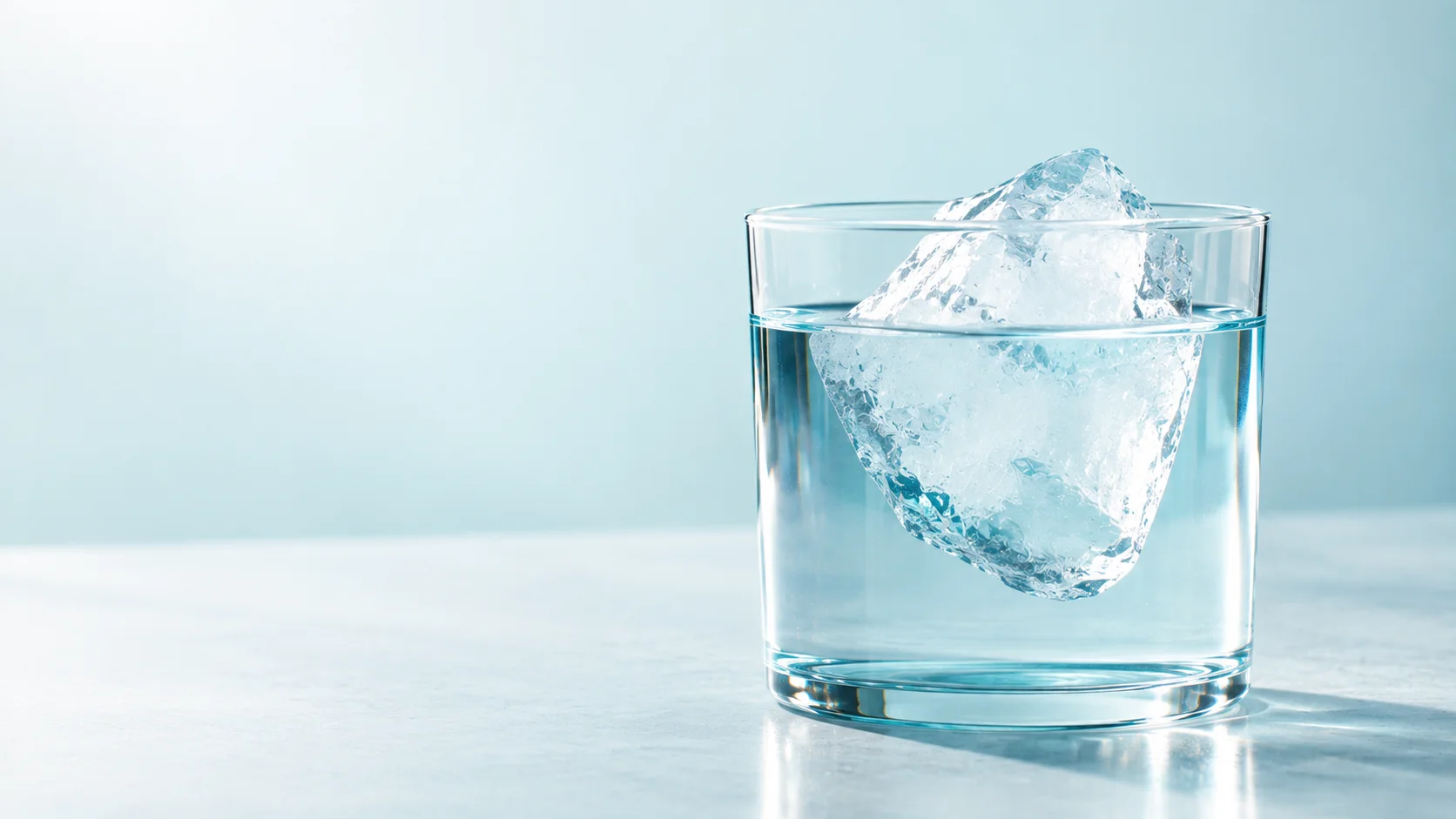
Water expands when it freezes because its molecules lock into an open, hexagonal crystal lattice held apart by hydrogen bonds — instead of packing closer together the way most substances do when they solidify. The result is that ice takes up about 9% more volume than the same mass of liquid water. That single fact is why ice floats, why unattended pipes split in a cold snap, and why lakes freeze from the top down instead of the bottom up.
Run the numbers Water Freezing Expansion Calculator Open →What's happening inside the water
A water molecule is bent, not straight, with the two hydrogen atoms sitting at roughly 104.5° to each other around the oxygen. That shape, combined with oxygen's pull on shared electrons, gives each molecule a slightly negative side and a slightly positive side. Neighboring molecules attract each other through hydrogen bonds — weak compared with the bonds inside a molecule, but strong enough to organize how water behaves as a liquid and, especially, as a solid.
In liquid water at room temperature, molecules are packed relatively close together, and hydrogen bonds are constantly breaking and re-forming as molecules jostle past one another. There's no fixed structure — it's disordered, the way a crowd of people milling around a room is disordered. As the temperature drops, though, the molecules move more slowly and the hydrogen bonds hold longer, nudging the water toward a more organized arrangement.
When water freezes into ordinary ice, each molecule settles into a fixed position and bonds permanently with four neighbors, forming a repeating hexagonal lattice. That lattice is open and roomy compared with the jumble of liquid water — think of the difference between people packed shoulder-to-shoulder and the same people standing in a spaced-out formation, each holding hands with four others in a fixed pattern. The atoms haven't gotten bigger; they've simply been forced apart to satisfy the geometry of hydrogen bonding. That extra open space is where the 9% comes from.
Most liquids do the opposite. In a typical liquid, molecules slow down as they cool and pack more tightly together when they solidify, so the solid is denser than the liquid — which is why, for example, a block of solid wax or paraffin sinks in its own melted liquid. Water's hydrogen-bonded lattice is the exception that makes ice float.
The 4°C anomaly
Here's the part that surprises most people: water isn't densest right at its freezing point. It's densest at about 3.98°C (39.6°F) — a few degrees above freezing. Cool water from room temperature down to 4°C and it behaves normally, contracting and getting denser as expected. Keep cooling it from 4°C down to 0°C, though, and it starts expanding again, even though it's still fully liquid.
The cause is the same hydrogen-bonded structure that builds solid ice, just getting a head start. As water approaches the freezing point, a growing share of its molecules arrange themselves, briefly, into small clusters that resemble the open ice lattice. Those clusters take up more space per molecule than the disordered liquid around them, and they become more numerous the colder the water gets. Below 4°C, that expanding effect starts to outweigh the normal contraction from slowing molecular motion, so the overall volume creeps back up — right up until the water freezes solid and the volume jumps sharply.
This "anomalous expansion" is the reason a deep lake stratifies before it ices over. The densest water, at about 4°C, sinks to the bottom. Colder, lighter water — down to 0°C — stays near the surface and freezes there first, leaving a floating ice lid over liquid water underneath.
How much does it actually expand?
At ordinary atmospheric pressure, the standard reference figures are straightforward: liquid water at 0°C has a density of about 0.9998 grams per cubic centimeter, while ordinary ice (called Ice Ih) has a density of about 0.917 g/cm³. Divide one by the other and you get the volume change.
| State | Density (kg/m³) | Density (g/cm³) |
|---|---|---|
| Liquid water, ~4 °C (densest point) | 1,000.0 | 1.000 |
| Liquid water, 0 °C (freezing point) | 999.8 | 0.9998 |
| Ice (Ice Ih), 0 °C | 917 | 0.917 |
That 9% figure is worth keeping in your head, because it scales with any container. A little arithmetic turns it into something concrete:
| Volume of water | Volume once fully frozen | Extra space needed |
|---|---|---|
| 1 cup (8 fl oz) | ~8.7 fl oz | ~0.7 fl oz |
| 1 liter | ~1.09 L | ~90 mL |
| 1 US gallon | ~1.09 gal | ~0.37 gal |
| 55-gallon drum | ~60 gal | ~5 gal |
These are estimates based on the 9% rule of thumb, not exact figures for every temperature and pressure — the calculator above accounts for a specific starting volume and gives a precise result.
Why this matters in the real world
The physics is elegant, but it also has consequences you can see and feel. A handful of everyday examples make the abstract percentage tangible:
Sealed pipes
Thousands of psi
A closed pipe leaves the expanding ice nowhere to go, so pressure on the trapped water climbs fast enough to split copper, PVC or PEX.
Potholes
~9% wedge
Water seeps into a crack in pavement, freezes, and levers the crack wider. Repeated freeze-thaw cycles turn a hairline crack into a pothole.
Rock weathering
Frost wedging
The same wedging action, repeated over centuries, breaks apart bedrock and helps shape mountain talus slopes and canyon walls.
Floating ice
~8–10% above water
An iceberg or ice cube floats with roughly 8 to 10% of its bulk above the surface — the flip side of the same density difference.
The pipe-bursting case is worth a closer look, because the usual explanation — "the ice pushes on the pipe wall" — isn't quite right. As a pipe freezes, ice forms first at the cold outer wall and grows inward, forming a plug. If the line is closed at both ends (a shut valve, a capped fitting), the still-liquid water trapped between the ice plug and the closed end has nowhere to expand into. Because liquid water is nearly incompressible, that trapped water's pressure rises rapidly as the plug keeps growing — often reaching pressures far beyond what the pipe was built to hold. It's usually that hydraulic pressure spike, not the ice itself, that ruptures the pipe, and the break often shows up some distance from where the ice actually formed.
The lake-ice case runs the opposite direction: expansion is the reason cold-climate ecosystems survive winter at all. Because ice is less dense than the water beneath it, a lake freezes at the surface first and stays frozen there, rather than freezing solid from the bottom up. That density difference keeps the coldest water and the ice at the top, insulating the liquid water — and the fish, insects and plants in it — from the full force of winter air temperatures below.
Can the expansion be contained safely?
You can't stop water from expanding as it freezes — the hydrogen-bond geometry is fixed physics, not a design choice. What engineers and plumbers actually manage is where that expansion goes. A few practical strategies come up again and again:
- Leave room to expand. An open container, or a pipe with one end open to air, lets the ice grow into empty space instead of building pressure. This is why an ice cube tray doesn't crack, but a sealed glass bottle full to the brim often does.
- Drain before a freeze. Outdoor spigots, garden hoses and irrigation lines are drained ahead of winter specifically so there's no trapped water left to expand against a closed valve.
- Use flexible materials. Some plastic pipe, such as PEX, can stretch slightly to absorb part of the expansion, which is one reason it tends to be more freeze-tolerant than rigid copper or PVC — though it isn't freeze-proof.
- Add an air gap or cushion. Industrial systems sometimes engineer in a compressible air pocket that absorbs the volume increase before pressure reaches damaging levels.
The bottom line
Water expands by roughly 9% when it freezes because hydrogen bonds force its molecules into an open hexagonal lattice that's roomier than the jumble of liquid water. The effect actually starts a few degrees before freezing — water's density peaks at about 4°C, not 0°C — and it has outsized real-world consequences, from burst pipes and potholes to the fact that lakes freeze at the surface instead of the bottom, keeping aquatic life alive underneath. It's an odd quirk of one molecule's geometry, and life as we know it depends on it.
Frequently asked questions
How much does water expand when it freezes?
About 9% by volume at normal atmospheric pressure. Liquid water near its freezing point has a density of roughly 0.9998 g/cm³, while ordinary ice has a density of about 0.917 g/cm³, so the same mass of water takes up about 9% more space once it's frozen solid.
Why is water densest at 4°C instead of at 0°C?
As water cools toward freezing, more of its molecules form transient hydrogen-bonded clusters that resemble the open structure of ice. Those clusters take up more space per molecule, so below about 3.98°C water starts expanding again even though it's still liquid, right up until it freezes.
Why do pipes burst when water freezes inside them?
Usually not from ice physically pushing outward on the pipe wall. In a closed pipe, an ice plug forms and grows, squeezing the remaining liquid water toward a closed valve or fitting with nowhere to go. Because liquid water barely compresses, that trapped water's pressure climbs rapidly, and it's this hydraulic pressure — not the ice itself — that splits the pipe.
Do other liquids expand when they freeze?
A handful do, including silicon, gallium, bismuth and antimony. But the vast majority of liquids, including nearly every common household fluid, contract as they solidify. Water's expansion is the unusual case, not the rule.
Why does ice float instead of sinking?
Ice floats because it is less dense than the liquid water it formed from — about 8 to 9% less dense. An object floats when it's less dense than the fluid around it, so a block of ice displaces its own weight in water before it's fully submerged, leaving roughly 8 to 10% of it above the surface.
Can freezing water be stopped from expanding?
The expansion itself can't be prevented physically, but engineers manage its effects by leaving air space for the ice to expand into, using flexible or expandable materials, or draining lines before a freeze. That's why plumbing codes call for draining outdoor spigots and irrigation lines ahead of winter rather than leaving them full.
Sources & references
The figures in this guide follow standard reference values for the density and structure of water and ice:
- U.S. Geological Survey, Water Science School — Water Density. Ice is less dense than liquid water, which is why it floats.
- Penn State University, EARTH 111: Water: Science and Society — Thermal Expansion and Density. Water's volume increases a little over 9% on freezing.
- NASA Earthdata — Lake Ice. How a floating ice layer forms and insulates the water below.
Water Systems Specialist · Austin, Texas
A Texas-licensed Professional Engineer with 13+ years in residential water systems, John leads the science, flow and pressure guides on Water Calculator. Read full bio
Licensed Professional Engineer (PE) · Specializes in water density, flow and pressure