Why Does Water's Weight Change With Temperature?
The same volume of water weighs a little less when it's hot and a little more when it's near 4°C. Here's the density science behind that shift, how big it actually is, and when it's worth caring about.

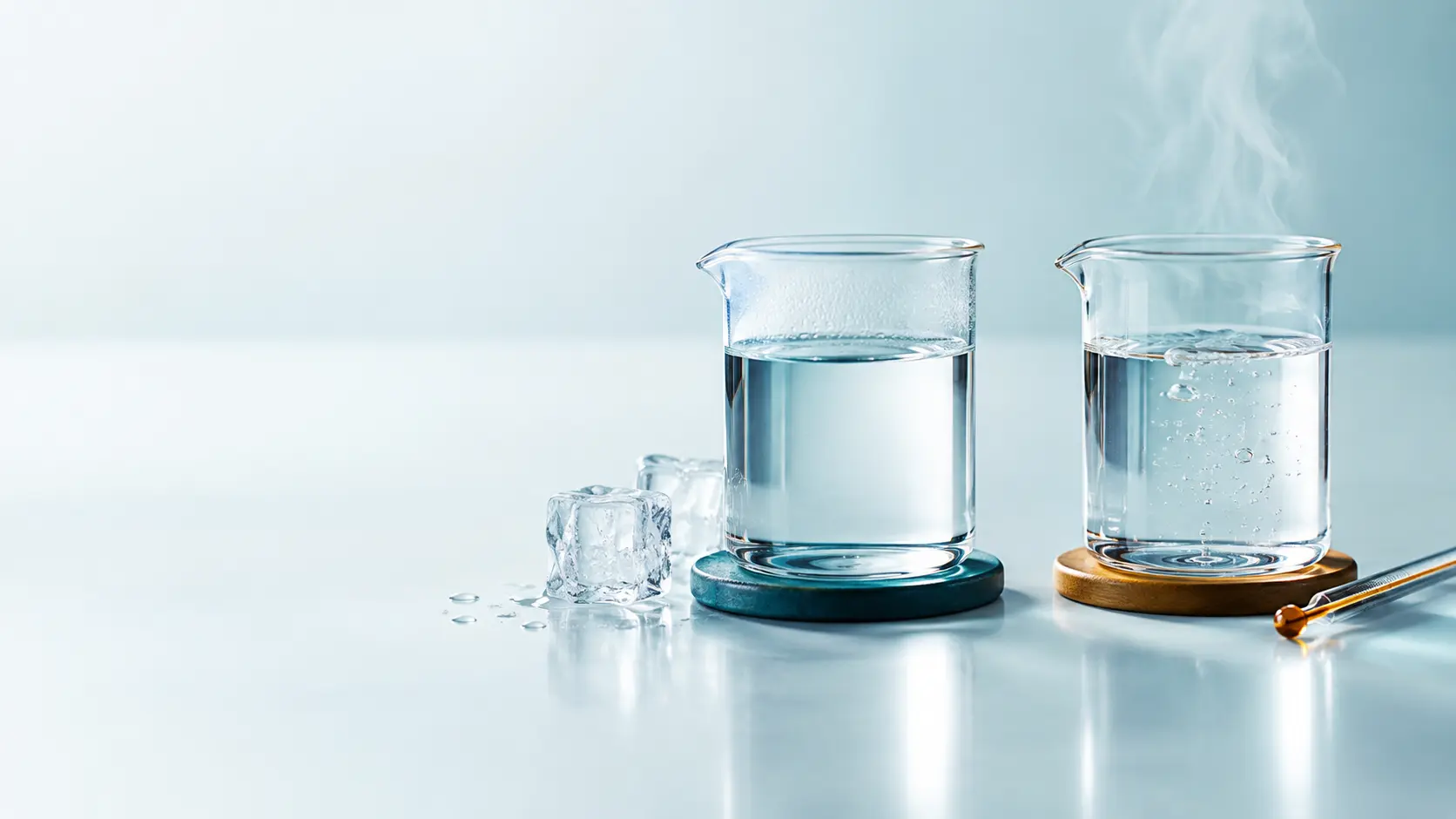
Water's weight changes with temperature because heating or cooling it changes how tightly its molecules pack together — its density — even though the mass of the water itself never changes. A gallon of water near boiling weighs about 4% less than the same gallon near its coldest, densest point around 39°F (4°C). The water isn't disappearing; it's simply taking up more room per molecule, so a fixed volume like a gallon or a liter contains slightly less mass. That's the whole mechanism — the rest is detail on how much it shifts and where it actually matters.
Check any temperature Water Density by Temperature Calculator Open →The short answer: mass stays put, density moves
Weight comes from a simple relationship: weight = volume × density. If you keep the volume fixed — one gallon, one liter, one cubic foot — then whatever happens to the weight has to come from a change in density. Density is just how much mass is squeezed into that space.
When you heat water, its molecules move faster and push each other slightly farther apart. The water expands. Since a gallon container still holds exactly a gallon, that expanded water now has a bit less mass inside the same gallon-sized space — so it weighs a little less. Cool the water back down and the molecules settle closer together again, restoring the weight. No water is gained or lost in either direction; only the packing changes.
How much the weight actually changes
The effect is real but modest across the temperatures most people encounter. Here's what one US gallon of pure water weighs at several points from near-freezing to boiling:
| Temperature | Density (kg/m³) | Weight of 1 US gallon |
|---|---|---|
| 32 °F / 0 °C (just above freezing) | 999.8 | 8.34 lb |
| 39.2 °F / 4 °C (maximum density) | 1,000.0 | 8.35 lb |
| 68 °F / 20 °C (room temp) | 998.2 | 8.33 lb |
| 104 °F / 40 °C (hot tap) | 992.2 | 8.28 lb |
| 140 °F / 60 °C (water heater) | 983.2 | 8.20 lb |
| 212 °F / 100 °C (boiling) | 958.4 | 8.00 lb |
Between the densest point and boiling, a gallon loses about 0.35 lb — roughly a 4% drop. Between an average cold tap and an average hot tap, the difference is well under 1%, which is why nobody notices it lifting a glass of water. It only starts to show up once you're weighing many gallons at once, or need a precise figure.
Why heating water lowers its density
This comes down to basic thermal expansion, a property shared by nearly every liquid. Adding heat energy makes molecules vibrate and move more vigorously. That extra motion means each molecule sweeps out more space on average, pushing its neighbors slightly farther away. Multiply that tiny separation across the trillions of molecules in a gallon of water, and the whole volume measurably expands.
Since the water's total mass hasn't changed — you haven't added or removed any H2O — spreading that same mass over a larger volume necessarily lowers the density (mass ÷ volume). And because weight for a fixed container size tracks density directly, warmer water reads lighter on a scale, gallon for gallon.
It's expansion, not evaporation. A sealed gallon of water heated from 68°F to 140°F doesn't lose any water to evaporation — the container just isn't perfectly full anymore, because the same water now occupies slightly more space than a gallon.
The 4°C anomaly: water's odd exception
Most liquids simply get less dense the warmer they get, all the way down to freezing. Water does something unusual: it reaches maximum density at about 39.2°F (4°C), then becomes less dense both above and below that point. That's why the coldest water in a lake sinks to about 39°F near the bottom in winter, while colder water — and ice — floats above it.
The cause is hydrogen bonding. As water cools toward freezing, its molecules increasingly lock into a partially ordered, cage-like arrangement that holds them slightly farther apart than in ordinary liquid water at 4°C. That structure becomes fully rigid at 0°C, when water freezes into ice — which is why ice is about 9% less dense than liquid water and floats instead of sinking. It's the same hydrogen-bonding behavior that gives water its unusually high density peak away from either end of its liquid range, rather than simply increasing all the way to the freezing point the way most substances do.
Practically, this quirk is also why lakes and ponds freeze from the top down, letting fish survive underneath through winter — a direct consequence of the same density-temperature relationship covered here.
How to calculate it for any temperature
For a quick, exact figure at a given temperature, work from density directly. Convert your volume to liters, multiply by water's density at that temperature in kilograms per liter, then convert to pounds if needed:
Compare that with the same 10 gallons at room temperature — about 83.3 lb — and the gap is roughly 1.2 lb, consistent with the percentages in the table above. The water density by temperature calculator does this lookup automatically across the full liquid range, and the thermal expansion of water calculator is useful when you need the volume change itself rather than the resulting weight.
Why this matters in practice
For a glass of water, none of this is worth thinking about. It becomes relevant once volumes get large or precision matters:
50-gallon water heater
−2.0 lb
Roughly the difference between filling it with cold supply water and heating it to 140°F — the tank holds the same volume but slightly less mass once hot.
Boiler & HVAC design
Density tables
Engineers use water's density at operating temperature, not room temperature, when sizing expansion tanks and calculating circulated mass flow.
Precise lab dosing
±0.2%
Chemistry and pharmaceutical protocols that measure water by weight often specify a reference temperature for exactly this reason.
Aquariums & ponds
Layering
The density peak at 4°C is why pond water stratifies by temperature, which matters for winter fish survival and turnover timing.
Other things that affect water's weight
Dissolved salt. Seawater is roughly 2–3% denser than fresh water because of dissolved minerals, and unlike fresh water it keeps getting denser all the way down to its freezing point — salt disrupts the hydrogen-bond structure responsible for fresh water's 4°C anomaly.
Pressure. Water is nearly incompressible, so ordinary pressure changes have a negligible effect on its weight compared with temperature. It only becomes a factor in deep-ocean or high-pressure industrial contexts.
Purity. Dissolved minerals in tap water add a trace amount of mass, but far too little to compete with the temperature effect described here.
The bottom line
Water's weight changes with temperature because heat changes its density, not its mass. Cooling water toward 39°F packs it slightly tighter and makes it marginally heavier per gallon; heating it toward boiling spreads it out and makes it marginally lighter. The swing across the full liquid range is about 4% — small enough to ignore for daily life, but real enough to matter for tanks, boilers, and any calculation that needs to be precise.
Frequently asked questions
Does hot water weigh less than cold water?
Yes, slightly. A fixed volume of hot water contains a little less mass than the same volume of cold water because heat makes water expand. A gallon of water at 212°F weighs about 4% less than a gallon at 39°F.
At what temperature is water heaviest per gallon?
Water is densest, and therefore heaviest per gallon, at about 39.2°F (4°C). That's its point of maximum density; water is slightly less dense both above and below that temperature.
Why is water densest at 4°C instead of at freezing?
Water molecules form hydrogen bonds that pull them into a more open, cage-like structure as they approach freezing. That structure takes up more space per molecule than liquid water at 4°C, so density peaks slightly above the freezing point rather than at it.
How much does the weight of a gallon of water change between freezing and boiling?
Roughly 4%. A US gallon weighs about 8.35 pounds near its point of maximum density (39°F) and about 8.02 pounds at boiling (212°F), a difference of about 0.33 pounds per gallon.
Does this temperature effect matter for everyday plumbing or drinking water?
Not for typical household use. The weight change across normal hot and cold tap temperatures is under 1%, far too small to notice by hand. It becomes relevant for large tanks, boilers, precise dosing, and engineering calculations.
Does temperature affect saltwater density the same way?
Saltwater follows the same general cooling-contracts, heating-expands pattern, but dissolved salt changes the details: seawater's density keeps increasing all the way to its freezing point instead of peaking at 4°C, because salt disrupts the hydrogen-bond structure that causes fresh water's anomaly.
Sources & references
The figures and physics in this guide follow standard reference values for the density and thermal behavior of water:
- U.S. Geological Survey, Water Science School — Water Density. Pure water reaches its maximum density (0.99984 g/mL) at about 4 °C.
- The Engineering ToolBox — Water: Density, Specific Weight and Thermal Expansion Coefficients. Density values across the 0–100 °C range.
- NOAA National Ocean Service — Is seawater more dense than freshwater?. How temperature and salinity together govern water density.
Water Systems Specialist · Austin, Texas
A Texas-licensed Professional Engineer with 13+ years in residential water systems, John leads the science, flow and pressure guides on Water Calculator. Read full bio
Licensed Professional Engineer (PE) · Specializes in water density, flow and pressure