How Much Water Does Watering the Lawn Really Use?
Watering the lawn is the biggest swing in most household water bills. Here is what a lawn really needs, how many gallons that is for your yard, and where the extra water goes.
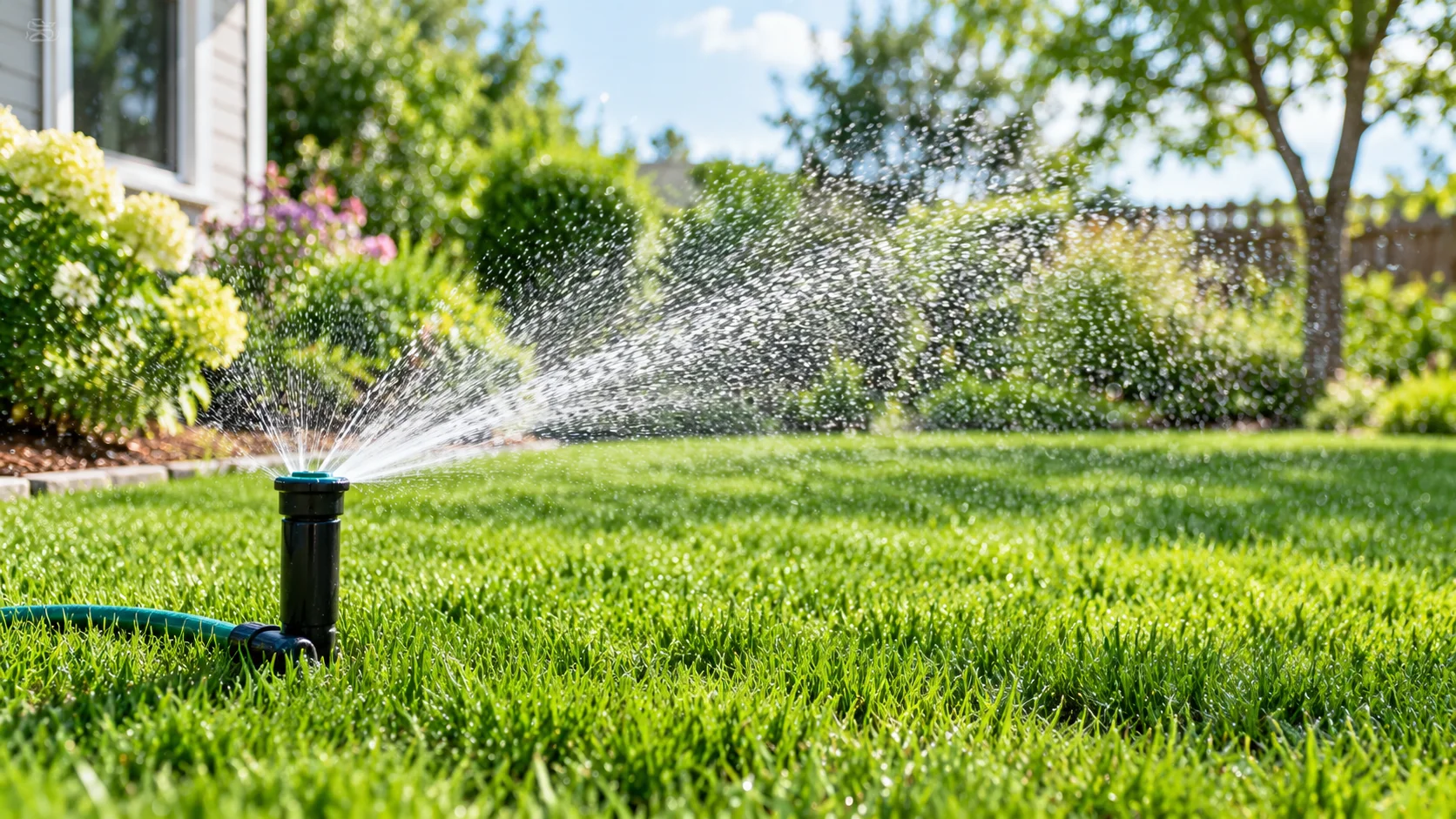
A lawn needs about 1 inch of water a week during the growing season, rainfall included. That works out to roughly 0.62 gallons per square foot, or about 623 gallons for every 1,000 square feet — so a 5,000-square-foot lawn takes around 3,100 gallons for one full inch. Rain does some of the work for free and sprinklers waste some of what they throw, so your real number depends on a handful of factors. Here is how to work it out for your own yard.
Skip the math Garden Hose Water Usage Calculator Open →Lawn watering at a glance
Almost every lawn-watering question reduces to one conversion: a depth of water spread over an area. One inch of water over one square foot is about 0.623 gallons. Scale that up and the volumes get large quickly:
| Lawn area | Gallons for 1 inch | Liters for 1 inch |
|---|---|---|
| 1 square foot | 0.62 gal | 2.4 L |
| 1,000 square feet | 623 gal | 2,358 L |
| 5,000 square feet | 3,115 gal | 11,790 L |
| 1 acre (43,560 sq ft) | about 27,100 gal | about 102,600 L |
Those are the gallons your lawn needs to receive. What your meter records is higher, because no sprinkler delivers every drop where it is wanted. A few reference points put the scale in context:
1,000 sq ft, 1 inch
623 gal
One weekly watering of a small lawn when rain has not helped at all.
5,000 sq ft, 1 inch
3,115 gal
A mid-size suburban lawn in a dry week, before any sprinkler losses.
One hour at 5 gal/min
300 gal
An illustrative flow rate. Measure your own with a bucket and a timer.
Average household, outdoors
50,500 gal/yr
The EPA's average for all outdoor use per household, lawn included — about 138 gallons a day when spread across the year.
How much water a lawn actually needs
The standard guideline is about 1 inch of water per week for grass in its growing season. University extension programs, including the University of Tennessee's, use that figure, and it is the right place to start. It is a baseline, not a prescription.
The inch includes rain. The target is the total from rainfall plus irrigation. If a storm drops 0.4 inch, your sprinklers only need to supply 0.6 inch. Forgetting to subtract rain is an easy way to overwater without noticing.
The inch is meant to wet the root zone, not just the surface. How the water gets there matters as much as how much you apply. One or two deep sessions a week push roots down and make the lawn more drought tolerant. A short sprinkle every day does the opposite: roots stay shallow, and more of each application evaporates before it does any good.
Soil changes the delivery. Sandy soil drains fast and holds little, so it does better with smaller, more frequent doses. Clay absorbs slowly and sheds water as runoff if you apply it faster than it can soak in. New seed and fresh sod are the exception to the deep-and-infrequent rule: they need light, frequent watering until the roots establish.
Gallons by lawn size and depth
Pick the depth that matches your weather, then read across. Half an inch fits a cool or rainy week, one inch is the typical growing-season target, and an inch and a half covers a hot, dry stretch or sandy soil.
| Lawn size | 0.5 inch | 1 inch | 1.5 inches |
|---|---|---|---|
| 1,000 sq ft | 312 gal | 623 gal | 935 gal |
| 2,500 sq ft | 779 gal | 1,558 gal | 2,336 gal |
| 5,000 sq ft | 1,558 gal | 3,115 gal | 4,673 gal |
| 7,500 sq ft | 2,336 gal | 4,673 gal | 7,009 gal |
| 10,000 sq ft | 3,115 gal | 6,230 gal | 9,345 gal |
These figures assume every drop lands on the lawn. Real systems lose some, so treat them as the minimum. The next section shows how to adjust.
How to work out your own number
Measure the grass, not the property. Multiply length by width for each rectangular section, split odd shapes into rectangles, and subtract the house, driveway and planting beds. Then apply the conversion:
Next, take rain off the top. If the lawn already received 0.4 inch, the depth you owe is 0.6 inch: 5,000 × 0.6 × 0.623 = 1,869 gallons. A cheap rain gauge pays for itself here.
Finally, allow for losses. Your system has to apply more than the lawn needs, and how much more depends on its efficiency — the share of applied water that actually reaches the root zone:
The efficiency values are assumptions for the example, not measured figures for your yard. The point is the shape of the relationship: a leaky system can double what you pay for the same green lawn.
How much your sprinkler really puts out
The weekly gallons only help if you know how long to run the sprinkler. Two quick tests give you the answer.
The catch-can test (depth per hour). Scatter several straight-sided containers, such as empty tuna cans, across one zone. Run it for 15 minutes, measure the depth in each can, average the readings, and multiply by four. If the average is 0.25 inch, that zone applies about 1 inch an hour. Cans that differ wildly mean uneven coverage, a clogged nozzle or a pressure problem.
The bucket test (gallons per minute). For a hose-end sprinkler, time how long it takes to fill a 5-gallon bucket. Five gallons in 60 seconds is 5 gallons per minute, or 300 an hour. To put 623 gallons on 1,000 square feet at that rate takes about 125 minutes, assuming the sprinkler covers that area evenly. Real coverage is rarely that tidy, which is why the catch-can test is worth ten minutes of your time. Our garden hose water usage calculator does the arithmetic once you have your flow rate.
What a season of watering adds up to
Multiply the weekly figure by the length of your watering season and the totals look different. This example uses a 5,000 sq ft lawn, a 20-week season and an assumed rate of $5 per 1,000 gallons. Your rate will differ.
| Scenario | Weekly depth | Gallons per week | Season gallons | Season cost |
|---|---|---|---|---|
| Rain covers about half | 0.5 in | 1,558 | about 31,200 | about $155 |
| Dry, full inch | 1.0 in | 3,115 | about 62,300 | about $310 |
| Hot and arid | 1.5 in | 4,673 | about 93,500 | about $470 |
These are floor values. Add sprinkler losses and the totals climb. They sit in the same range as the EPA's national figure of 50,500 gallons of outdoor use per household per year, which covers everything outside the house, not just turf. Check your bill for tiered pricing, because the last gallons of a hot month are often the most expensive ones. Sewer charges are another variable: some utilities bill sewer on all metered water, while others offer a separate irrigation meter or a seasonal adjustment.
Where lawn water gets wasted
The EPA reports that residential outdoor use accounts for nearly 8 billion gallons of water each day in the United States, mainly for landscape irrigation, and that experts estimate as much as half of outdoor water use is wasted through overwatering caused by inefficient irrigation methods and systems. The usual culprits are mechanical and easy to fix:
- Overspray and runoff. Heads that hit pavement, or water applied faster than the soil absorbs it, send gallons to the gutter.
- Evaporation and wind. Midday watering and fine mist lose a large share before it lands. Early morning is calmer and cooler.
- Excess pressure. The EPA notes that systems running above the recommended pressure waste water, which is why it labels pressure-regulating spray sprinkler bodies.
- Leaks and broken heads. A cracked riser or a stuck valve can run unnoticed for weeks.
- Calendar schedules. A clock-based timer waters on Tuesday whether or not it rained Monday.
How to use less without a browner lawn
- Subtract the rain. Keep a gauge, and skip a cycle after a soaking storm.
- Water deeply, not daily. Hit the weekly depth in one or two sessions, split into cycles if runoff starts on slopes or compacted soil.
- Water early. Pre-dawn to mid-morning cuts evaporation and wind drift.
- Run the catch-can test. Fix misaligned heads and clogged nozzles, then reset run times from measured output rather than guesses.
- Let the lawn tell you. If you step on the grass and the blades spring back, it does not need water yet.
- Upgrade the controller. The EPA says replacing a standard clock-based controller with a WaterSense labeled one can save an average home up to 15,000 gallons a year.
- Shrink the lawn where it is not earning its keep. Shaded strips, steep banks and thin corners are good candidates for mulch or plants suited to your climate.
The bottom line
One inch of water a week is about 0.62 gallons per square foot, or roughly 623 gallons per 1,000 square feet. Subtract rainfall, divide by your system's real efficiency, and measure what your sprinklers actually apply. Do that and you will know your own number instead of guessing, and in most yards the measuring turns up water you can stop wasting.
Frequently asked questions
How many gallons does it take to water a lawn?
It depends on lawn size and how deep you water. One inch of water takes about 0.62 gallons per square foot, so 1,000 square feet needs about 623 gallons and a 5,000-square-foot lawn needs about 3,115 gallons per inch. Rain counts toward the total, and sprinkler losses push the real figure higher.
How much water does a sprinkler use per hour?
There is no single figure, because it depends on the sprinkler and your water pressure. Multiply its flow in gallons per minute by 60: a sprinkler running at 5 gallons per minute uses 300 gallons an hour, and one at 8 uses 480. To find yours, time how long it takes to fill a 5-gallon bucket.
How much water does a lawn need per week?
About 1 inch per week during the growing season is the standard starting point, counting rainfall. Hot, dry weather and sandy soil can push it higher; cool weather and rain bring it down.
How much does it cost to water a lawn?
It depends on your rate. At an assumed $5 per 1,000 gallons, one inch on a 5,000-square-foot lawn (about 3,115 gallons) costs roughly $16. Check your own bill, because rates are often tiered and some utilities add sewer charges.
Is it better to water the lawn every day?
Usually not. Watering deeply once or twice a week moves water into the root zone and encourages deeper roots, while a little every day keeps roots shallow and loses more to evaporation. New seed and sod are the exception and need frequent light watering until established.
How much lawn watering water is wasted?
The EPA says experts estimate that as much as 50 percent of outdoor water use is wasted through overwatering caused by inefficient irrigation methods and systems. Overspray, runoff, high pressure and schedules that ignore the weather are common causes.
How do I measure how much water my sprinklers apply?
Set several straight-sided, flat-bottomed containers, such as empty tuna cans, across the zone, run the sprinkler for 15 minutes, then measure the depth in each. Average the readings and multiply by four to get inches per hour. Big differences between containers point to uneven coverage.
Sources & references
Source figures in this guide come from the EPA's WaterSense program and university extension guidance. Gallons-per-inch conversions, season totals, costs and efficiency examples are our own calculations or illustrative assumptions, not source figures.
- U.S. EPA, WaterSense — Outdoors. Residential outdoor water use in the United States accounts for nearly 8 billion gallons of water each day, mainly for landscape irrigation.
- U.S. EPA, WaterSense — Spray Sprinkler Bodies. Cites an average household using 50,500 gallons outdoors, and the estimate that as much as 50 percent of outdoor water use is wasted through overwatering.
- U.S. EPA, WaterSense — WaterSense Labeled Controllers. Replacing a standard clock-based controller can save an average home up to 15,000 gallons annually.
- University of Tennessee Institute of Agriculture Extension, Natalie Bumgarner — W871: Irrigation. Grass generally needs about 1 inch of water per week.

Water Quality & Sustainability Specialist · Portland, Oregon
Sarah is a water quality and sustainability specialist who writes Water Calculator's guides on water usage, treatment and conservation. Read full bio
MS · Specializes in water quality, water usage and sustainability