How Much Does It Cost to Fill a Swimming Pool?
Gallons by pool size, what each fill costs at common water rates, and how tiers, sewer charges and your water source can move the total.
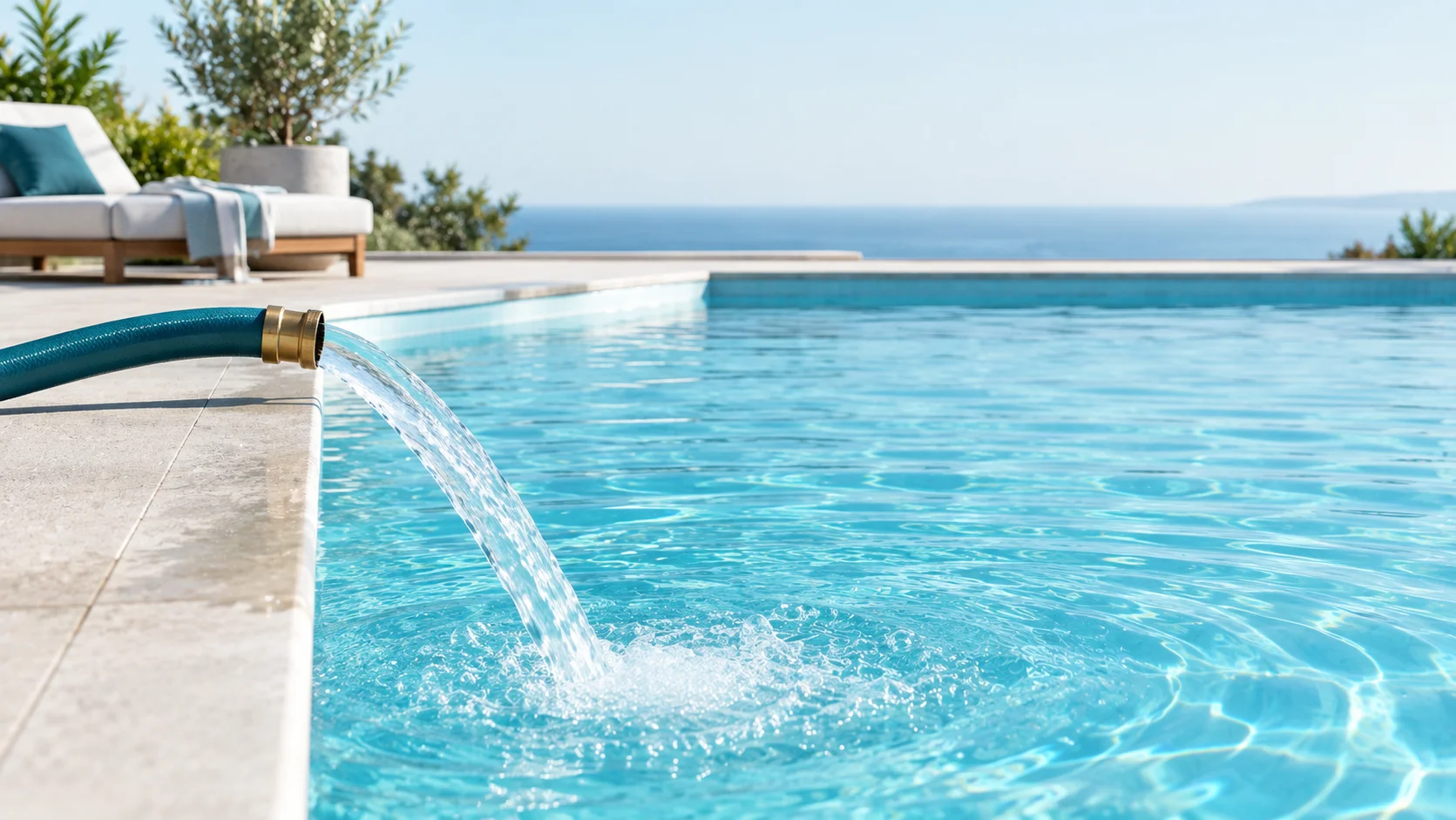
Filling a typical in-ground backyard pool costs roughly $60 to $230 in water charges, and a small above-ground pool is often under $60. Those figures assume metered city water at about $4 to $12 per 1,000 gallons and a pool that holds somewhere between 4,600 and 19,100 gallons. Your own number depends on two things you can look up in minutes: how many gallons your pool holds, and what your utility charges for each one. Sewer fees, tiered rates and fixed charges can nudge the total up, so here's how to price your fill properly.
Check your rate Water Cost per Gallon Calculator Open →Pool fill cost at a glance
The table below prices the water for common pool sizes at three illustrative rates. Low, middle and high stand in for the range most US households see on a bill; none of them is a quote for your area.
| Pool (average water depth) | Gallons | At $4 per 1,000 gal | At $8 per 1,000 gal | At $12 per 1,000 gal |
|---|---|---|---|---|
| 12 ft round above-ground (3.5 ft) | ~2,960 | $12 | $24 | $36 |
| 15 ft round above-ground (3.5 ft) | ~4,630 | $19 | $37 | $56 |
| 18 ft round above-ground (4 ft) | ~7,610 | $30 | $61 | $91 |
| 24 ft round above-ground (4 ft) | ~13,500 | $54 | $108 | $162 |
| 12 × 24 ft in-ground (4.5 ft) | ~9,700 | $39 | $78 | $116 |
| 14 × 28 ft in-ground (5 ft) | ~14,700 | $59 | $118 | $176 |
| 16 × 32 ft in-ground (5 ft) | ~19,100 | $76 | $153 | $229 |
| 20 × 40 ft in-ground (5.5 ft) | ~32,900 | $132 | $263 | $395 |
Volumes assume the pool is filled to its normal waterline, not to the brim. Costs are rounded to the nearest dollar and cover the water only, not chemicals, electricity or a delivery fee.
How many gallons your pool holds
Cost starts with volume. Multiply the pool's length, width and average depth, all in feet, to get cubic feet, then convert to US gallons. A US gallon is defined as exactly 231 cubic inches, which works out to 7.48 gallons per cubic foot.
Average depth is where most estimates go wrong. If the floor slopes evenly, add the shallow-end and deep-end depths and divide by two. A pool that is 3.5 ft at one end and 6.5 ft at the other averages 5 ft. Pools with a separate deep section or a sharp drop-off need a little more care, and freeform shapes are best treated as an estimate.
Measure water depth, not wall height. A 4 ft above-ground wall is usually filled to about 3.5 ft, and an in-ground pool is filled to about the middle of the skimmer opening. Using the full wall height overstates both gallons and cost.
Work out your own cost
Once you have gallons, the cost is a single multiplication. Utilities that bill per 1,000 gallons use the first formula below; those that bill by the CCF use the second. One CCF is 100 cubic feet, or 748 gallons.
The two answers differ by a dollar only because $8 per 1,000 gallons is slightly different from $6 per CCF once converted. If you'd rather not do the conversion, the water cost per gallon calculator turns your bill's rate into a per-gallon price for you.
Why your rate changes the answer
The advertised rate is rarely the whole story. Four features of a typical bill decide what a fill really costs.
Tiered pricing. Many utilities charge more per gallon as monthly use climbs. A pool fill lands on top of normal household use, so much of it can fall in the upper tiers. As an example, suppose the first 6,000 gallons cost $5 per 1,000, the next 6,000 cost $8, and anything above that costs $12. A 19,100-gallon fill would cost 6 × $5 + 6 × $8 + 7.1 × $12, or about $163, before counting your regular use that month.
Sewer charges. Many utilities base the sewer bill on the water that passes through your meter, which would include a pool fill, even though that water never reaches the sewer. At an illustrative $9 per 1,000 gallons for sewer, the 19,100-gallon fill above would add about $172 and bring the total near $325. Some utilities offer a separate irrigation meter, a seasonal cap or a one-time adjustment, so it pays to ask.
Fixed charges. The base fee on your bill does not change with a pool fill, so leave it out of the calculation. Only the volume-based charges matter.
Seasonal rates. Some utilities raise rates in summer, when lawn watering pushes demand up, and some apply drought surcharges. Filling in a cooler month can be cheaper, and drought restrictions may limit filling altogether.
Common real-world examples
Here are four typical pools, with the water-only cost shown as a range from $4 to $12 per 1,000 gallons:
15 ft round above-ground
$19–$56
About 4,630 gallons. A cheap fill, and the one you'll repeat most often if you refill each season.
14 × 28 ft in-ground
$59–$176
About 14,700 gallons at a 5 ft average depth, a common size for a modest backyard pool.
16 × 32 ft in-ground
$76–$229
About 19,100 gallons. Add sewer charges and the high end can approach double.
20 × 40 ft in-ground
$132–$395
About 32,900 gallons, enough to push most households deep into upper pricing tiers.
How long filling takes
Time is the hidden cost of a big fill. A garden hose typically delivers roughly 5 to 10 gallons per minute, depending on your water pressure and hose diameter. At that rate, a 19,100-gallon pool needs about 32 to 64 hours of continuous running, which is roughly a day and a half to two and a half days. Two hoses cut the time about in half, provided your home's pressure can support both.
Plan for the full duration. Check the level periodically so the pool doesn't overflow, and confirm that local watering restrictions allow a long fill. If your meter is read monthly, a fill that straddles two billing periods can also keep more of it out of the highest tier. Ask your utility how it handles that.
Utility water, a well or a water truck
Municipal water is the baseline: treated, pressurized and billed by the gallon, so every figure above applies directly.
Well water avoids utility charges, so the cost is mostly the electricity to run the pump. The catches are capacity and quality. A low-yield well can struggle with a fill that runs for days, and iron, hardness or other dissolved minerals can stain surfaces and complicate chemical balance. Test the water before you commit.
Delivered water from a bulk hauler is usually priced per load plus a delivery fee. A tanker carries a few thousand gallons, not tens of thousands, so a full pool can take several loads. Get written quotes, compare the total with your metered rate, and ask where the water comes from and whether it is treated.
Ways to keep the cost down
Call your utility first. Ask whether sewer charges apply to a pool fill, whether a separate meter or an adjustment is available, and which tier you'll land in. A five-minute call can be worth more than any other step on this list.
Fill to the right level. Stop at the normal waterline. Every extra inch on a 16 × 32 ft pool is roughly 320 gallons.
Cover the pool. After the fill, evaporation is the main ongoing loss. The EPA says a pool cover can prevent up to 95 percent of it, which also cuts the number of top-ups you'll pay for.
Fix leaks promptly. A pool that loses more than evaporation explains turns every fill into a recurring expense.
Think twice before draining. Partial water changes usually do the job. Before emptying an in-ground pool, talk to a pool professional, because high groundwater can lift an empty pool shell out of the ground.
The bottom line
Multiply your pool's length, width and average depth by 7.48 to get gallons, then multiply by your rate per gallon. For most homes that lands between about $10 and $400 for the water, depending on pool size and local pricing. Sewer fees and tiered rates are the two things most likely to make the real bill larger than the simple math, so check how your utility treats a pool fill before you open the valve.
Frequently asked questions
How much does it cost to fill a swimming pool?
For most home pools, the water itself costs roughly $10 to $400, depending on pool size and your local rate. A 15 ft round above-ground pool holds about 4,600 gallons and costs roughly $19 to $56 at $4 to $12 per 1,000 gallons, while a 16 × 32 ft in-ground pool holds about 19,100 gallons and costs roughly $76 to $229. Sewer charges, if your utility applies them to the fill, can increase the total.
How many gallons does it take to fill a pool?
Multiply the pool's length, width and average depth in feet to get cubic feet, then multiply by 7.48 to convert to US gallons. A typical backyard in-ground pool, from 14 × 28 ft to 16 × 32 ft, holds roughly 14,700 to 19,100 gallons.
How long does it take to fill a pool with a garden hose?
A single garden hose usually delivers roughly 5 to 10 gallons per minute, so a 19,100-gallon pool takes about 32 to 64 hours of continuous filling, or roughly 1.3 to 2.7 days. Running two hoses at once cuts the time about in half.
Do I pay sewer charges when I fill a pool?
It depends on your utility. Many utilities charge for sewer based on the water that passes through your meter, which would include a pool fill, while others offer a separate irrigation meter, a seasonal cap or a one-time adjustment. Call your utility before you start filling and ask how a pool fill is billed.
Can I fill my pool with well water?
Yes, if your well can supply the volume. Well water avoids utility charges, so your cost is mainly the electricity to run the pump, but a long fill can strain a low-yield well, and the water may carry iron, hardness or other minerals that stain surfaces or complicate chemical balance. Test the water first.
How much does it cost to keep a pool topped up?
Pools lose water to evaporation, splashing, filter backwashing and leaks, so most need periodic top-ups. A pool cover can prevent up to 95 percent of evaporation, according to the EPA, which makes a cover the most effective way to cut that ongoing water use.
Sources & references
Conversion factors and billing practices in this guide follow these references. Dollar figures are illustrative estimates, not quoted rates.
- U.S. Environmental Protection Agency, WaterSense — Understanding Your Water Bill. One CCF equals 748 gallons; utilities combine fixed and volume charges, and many bill sewer based on the water entering the property.
- U.S. Environmental Protection Agency, WaterSense — Pool Water Efficiency. A pool cover can prevent up to 95 percent of pool water evaporation.
- NIST, Handbook 44, Appendix C: General Tables of Units of Measurement — Appendix C. The US gallon is exactly 231 cubic inches, or about 3.785 liters.

Water Quality & Sustainability Specialist · Portland, Oregon
Sarah covers water treatment, water quality, usage, cost and conservation on Water Calculator, with a focus on helping households understand what their water really costs. Read full bio
MS · Specializes in water quality, treatment, usage and sustainability