How to Read and Understand Your Water Bill
Fixed charges, tiers, CCF, sewer fees — here's what every line on your water bill means, how the total is built, and how to spot a leak or an error.
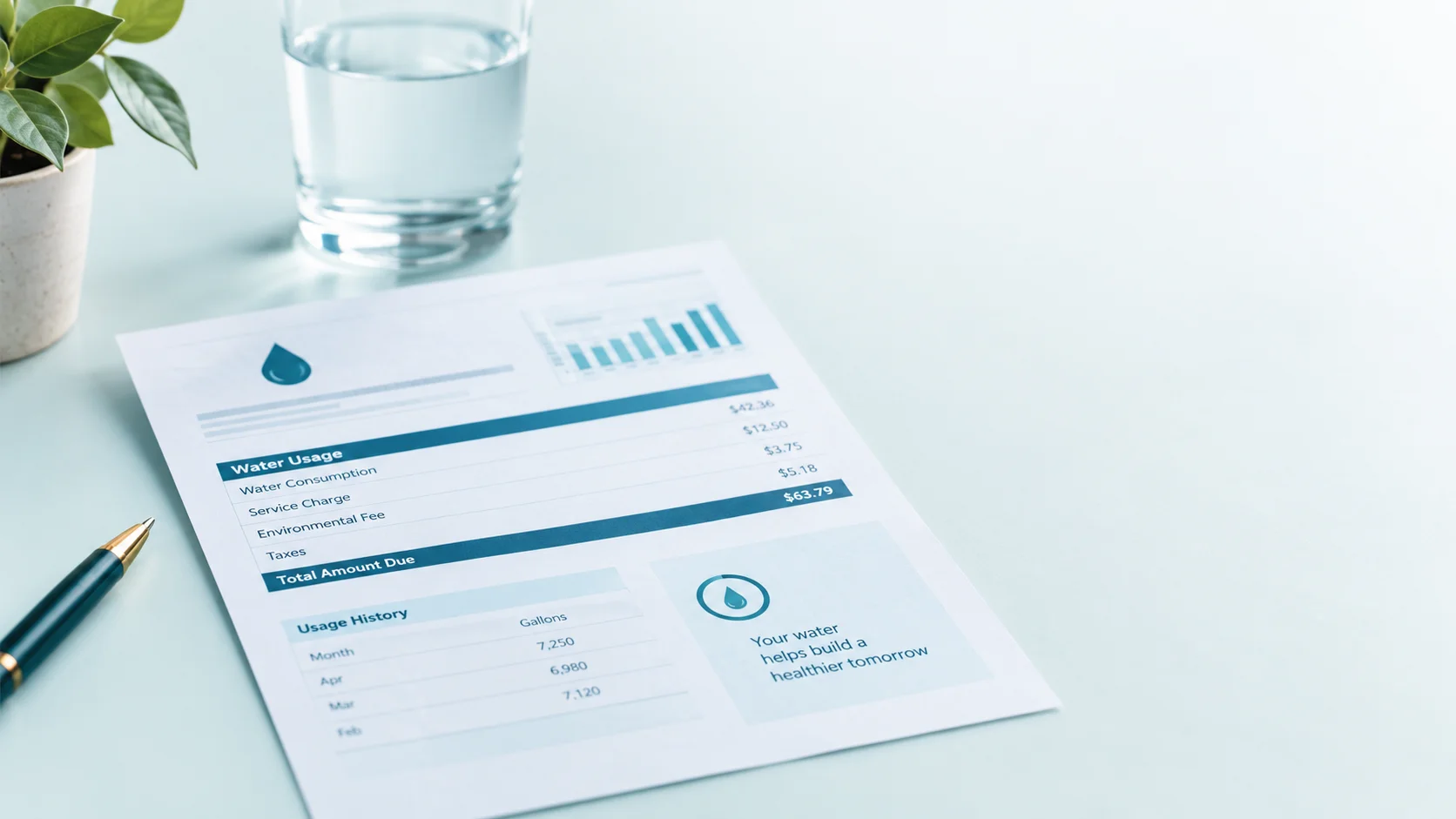
Your water bill is the sum of a few separate pieces: a fixed service charge, a usage charge based on the difference between two meter readings, a sewer charge that usually follows your water use, and sometimes stormwater or other fees. Find the meter readings, convert the usage unit to gallons if needed, and check each charge against your utility's published rates. That one routine explains almost any bill, and the sections below take it line by line.
Skip the math Water Bill Calculator Open →What's on a water bill
Layouts differ between utilities, but nearly every bill contains the same building blocks. Knowing what each one is meant to do tells you where to look when the total surprises you.
| Line item | What it is | What drives it |
|---|---|---|
| Service (base) charge | Flat fee to stay connected to the system | Meter size, not usage |
| Water usage charge | Cost of the water you used | Usage × rate, often in tiers |
| Sewer / wastewater charge | Cost of treating water that goes down the drain | Usage (or averaged usage) × sewer rate |
| Stormwater fee | Share of runoff infrastructure | Property size or paved area |
| Taxes, surcharges, past due | Local fees and carried-over balances | Local rules and payment history |
Not every utility charges every item. Some bundle water and sewer into one line, and some charge the base fee per billing period rather than per month. Your utility's rate schedule is the final word.
Understanding the units: gallons, CCF and cubic feet
Usage is where most confusion starts. Some utilities bill in gallons (often per 1,000 gallons), others in CCF (hundred cubic feet), and a few use cubic meters. They measure the same thing at different scales.
| Billing unit | Equals | US gallons |
|---|---|---|
| 1 cubic foot | 1 ft³ | about 7.48 |
| 1 CCF (also written HCF or Ccf) | 100 ft³ | about 748 |
| 1 kgal | 1,000 gallons | 1,000 |
| 1 cubic meter | 1,000 liters | about 264 |
So 10 CCF is about 7,480 gallons, and 1,000 gallons is about 1.34 CCF. When you compare your use to a household average or to a neighbor's bill, convert to the same unit first. A bill that reads "6" in CCF and one that reads "6" in thousands of gallons differ by about 40%.
The conversion factors follow from 1 cubic foot being about 7.48 US gallons. They are calculated values, rounded for readability.
How your usage is calculated
Your usage is the current meter reading minus the previous reading. The meter works like a car odometer: it only counts up, and the difference between two readings is the water that passed through in between. The bill normally prints both numbers, the read dates, and the resulting usage.
Check three details. First, whether the read is marked actual or estimated. Second, whether the billing period is about 30 days (some utilities bill every two months or quarterly). Third, whether the meter dials are in the same unit as the billed unit. Dividing usage by the days in the period gives your average daily use, which is the easiest number to compare month to month.
Meter reads vs. billing periods. A longer period means more days of water, not necessarily higher use. Compare daily averages, not totals, when the period lengths differ.
Rate structures: flat, tiered and seasonal
The usage charge is usage multiplied by a rate, but the rate itself can work in several ways.
Flat (uniform) rate. Every unit costs the same. This is the simplest to check: usage × rate.
Tiered (increasing block) rates. The price per unit rises as use climbs through set blocks. Only the units inside each block are charged at that block's price, so the second tier does not reprice your first units. Tiered rates are designed to reward conservation, and your water rate tier calculator result shows exactly how much of your use landed in each tier.
Seasonal rates. Some utilities charge more per unit, or shift tier limits, in summer when outdoor watering drives demand.
Budget-based rates. A few utilities set an allotment from household size and lot size, then charge more for use above it.
Sewer, stormwater and other charges
The sewer line often surprises people, because it can equal or exceed the water charge. Utilities generally can't meter what goes down your drain, so they estimate it from the water that came in. Two methods are common:
Billed on current use. Sewer is charged on every unit of water you use that month. Water that never reaches the drain, such as lawn irrigation, is still billed as sewer.
Winter averaging. Sewer is set from your lowest-use months, typically winter, when little water goes outdoors. That figure is then applied as a fixed monthly sewer volume. A leak or heavy use during the averaging months can raise the charge for the rest of the year. The sewer bill calculator helps you test both methods against your own numbers.
Stormwater fees are usually flat and tied to the property, not to the water you use, so they don't move with your habits.
Worked example: one bill, line by line
Here is an illustrative bill using made-up rates. Your own utility's numbers will differ, but the steps are the same.
| Line | Calculation | Charge |
|---|---|---|
| Service charge | Flat | $18.00 |
| Water, tier 1 | 4 CCF × $3.10 | $12.40 |
| Water, tier 2 | 3 CCF × $4.60 | $13.80 |
| Sewer | 7 CCF × $5.20 | $36.40 |
| Stormwater | Flat | $6.50 |
| Total | $87.10 |
That last figure is worth calculating on your own bill. It folds every fee into one cost per unit, which makes it easy to judge what a leak or a long shower really costs. The water bill calculator runs this arithmetic from your own rates.
Red flags to check on every bill
Usage spike
Check daily avg.
Compare gallons per day with last month and the same month last year before blaming the rate.
Estimated reads
Look for "E"
Back-to-back estimates hide changes in use. Ask the utility for an actual read if you see more than one.
Steady night use
Leak sign
If the meter moves with every fixture off, water is escaping. A running toilet is a frequent culprit.
Wrong tier or rate
Verify
Match the printed rates to the current rate schedule on your utility's website after any rate change.
On the scale of a leak, EPA reports that household leaks can waste nearly 10,000 gallons a year, and that about 10 percent of homes have leaks wasting 90 gallons or more per day. At the all-in rate from the example above, a 90-gallon-per-day leak would add roughly $45 to a 30-day bill. That is an estimate from the illustrative rate, and the water leak cost calculator lets you use your real one.
What to do if the bill looks wrong
Start with the facts on the page: read type, dates, usage and rates. Then read the meter yourself and compare it to the printed current reading. If the numbers don't reconcile, contact the utility and ask for a meter re-read or a meter accuracy test. Many utilities also offer one-time leak adjustments or payment plans, so ask what yours provides. Keep photos of the meter with a date on them; they settle most disputes quickly.
The bottom line
A water bill is easier to read once you split it into fixed charges, usage charges and sewer charges. Subtract the previous meter read from the current one, convert the unit to gallons (1 CCF is about 748), apply your tiers one block at a time, and compare the daily average to earlier months. If a number doesn't match your utility's published rates, or the meter moves when nothing is running, call the utility. Doing this check a few times a year costs little and catches both errors and leaks early.
Frequently asked questions
What does CCF mean on a water bill?
CCF stands for hundred cubic feet. One CCF is 100 cubic feet of water, which is about 748 gallons. Many utilities bill in CCF because meters register cubic feet.
How do I convert CCF to gallons?
Multiply the CCF figure by about 748. For example, 6 CCF is roughly 4,488 gallons. To go the other way, divide gallons by 748.
Why is my sewer charge so high?
Sewer charges usually track your water use, and the sewer rate per unit is often higher than the water rate. Many utilities set the sewer charge from winter-month usage, so a high winter reading can raise the charge all year.
Why did my water bill suddenly go up?
The usual causes are a leak (a running toilet is the most common), a seasonal change like lawn watering, a rate increase, an estimated read that was later corrected, or more people at home. Compare the meter reading and usage to last month's before anything else.
What is the difference between an estimated and an actual read?
An actual read comes from the meter itself. An estimated read is the utility's best guess when it couldn't read the meter, based on past use. Estimates are trued up on the next actual read, which can produce a bigger or smaller bill than expected.
How can I tell if I have a leak from my bill?
Look for usage that stays high in months when you were away or use is normally low. For a direct check, shut off all water-using fixtures and watch the meter's leak indicator; if it moves, water is flowing somewhere.
Sources & references
Unit conversions in this guide are calculated; the leak statistics come from EPA. Rates in the worked example are illustrative.
- U.S. Environmental Protection Agency, WaterSense — Fix a Leak Week. Household leak statistics and guidance on finding leaks.
- U.S. Environmental Protection Agency, WaterSense — How We Use Water. Background on household water use.
- U.S. Environmental Protection Agency — Consumer Confidence Reports. Annual reports from your water supplier, often mailed or posted alongside billing information.

Water Quality & Sustainability Specialist · Portland, Oregon
Sarah covers water quality, treatment, usage, cost and conservation at Water Calculator, with a focus on helping households understand what they use and what it costs. Read full bio
MS · Specializes in water usage, cost and sustainability