How Are Water Bills Calculated? A Line-by-Line Breakdown
A water bill is a base charge, plus metered water priced by tier, plus sewer and fees. Here is how each line is calculated, and how to check yours.
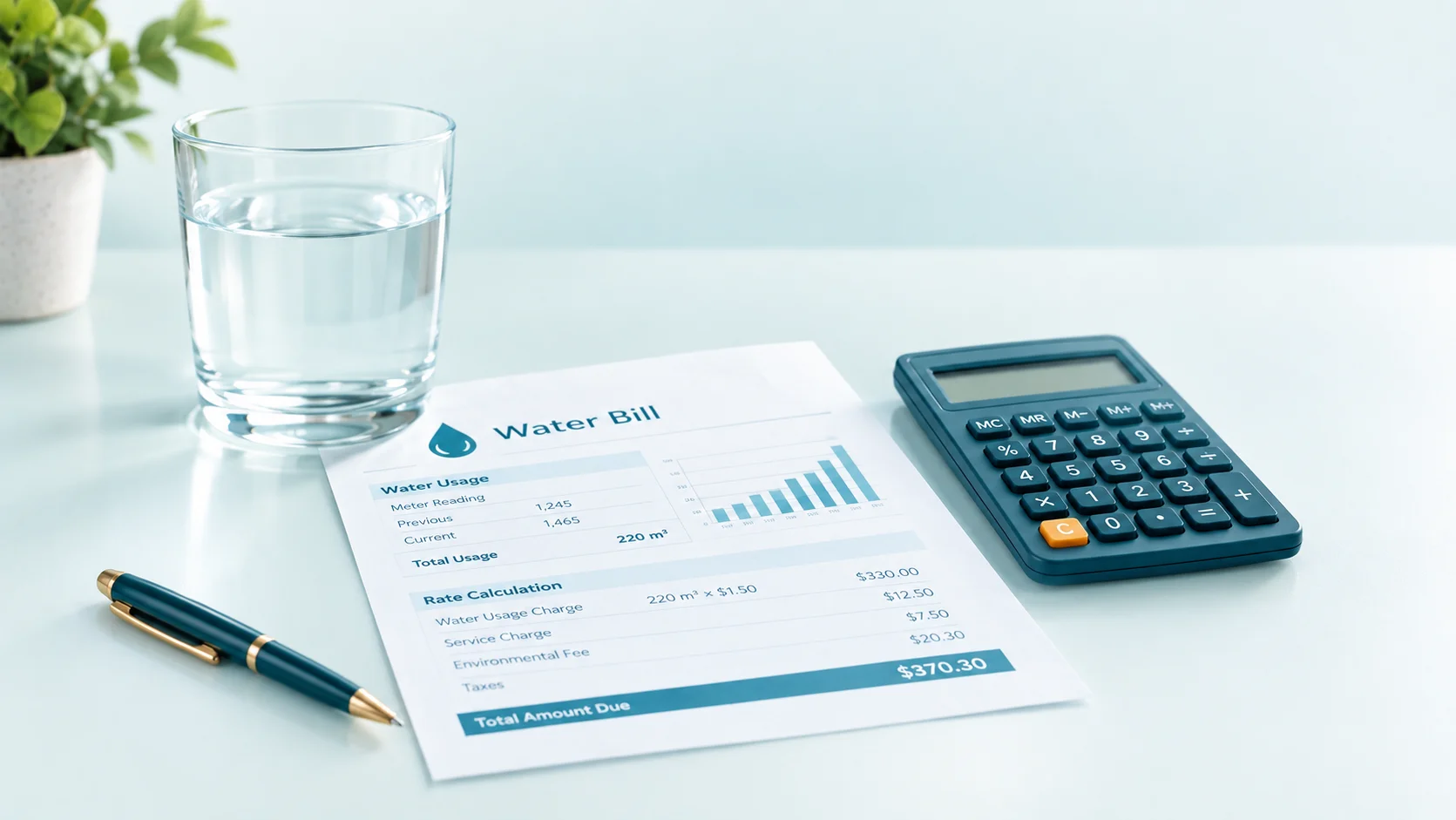
A water bill is calculated as a fixed base charge plus a volume charge — the water your meter recorded, multiplied by your utility's rate — with sewer, stormwater and other fees added on top. Utilities meter in gallons or in CCF (one CCF is 748 gallons), and many price the volume in tiers, so each additional block of water costs more than the last. The details vary from one utility to the next, but nearly every residential bill follows this structure. Here is how each piece works, with a full worked example you can compare against your own bill.
Skip the math Water Bill Calculator Open →A water bill at a glance
Strip away the formatting and almost every residential water bill is assembled from the same few parts:
| Component | Usually based on | Rises with use? |
|---|---|---|
| Base (service) charge | Meter size | No |
| Water volume charge | Metered volume | Yes |
| Sewer charge | Metered volume, or flat | Usually |
| Stormwater and other fees | Property or flat fee | Rarely |
| Taxes and surcharges | Percent of charges | Indirectly |
EPA WaterSense notes that many utilities pair a fixed fee with a variable, volume-based fee. The fixed part pays for costs that exist whether or not a tap is open: electricity to move and treat water, staff, maintenance and other operating costs. The variable part is what you control.
Why you get a bill even when you use nothing. A utility has to keep pipes pressurized and treatment running around the clock. Those costs don't drop when one household is away, so part of them is recovered through the base charge. That is why a month on vacation still produces a bill.
Meter readings and units: CCF vs gallons
Your meter works like a car odometer: it counts total water that has passed through since it was installed. Your usage for the period is the difference between the previous and current readings. If the last read was 1,284 and this read is 1,292, you used 8 units.
What a "unit" means depends on the utility. Some bill in gallons or thousands of gallons. Many bill in CCF (centum cubic feet), also written HCF (hundred cubic feet), which is one hundred cubic feet of water. EPA states that one CCF equals 748 gallons. That figure follows from the geometry: a cubic foot holds about 7.48 US gallons, and 100 cubic feet holds about 748.
| Usage | Cubic feet | US gallons |
|---|---|---|
| 1 CCF | 100 | 748 |
| 2 CCF | 200 | 1,496 |
| 5 CCF | 500 | 3,740 |
| 8 CCF | 800 | 5,984 |
| 10 CCF | 1,000 | 7,480 |
| 15 CCF | 1,500 | 11,220 |
| 20 CCF | 2,000 | 14,960 |
If a utility bills per 1,000 gallons, note that 1,000 gallons is about 1.34 CCF. Convert before comparing prices between utilities.
Some meters register only whole units, so the fraction you used carries forward into later reads. That is one reason usage can look nearly identical for a few bills in a row without the meter being faulty.
Rate structures: how the unit price is set
The volume rate is where bills differ most between towns. EPA WaterSense describes several common structures:
| Structure | Price per unit | Typical aim |
|---|---|---|
| Uniform | Constant | Simplicity |
| Increasing block | Rises with use | Conservation |
| Declining block | Falls with use | Bulk users |
| Seasonal | Changes by season | Peak demand |
| Drought | Rises in shortage | Cut demand |
| Water budget | Rises above allotment | Fair share |
Increasing block (tiered) rates are designed to promote conservation, and EPA says they are most often found in urban areas and places with limited water supplies. Declining block rates are the opposite: later blocks cost less per unit. Under a water budget, each household is typically given an allotment based on factors like household size and landscape, and use above it is priced higher.
To find your own structure, search for your utility's name plus "water rates." The schedule lists the base charge by meter size, the tier boundaries and the price in each tier. For a side-by-side look at how those tiers affect a bill, try the water rate tier calculator.
How tiered rates are applied
The most common misunderstanding about tiers is that reaching a higher one reprices the whole bill. It doesn't. Each tier prices only the units that fall inside it. Suppose tier 1 covers the first 4 CCF, tier 2 covers the next 4, and tier 3 covers everything above 8. A household using 10 CCF pays the tier 1 price on 4 units, the tier 2 price on 4 units and the tier 3 price on just 2 units.
Marginal vs. average price. Your average price per unit sits somewhere between the lowest and highest tier. The price of your next unit — the marginal price — is the top tier you've reached. That marginal price is what determines how much you save by trimming use.
Worked example: one full bill
The rates below are invented for illustration and do not belong to any real utility. Say a household uses 10 CCF (7,480 gallons) in a billing period. First, the tiered water charge:
| Tier | Units billed | Price per CCF | Charge |
|---|---|---|---|
| Tier 1 (1–4 CCF) | 4 | $4.20 | $16.80 |
| Tier 2 (5–8 CCF) | 4 | $5.60 | $22.40 |
| Tier 3 (9+ CCF) | 2 | $7.90 | $15.80 |
| Water volume total | 10 | — | $55.00 |
Now add the base charge, sewer and a flat stormwater fee to reach the full bill:
| Line item | Calculation | Amount |
|---|---|---|
| Base charge (small meter) | Fixed | $18.00 |
| Water volume | Tiers above | $55.00 |
| Sewer | 10 CCF × $5.50 | $55.00 |
| Stormwater fee | Flat | $6.50 |
| Total | $134.50 |
Three things stand out. First, the water volume charge is $55.00 of the $134.50 total — less than half. Second, pricing all 10 units at the top-tier rate would produce $79.00, overstating the water charge by $24.00, which is the error people make when they misread tiers. Third, because sewer rides on the same volume, dropping from 10 to 9 CCF would save the tier 3 price plus the sewer price: $7.90 + $5.50 = $13.40. Spread over 7,480 gallons, this example works out to roughly $18 per 1,000 gallons all-in — an estimate that applies only to these made-up rates.
Sewer, stormwater and other charges
Sewer. Most homes have no meter on the sewer line, so utilities bill wastewater based on the water that came in, assuming it went down the drain. EPA's WaterSense at Work guide describes this approach. Some utilities refine it by using winter-month usage, or by allowing a separate irrigation meter, so outdoor watering isn't charged as sewage. Check your utility's rules if you irrigate heavily. You can estimate this line with the sewer bill calculator.
Base charges. The fixed charge often depends on meter size, because a larger meter serves a larger potential demand on the system. A typical house on a small meter pays the lowest base tier.
Stormwater and other fees. Some utilities add a stormwater fee, either flat or based on property size, along with items such as fire protection, capital surcharges, taxes and late fees. Your bill's back page or the utility website usually explains each one.
Why your bill goes up or down
When a bill surprises you, look for one of these causes before assuming the utility made a mistake:
- Billing period length. A 33-day period includes about 18% more days than a 28-day one, and more days means more water.
- Estimated reads. If the meter wasn't read, the bill may use an estimate that is corrected on the next actual read.
- Season. EPA reports that nationally outdoor water use makes up about 30 percent of household use, and much more in dry regions with irrigated landscapes.
- Tier crossings. A summer spike can push your last few units into a higher tier.
- Leaks. EPA says the average family can waste 180 gallons per week, or 9,400 gallons per year, from household leaks. The water leak cost calculator shows what a leak adds to a bill.
- Rate changes. Utilities adjust base charges and unit prices, often once a year.
Common figures in context
Converting between gallons and CCF makes everyday numbers easier to judge:
An 8-unit reading
5,984 gal
A meter that moved from 1,284 to 1,292 CCF used 8 × 748 gallons.
A typical household month
~12 CCF
EPA says the average family uses more than 300 gallons a day at home. Over 30 days that is about 9,000 gallons, or roughly 12 CCF.
A year of household leaks
~12.6 CCF
EPA's 9,400 gallons per year of average leakage works out to about 12.6 CCF of paid-for water.
1,000 gallons
~1.34 CCF
Useful when one utility bills per 1,000 gallons and another bills per CCF.
How to check your own bill
You can reproduce almost any bill in about ten minutes with the utility's rate schedule in hand:
- Note the billing period. Record the start and end dates and the number of days.
- Find the usage. Subtract the previous reading from the current one, and confirm the unit on the bill.
- Match the rate schedule's unit. Convert gallons to CCF, or the reverse, using 748.
- Apply the tiers. Price only the units inside each block, then add the blocks.
- Add the base charge for your meter size.
- Add sewer, stormwater, taxes and fees, checking how each is calculated.
- Compare to the total. If you are off by more than a few dollars, ask the utility to walk through the lines.
The most common mistakes are applying the top-tier price to every unit, mixing CCF and gallons (a 748-fold error), forgetting that sewer is billed separately, and ignoring a longer-than-usual billing period. To run the numbers automatically, use the water bill calculator.
The bottom line
Every water bill reduces to the same recipe: a fixed base charge, plus metered volume priced by your utility's rate structure, plus sewer and fees. Know your unit (one CCF is 748 gallons), know your tier boundaries, and remember that a higher tier only raises the price of the units above it. With those three facts and your utility's rate schedule, you can explain, check and plan around any bill.
Frequently asked questions
How is a water bill calculated?
A water bill is a fixed base charge plus a volume charge, with sewer, stormwater and other fees added on top. The volume charge is your metered use, in gallons or CCF, multiplied by the utility's rate, usually applied tier by tier. Sewer is most often billed on the same metered water use.
What is a CCF on a water bill?
CCF stands for centum cubic feet, which means one hundred cubic feet of water. One CCF equals 748 gallons, so a bill showing 10 CCF covers about 7,480 gallons.
Why is my water bill so high?
The usual causes are a longer billing period, an estimated meter read, summer irrigation, crossing into a higher tier, a rate increase, or a leak. A silent leak such as a running toilet adds up fast, so check whether your meter still moves when every fixture is off.
Do I pay the higher tier rate on all my water?
No. In a standard tiered structure, each rate applies only to the units that fall inside that tier. Crossing into a higher tier raises the price of the additional units, not the units you already used at lower rates.
Why is my sewer charge based on how much water I use?
Most homes have no meter on the sewer line, so utilities estimate wastewater from the water that enters the home. Some utilities base the charge on winter-month usage so you are not billed for lawn watering that never reaches the sewer.
How much does the average household pay for water?
EPA WaterSense reports that the average family spends more than $1,000 a year on water costs. Your own total depends heavily on local rates, climate and household size, so use your utility's published rate schedule for a precise figure.
Sources & references
Unit definitions and rate types follow U.S. EPA WaterSense guidance. The prices in the worked example are invented for illustration and do not come from any source.
- U.S. EPA, WaterSense — Understanding Your Water Bill. Defines the CCF (one CCF equals 748 gallons) and describes uniform, increasing block, declining block, seasonal, drought and water budget rates, and the combination of fixed and variable fees.
- U.S. EPA, WaterSense — Statistics and Facts. Average family water costs of more than $1,000 per year, and household leaks of 180 gallons per week (9,400 gallons per year).
- U.S. EPA, WaterSense — How We Use Water. National outdoor water use of about 30 percent of household use, and more than 300 gallons per day for the average family at home.
- U.S. EPA, WaterSense at Work (2012), Water Management Planning — Example information on a water bill (archived page). Sewer charges based on water use, base charges that can depend on meter size, and additional fees such as stormwater.

Water Quality & Sustainability Specialist · Portland, Oregon
Sarah specializes in water quality, treatment, sustainability and water usage, and leads the usage, cost and conservation guides on Water Calculator. Read full bio
MS · Specializes in water usage, cost and conservation