What Is the Sewer Charge on Your Water Bill?
That line item isn't a mystery fee. Here is what the sewer charge pays for, how utilities work it out from your water use, and why it can climb even when your indoor habits haven't changed.
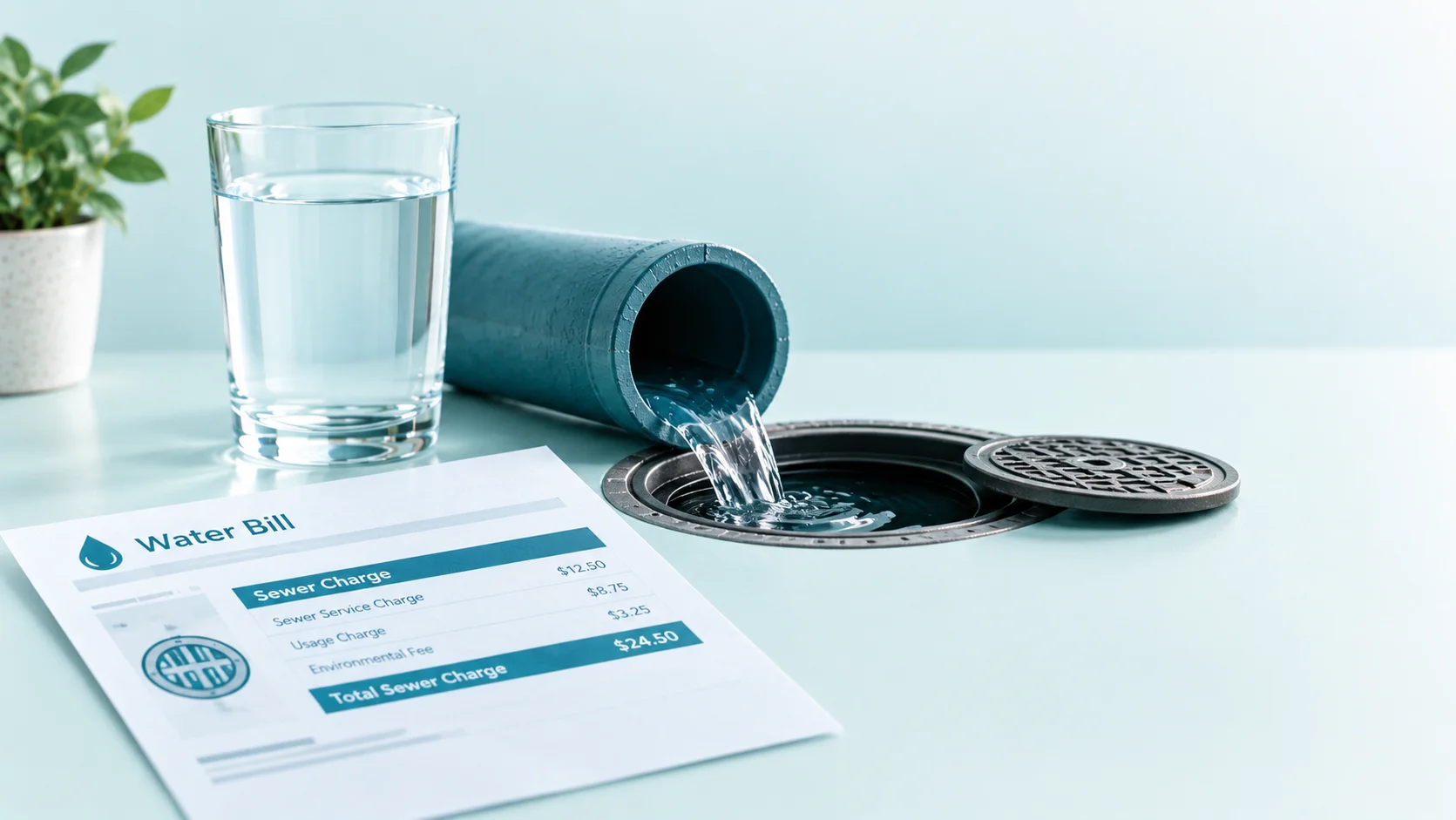
The sewer charge on your water bill is the fee for carrying wastewater away from your home and treating it before it returns to the environment. Because most properties have no meter on the drain line, utilities almost always work it out from the water you use instead: every gallon that comes in, an average of your low-use winter months, or a flat fee. Here is how each method works, why the sewer line can rival the water line, and what you can do about it.
What the sewer charge is
Wastewater is everything that goes down your drains and toilets. Once it leaves your house it travels through a network of collection pipes and pump stations to a treatment plant, where it is cleaned to meet discharge standards. The sewer charge pays for that whole chain: the pipes, the pumping, the plant, the staff, and the debt on upgrades.
A sewer charge usually has two parts:
- A fixed service charge. A flat monthly amount you pay for being connected to the system, whether you use much water or not.
- A volume charge. A rate applied to the amount of wastewater the utility assigns to your account, typically quoted per 1,000 gallons or per CCF.
Treating wastewater is a separate job from supplying drinking water, which is why it shows up as its own line. Some utilities bill both services together under one account; others send two bills.
Why it's based on your water use
Measuring wastewater directly would mean a second meter on every sewer lateral, and that is expensive to install and read. So utilities take a shortcut: they bill sewer from the water meter and assume that most of what came in went down the drain. The U.S. EPA notes that while some utilities measure both the water entering a home and the waste leaving it, many have only one meter and charge both volumes based on the water entering the house.
The assumption holds well for indoor use. Water from your shower, sinks, dishwasher and washing machine all ends up in the sewer. It breaks down outdoors: water that soaks into a lawn, fills a pool or washes a car never reaches the sewer, but a simple meter can't tell the difference. Most of the variety in how sewer is billed is just different answers to that one problem.
Skip the mathSewer Bill Calculator Open →How utilities calculate it
Five approaches cover nearly every bill you will meet. The most useful question to ask about yours is whether summer watering raises the sewer line.
| Method | Billed on | Outdoor watering raises it? |
|---|---|---|
| Full metered water | 100% of metered use | Yes |
| Percentage of metered water | A set share, such as 90% | Yes |
| Winter average | Average of low-use months | No |
| Winter average with a cap | The lesser of the average or a limit | No |
| Flat fee | Same amount each month | No |
| Separate sewer or irrigation meter | Measured or deducted use | Usually no |
Utilities that bill a percentage of metered water are trying to be a little fairer, since some indoor water (cooking, drinking, plants) never reaches the drain. Where a flat fee is used, your sewer cost is predictable but gives you no financial reason to cut indoor use.
The sewer charge formula, with an example
Whatever the method, the arithmetic is the same: a fixed charge plus a rate times the billable volume.
Many bills show water in CCF (hundred cubic feet) rather than gallons. One CCF is about 748 gallons, so divide a CCF rate by 0.748 to compare it with a per-1,000-gallon rate.
Here is a worked comparison using made-up round numbers, not any real utility's rates: a $12 fixed charge, a sewer rate of $7.00 per 1,000 gallons, and a household whose winter average is 5,000 gallons a month.
5,000 gal month
$47.00
$12 + (5 × $7.00). A winter month costs the same under either method.
12,000 gal, winter average
$47.00
Summer watering is ignored. Sewer is still billed on the 5,000-gallon average.
12,000 gal, full metered
$96.00
$12 + (12 × $7.00). Every gallon on the meter is billed as sewer.
The gap
$49 / month
The same watering habit, billed two different ways. Check which one your utility uses.
You can plug in your own rates and usage with the sewer bill calculator.
How winter averaging works
Winter averaging uses the months when almost no one waters a lawn as a stand-in for your indoor use. The utility averages your consumption across a set winter window and bills sewer on that figure all year, or bills the lower of the winter average and your actual use in the warm months.
Seattle Public Utilities, for example, bases a single-family household's summer sewer bill on its average winter use when that is lower than its actual summer use, so lawn, garden and car-washing water is not charged as sewer. If you use less in summer than in winter, you are billed on the lower summer figure. The exact months, caps and rules differ by utility.
New customers have no winter history yet, so many utilities assign a default volume, often a citywide average, until one builds up.
The blind spot. Winter averaging rewards low winter use and punishes anything that inflates it. A hidden toilet leak, a long stretch of houseguests or a pipe-freeze drip during the averaging window can raise your sewer baseline for the next twelve months.
Why your sewer charge may be high
If the sewer line looks out of proportion, one of these is usually behind it:
- A leak or running toilet. Water that leaks inside the house goes straight to the drain, so you pay for it as water and again as sewer.
- Outdoor use on a full-metering utility. Irrigation, pool filling and washing vehicles are all counted as wastewater if no averaging or credit applies.
- An inflated winter baseline. See the callout above: an unusual winter can set a higher charge for the whole year.
- Rate increases. Sewer systems are capital-intensive. Utilities raise rates to pay for pipe replacement, plant upgrades and regulatory requirements, so the volume rate can climb even if your use stays flat.
- A high fixed charge. If the fixed portion dominates, cutting water use trims the bill less than you'd expect.
How to lower it
- Find out which method your utility uses. The rate page or a call to customer service will tell you whether sewer is billed on full metered use, a winter average, a cap or a flat fee. Everything else depends on that answer.
- Hunt for leaks. Turn off every fixture and check whether your meter's low-flow indicator still moves. A moving dial points to a leak somewhere downstream of the meter, and a toilet flapper is the most common culprit.
- Cut indoor use. Efficient toilets, showerheads and aerators lower sewer volume directly on utilities that bill by use, and they keep your winter baseline low on those that average.
- Ask about credits and separate meters. If you irrigate heavily on a full-metering utility, ask whether a separate irrigation meter or sewer credit is available.
- Be careful in the averaging window. Fix leaks and dripping fixtures before the winter months the utility measures.
Charges that look like sewer but aren't
A few other items often sit next to the sewer line and get mistaken for it:
- Stormwater or drainage fees. These pay for managing rain runoff and are often tied to property size or paved area, not your water use.
- Trash or solid waste. Some municipalities fold it into the same utility bill.
- Connection or tap fees. One-time charges to connect a new building to the system, not part of the monthly bill.
If you are on a septic system, you are not connected to a municipal sewer and pay no sewer charge. The trade-off is that pumping, inspection and repairs are your own responsibility.
The bottom line
The sewer charge pays for carrying away and treating the wastewater your home produces, and because there is rarely a meter on the drain, it is almost always estimated from your water use. Whether that estimate counts every gallon, a winter average or a flat fee decides how much your own habits can move it. Find out which method your utility uses, fix leaks early, and use the calculator below to see what a change in usage does to your bill.
Frequently asked questions
What is the sewer charge on my water bill?
It is the fee for collecting and treating the wastewater that leaves your home through drains and toilets. Most utilities calculate it from the water you use, because there is usually no meter on the drain line, and many add a fixed monthly service charge on top.
Why is my sewer charge so high?
The usual causes are a leak or running toilet, heavy outdoor watering on a utility that bills sewer on all metered water, an unusually high winter baseline, or a rate increase. Because sewer is often tied to water use, anything that raises your water usage can raise both charges at once.
Do I pay sewer charges on water I use for my lawn?
It depends on your utility. If sewer is billed on every gallon that passes through your meter, yes. Many utilities use winter averaging or a cap instead, which keeps summer irrigation out of the sewer calculation. Check your bill or your utility's rate page to see which method applies.
Can I get a sewer credit for outdoor water use?
Some utilities offer one. Common options include a separate irrigation meter that carries no sewer charge, or a sewer credit or deduct meter for water that never reaches the drain. Availability and eligibility vary, so ask your utility directly.
Is the sewer charge the same as a stormwater fee?
No. The sewer charge covers wastewater from inside your home. A stormwater or drainage fee covers runoff from rain and is often based on property size or paved area rather than water use. Some bills list the two together, so read the line items.
Do I pay a sewer charge if I have a septic system?
Usually not. A septic system treats wastewater on your own property, so you are not connected to the municipal sewer. You take on the cost of pumping, inspection and repair yourself instead.
Can a water leak raise my sewer bill?
Yes, if your utility bills sewer on metered water. A leaking toilet sends water to the sewer around the clock, so you pay for it twice, once as water and once as sewer. Leaks outdoors may not reach the sewer, but a utility that bills on total metered use can still charge sewer on them.
Sources & references
The explanations in this guide follow how utilities and public agencies describe sewer billing:
- U.S. Environmental Protection Agency, WaterSense — Understanding Your Water Bill. Notes that many utilities have a single meter and charge both water and sewer volumes based on the water entering the house.
- U.S. Environmental Protection Agency, Water Finance Center — Water Affordability Resources for Consumers. States that wastewater charges are also normally based on the amount of water used.
- Seattle Public Utilities — Understanding Your Sewer Bill. A working example of winter averaging for single-family customers.
- Oak Ridge National Laboratory (U.S. Department of Energy), Understanding Your Utility Bills: Water (ORNL/SPR-2021/2083) — PDF guide. Covers how sewer charges are billed and how sewer meters and credits can reduce them.

Water Quality & Sustainability Specialist · Portland, Oregon
Sarah covers water treatment, water quality, usage and cost on Water Calculator, with a focus on helping households understand what they pay for and how to use less. Read full bio
MS · Specializes in water quality, treatment, sustainability and water usage