The pH of Water Explained
Why pure water sits at 7, why rain and tap water rarely do, what range is right for drinking, and what to do when your water runs too acidic or too alkaline.
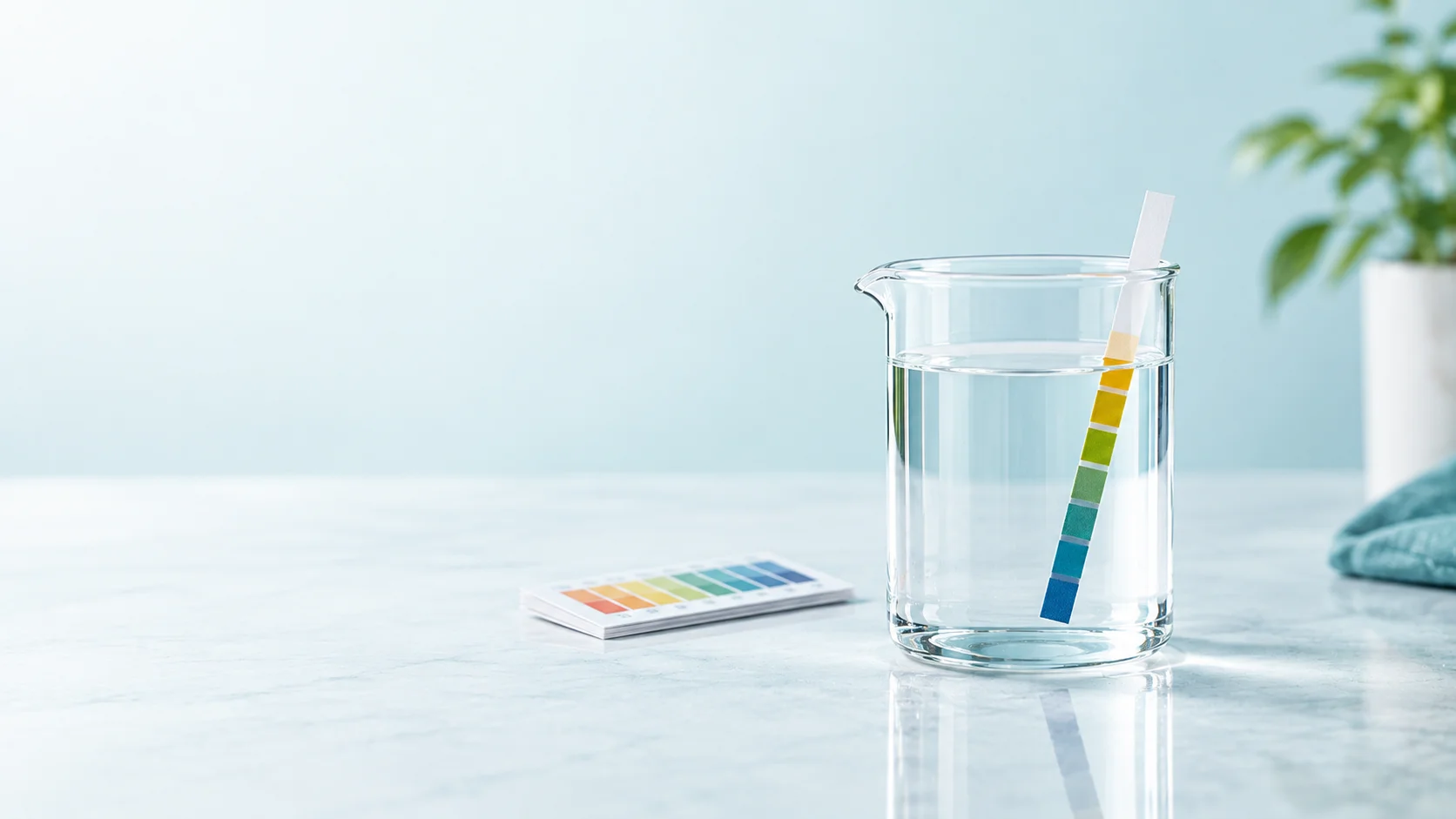
Pure water has a pH of 7.0 at 25 °C (77 °F), which is neutral — neither acidic nor basic. Real-world water rarely sits exactly there: clean rain is about 5.6, most US tap water falls between 6.5 and 8.5, and seawater runs around 8.1. The EPA's recommended range for drinking water is 6.5 to 8.5. Because the pH scale is logarithmic, every whole number is a tenfold change in acidity, so water at pH 6 is ten times more acidic than water at pH 7.
Is your water corrosive or scale-forming? Langelier Saturation Index Calculator Open →What pH actually measures
pH is a measure of how acidic or basic water is, and underneath the number it's a count of ions. Water molecules constantly split and re-form: a small fraction break into a hydrogen ion (H+) and a hydroxide ion (OH−). When the two are in balance, the water is neutral. Add something that releases extra hydrogen ions — carbon dioxide, for instance, which forms carbonic acid — and the water turns acidic. Add something that soaks them up or releases hydroxide, like dissolved limestone, and it turns basic (alkaline).
The scale runs from 0 to 14. Below 7 is acidic, 7 is neutral, and above 7 is basic. That's why pH is one of the first things measured in any water test: it's a quick read on whether the water's chemistry is shifting, and it controls how aggressively water dissolves the metals and minerals it touches.
Why the scale is logarithmic
Hydrogen ion concentrations in water are tiny and span an enormous range, so pH compresses them into a friendly number using a base-10 logarithm:
The practical upshot: pH differences multiply, they don't add. Going from 7 to 6 means ten times more hydrogen ions; from 7 to 5 means a hundred times more. Water at pH 6 and water at pH 8 look only two points apart, but one is 100 times more acidic than the other.
| pH | H+ (mol/L) | Acidity vs. neutral water | Everyday example |
|---|---|---|---|
| 2 | 10−2 | 100,000× more acidic | Lemon juice (~2) |
| 4 | 10−4 | 1,000× more acidic | Acid rain (~4.2–4.4) |
| 5 | 10−5 | 100× more acidic | Black coffee (~5) |
| 6 | 10−6 | 10× more acidic | Distilled water left open to air (~5.5–6) |
| 7 | 10−7 | Neutral | Pure water at 25 °C |
| 8 | 10−8 | 10× less acidic | Seawater (~8.1) |
| 10 | 10−10 | 1,000× less acidic | Milk of magnesia (~10.5) |
| 12 | 10−12 | 100,000× less acidic | Household ammonia (~11–12) |
pH of common waters
Almost no water you meet is exactly neutral, because almost all of it carries dissolved gases and minerals. Here's where the common types typically land:
| Type of water | Typical pH | Why |
|---|---|---|
| Pure water, freshly made (25 °C) | 7.0 | Ions in perfect balance |
| Distilled or RO water, exposed to air | ~5.5–6 | Absorbs CO2, no minerals to buffer it |
| Normal rain | ~5.6 | Atmospheric CO2 forms carbonic acid |
| Acid rain | 4.2–4.4 | Sulfur and nitrogen pollutants |
| US tap water | Usually 6.5–8.5 | Adjusted by utilities to limit corrosion |
| Private well water | Varies widely | Depends on the local rock and soil |
| Seawater | ~8.1 | Buffered by dissolved carbonate |
| Swimming pool (target) | 7.2–7.8 | Balances comfort and chlorine strength |
The pattern is worth noticing. Water with few dissolved minerals — rain, distilled water, water from granite or sandstone aquifers — tends to be acidic, because nothing neutralizes the carbon dioxide it picks up. Water that has soaked through limestone carries dissolved carbonate, which acts as a buffer and holds the pH at or above neutral.
Clean rain
~5.6
Slightly acidic from dissolved carbon dioxide — normal, not pollution.
Drinking water guideline
6.5–8.5
The EPA's recommended range for public water supplies.
Pool water target
7.2–7.8
Comfortable on skin and eyes while keeping chlorine effective.
Seawater
~8.1
Mildly basic, held steady by the ocean's large carbonate buffer.
Why pure water isn't always pH 7
"Neutral equals 7" is only exactly true at 25 °C. Heat makes water molecules split into ions more readily, so hot water holds more hydrogen and more hydroxide ions. The neutral point moves down as temperature rises — but the water doesn't become acidic, because the two ion types stay in equal numbers.
| Temperature | Neutral pH |
|---|---|
| 0 °C / 32 °F | ~7.47 |
| 25 °C / 77 °F | 7.00 |
| 50 °C / 122 °F | ~6.63 |
| 100 °C / 212 °F | ~6.14 |
This matters when you test. A reading taken on hot water isn't directly comparable to one taken cold, which is why good pH meters include automatic temperature compensation and why lab results note the temperature of the sample.
The right pH for drinking water
The EPA recommends a pH of 6.5 to 8.5 for drinking water. It sits among the agency's secondary standards — non-enforceable guidelines that address taste, staining and corrosion rather than direct health effects. Water slightly outside that range isn't poisonous in itself.
The real risk is what pH does to your pipes. pH controls how easily water dissolves metals such as lead and copper. Acidic water can pull these out of pipes, solder and brass fittings — and that dissolved metal, not the acidity, is the health concern. If your water tests low, test for lead and copper too.
Utilities usually run their water at the upper end of the range for exactly this reason. Slightly alkaline water is less aggressive toward plumbing, and in many systems it helps a thin protective mineral layer form on the inside of pipes.
Problems with low and high pH
Low pH (below about 6.5)
Acidic water is corrosive. The telltale signs are blue-green stains on sinks and tubs (dissolved copper), a bitter or metallic taste, and, over years, pinhole leaks in copper pipe. Water heaters and fixtures wear out faster. Low pH is most common in private wells drawing from mineral-poor rock and in homes using reverse osmosis without a remineralizing stage.
High pH (above about 8.5)
Alkaline water tends to deposit rather than dissolve. Expect scale on fixtures, in kettles and inside water heaters, along with a slippery feel and a flat, soda-like taste. High pH also weakens chlorine: the germ-killing form, hypochlorous acid, gives way to the much weaker hypochlorite ion as pH climbs, with roughly half of each around pH 7.5. That's why pools and treatment plants watch pH so closely.
Whether a given water will actually corrode or scale depends on more than pH alone — calcium, alkalinity, dissolved solids and temperature all play in. The Langelier Saturation Index pulls those together into one number:
pH vs. alkalinity vs. hardness
These three get confused constantly, and mixing them up leads to the wrong fix. They're related but measure different things:
| Property | What it measures | Typical units |
|---|---|---|
| pH | How acidic or basic the water is right now | 0–14 scale |
| Alkalinity | How well it resists a change in pH (buffering) | mg/L as CaCO3 |
| Hardness | Dissolved calcium and magnesium | mg/L or grains per gallon |
A useful way to picture it: pH is where the water sits; alkalinity is how hard it is to push it somewhere else. Low-alkalinity water swings easily, so a little carbon dioxide can drop its pH sharply. High-alkalinity water barely moves. And "alkaline" (high pH) is not the same as "high alkalinity" — water can have a pH of 8 with very little buffering behind it.
How to test your water's pH
Three methods cover almost every need. Test strips are cheap and fast but only read to about half a pH unit. Liquid drop kits are a step up in precision. A digital pH meter reads to 0.1 or better, but only if you look after it. For a reliable result:
- Calibrate first. Calibrate a meter against buffer solutions — pH 7 plus pH 4 or 10 — before each testing session.
- Run the cold tap briefly. Let water that has been sitting in the pipes clear out so you sample what's actually coming in.
- Test right away. Carbon dioxide escapes from a sample as it sits, which can shift the reading within minutes to hours.
- Note the temperature. Use temperature compensation if your meter has it, and compare readings taken at similar temperatures.
- Repeat. Take two or three readings and trust the consistent ones, not a single outlier.
If you're on a private well or see signs of corrosion, a certified lab test is worth the cost. It reports pH alongside alkalinity, hardness and metals, which is exactly what you need to choose a treatment.
How to fix low or high pH
On city water, start with your utility: its annual water quality report lists the pH it maintains, and a problem at your tap may point to something in your own plumbing. On a private well, the fix depends on how far off the water is.
Mildly acidic water is usually treated with an acid-neutralizing filter packed with calcite (crushed calcium carbonate), which dissolves slowly as water passes through and raises the pH. It adds some hardness in the process, so a softener may follow. More strongly acidic water typically needs a chemical feed system that injects a neutralizing solution such as soda ash. High pH is less common and often traces back to the aquifer or to a treatment step; it's usually managed with careful acid dosing or by adjusting the equipment causing it. In each case, retest after installation to confirm the new level.
A note on "alkaline" drinking water: bottled or ionized water at pH 8–10 is safe to drink, but there's little solid evidence it offers health benefits for most people. Stomach acid is strongly acidic, so the water's pH is neutralized soon after you swallow it.
The bottom line
pH tells you how acidic or basic water is on a logarithmic 0–14 scale, with 7 as neutral at room temperature. Pure water is 7, rain is about 5.6, and good drinking water sits between 6.5 and 8.5. Outside that band, the practical problems are corrosion on the low side and scale on the high side — and the biggest health concern is low-pH water dissolving lead and copper from plumbing. Test with a calibrated method, read pH together with alkalinity and hardness, and you'll know whether your water needs treatment at all.
Frequently asked questions
What is the pH of pure water?
Pure water has a pH of 7.0 at 25 °C (77 °F), which is neutral. In practice, pure water left open to the air absorbs carbon dioxide and drifts down to roughly 5.5–6 within hours, and the neutral point itself shifts slightly with temperature.
What is a safe pH for drinking water?
The EPA recommends keeping drinking water between pH 6.5 and 8.5. That is a non-enforceable guideline aimed at taste, staining and corrosion rather than a direct health limit. The main health concern with low pH is that it can dissolve lead and copper from plumbing.
Is distilled water acidic?
Slightly, once it has been exposed to air. Distilled and reverse-osmosis water have almost no minerals to buffer them, so dissolved carbon dioxide forms a little carbonic acid and pulls the pH down to roughly 5.5–6. It is harmless to drink, but it can be mildly corrosive to metal plumbing.
Is alkaline water better for you?
There is no strong evidence that alkaline water improves health for most people. Your stomach is strongly acidic, so water at pH 8–10 is neutralized soon after you drink it. Water within the normal 6.5–8.5 range is perfectly suitable for drinking.
Why does my well water have low pH?
Groundwater often picks up carbon dioxide from soil and passes through rock with little limestone to neutralize it, leaving it mildly acidic. Blue-green stains on fixtures, a metallic taste and pinhole leaks in copper pipe are the usual signs. A calcite neutralizing filter or a chemical feed system can raise it.
Does boiling water change its pH?
Only a little. Boiling drives off dissolved carbon dioxide, which can nudge the pH of tap water slightly upward. Hot pure water also has a lower neutral point — about 6.1 at 100 °C — but it is still neutral, not acidic, because hydrogen and hydroxide ions stay in balance.
Sources & references
The reference values in this guide follow these authoritative sources:
- U.S. Geological Survey, Water Science School — pH and Water. The 0–14 scale with 7 as neutral, the tenfold change per pH unit, and pH's effect on the solubility of metals such as lead and copper.
- U.S. Environmental Protection Agency — Secondary Drinking Water Standards: Guidance for Nuisance Chemicals. The non-enforceable 6.5–8.5 pH guideline and its effects on taste, corrosion and scale.
- U.S. Environmental Protection Agency — What is Acid Rain? Normal rain at a pH of about 5.6 and acid rain typically between 4.2 and 4.4.

Water Quality & Sustainability Specialist · Portland, Oregon
Sarah leads the water quality, treatment and sustainability guides on Water Calculator, translating lab numbers into practical decisions for households. Read full bio
MS · Specializes in water quality, water treatment and water usage