Dishwasher vs Hand Washing: Which Saves More Water?
A standard dishwasher cycle runs on a few gallons. Washing the same load by hand can use several times that — or barely more, depending entirely on technique. Here's what the numbers actually show.
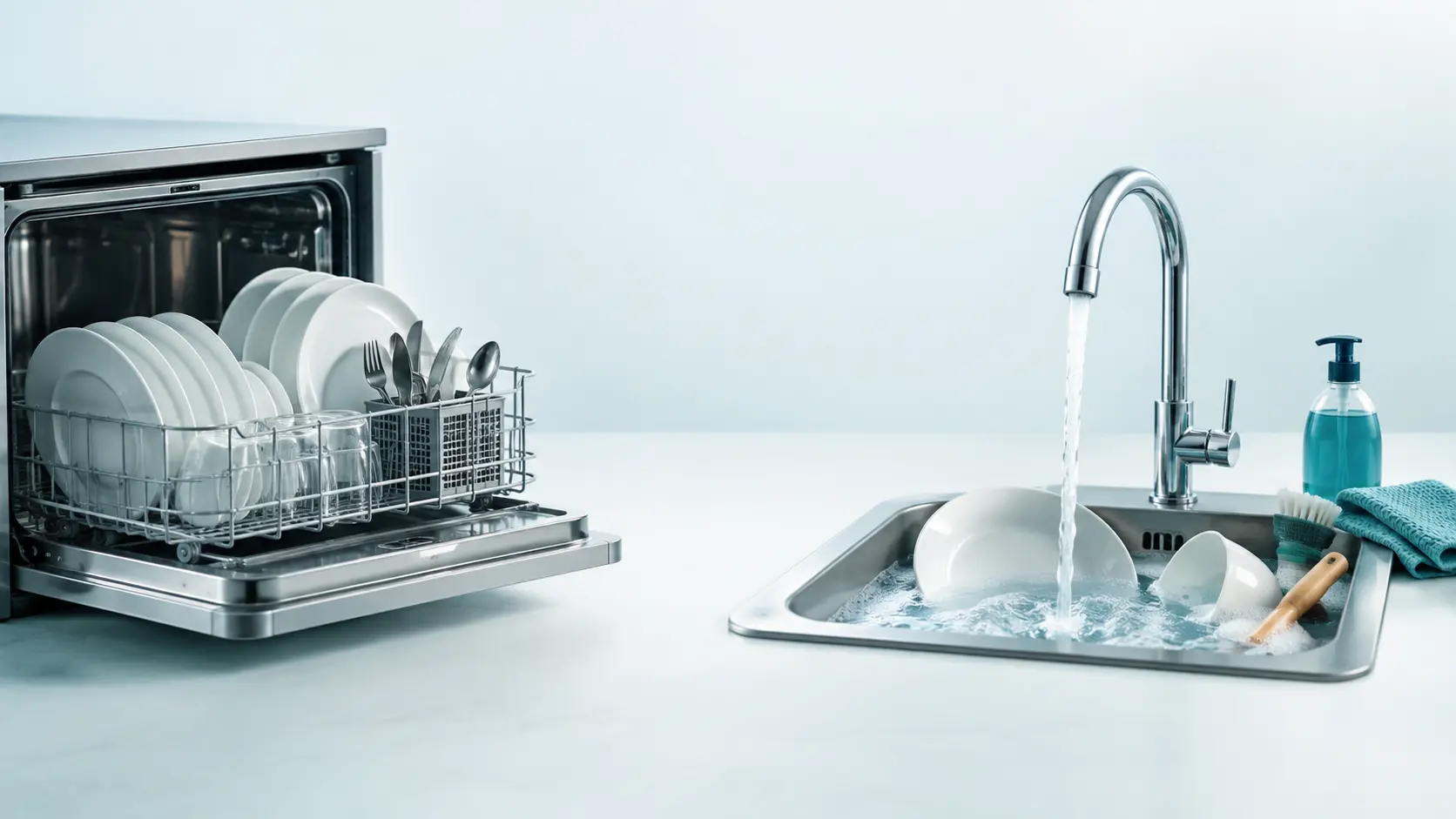
A dishwasher almost always wins. A standard ENERGY STAR certified dishwasher uses 3.2 gallons (about 12 liters) per cycle or less, while washing a full sink-load by hand has been measured using anywhere from roughly 5 to 86 gallons (19 to 325 liters) — the huge range coming almost entirely from technique, not the dishes themselves. Wash carefully with a stoppered basin and you can get close to a dishwasher's number. Rinse everything under a running tap and you can use ten times more water than the machine does.
Compare your own numbers Dishwasher vs. Hand Washing Calculator Open →Water use compared: dishwasher vs. hand washing
Here's how the two methods stack up per full load, using standard reference figures for machine efficiency and published research on hand-washing behavior:
| Method | Water per load (gallons) | Water per load (liters) |
|---|---|---|
| ENERGY STAR certified dishwasher (standard size) | 3.2 gal or less | 12 L or less |
| Federal minimum-standard dishwasher | 5.0 gal | 19 L |
| Older dishwasher (pre-efficiency standards) | ~10 gal (estimate) | ~38 L (estimate) |
| Hand washing, efficient basin technique | ~5 gal (estimate) | ~19 L (estimate) |
| Hand washing, typical to running-tap technique | up to 86 gal | up to 325 L |
The dishwasher rows come from EPA WaterSense efficiency criteria. The hand-washing range comes from a University of Bonn laboratory study that timed and metered 75 volunteers washing an identical 140-item load — the same dishes, wildly different water use, depending entirely on how each person worked.
Rows marked "estimate" are rough figures for context, not values quoted directly from a named source.
Why the gap is so large
A dishwasher's water use is fixed by design: a set number of spray-arm cycles fill, spray and drain a known volume, regardless of who's operating it. Hand washing has no such ceiling. The moment a tap is left running "just to rinse," water use stops being a function of how dirty the dishes are and becomes a function of habit.
That's the core finding from the Bonn research: the same 140 pieces of hardened-on food came out clean whether the volunteer used 5 gallons or 86, but the washers who used a stoppered basin for washing and a quick dip (or a second basin) for rinsing used dramatically less than those who let the tap run continuously through the whole process.
The dishwasher isn't just smaller-scale hand washing. It also reuses water within a cycle — the same water is pumped and re-sprayed across multiple wash phases — which is a big part of why a fixed few gallons can clean a full load that would take many more gallons of single-pass hand rinsing.
Hand-washing technique changes everything
If you hand wash, the single biggest lever isn't soap, water temperature, or how dirty the dishes are — it's whether the tap runs continuously. Two people washing the identical load can differ by a factor of ten or more:
- Running-tap method. Water flows the entire time, for both washing and rinsing. This is the least efficient approach and the one responsible for the high end of the range above.
- Single-basin method. One basin of soapy water for washing, then a quick rinse under a briefly-opened tap. A meaningful improvement over running water throughout.
- Two-basin method. One basin for washing, a second basin of clean water for rinsing, tap used only to refill. This is the technique behind the lowest measured water use in the Bonn study, and the closest hand washing gets to matching a dishwasher.
What this looks like over a year
Per-cycle gallons are easy to shrug off; annual totals are harder to ignore. A rough way to scale a single load up to a year:
ENERGY STAR puts a number on the comparison directly: it estimates that a new ENERGY STAR certified dishwasher saves about 8,400 gallons of water a year versus washing the same dishes by hand.
ENERGY STAR dishwasher
3.2 gal
or less per cycle, under the certification criteria in effect since 2023.
Federal minimum
5.0 gal
per cycle — the baseline every new dishwasher sold in the US must meet or beat.
Worst-case hand wash
86 gal
measured for one load, run continuously under a tap start to finish.
Annual savings
8,400 gal
a year, switching from hand washing to a certified dishwasher, per ENERGY STAR.
When hand washing still makes sense
The comparison above assumes a full dishwasher load against a full sink-load washed by hand — and that assumption matters. A dishwasher's efficiency is a per-load number: run it half-empty and the water-per-dish figure gets much worse, sometimes worse than an efficient hand wash of the same few items.
Hand washing tends to make more sense when:
- You only have a few items and running a mostly-empty dishwasher would waste the cycle's water on nearly nothing.
- You don't have a dishwasher at all — a camper, a small apartment, or a rental — in which case the two-basin technique is the main tool available to you.
- An item isn't dishwasher-safe and needs hand washing regardless of the water-use comparison.
In every one of these cases, the basin method described above is what keeps hand washing competitive.
Beyond water: energy and sanitizing
Water use isn't the only difference. ENERGY STAR notes that dishwashers can heat water to about 140°F, hotter than most people can comfortably keep their hands in at the sink, which improves germ removal compared with a typical hand wash. Dishwashers also use less energy overall: heating a smaller, contained volume of water inside an insulated machine is generally more efficient than heating water at the tap for an extended hand-washing session.
None of that means hand washing is unsafe — it just means the sanitizing and energy advantages both tend to favor the machine, on top of the water advantage.
Getting the most from either method
If you use a dishwasher: only run it full. Skip the pre-rinse under the tap — scrape food off instead — since modern machines are designed to handle scraped-not-rinsed dishes, and pre-rinsing quietly adds back much of the water the machine was designed to save.
If you hand wash: use the two-basin method whenever you can, scrape rather than rinse before washing, and save the dirtiest items for last so your wash water stays usable longer.
The bottom line
For a full load, a dishwasher is very likely to use less water than hand washing — often by a wide margin, and the manufacturer's own comparison points to about 8,400 gallons saved a year. The exception is technique: a careful two-basin hand wash can close most of that gap, and for a handful of dishes, hand washing (done efficiently) usually beats running a mostly-empty machine. Want the numbers for your own household? The calculator below runs it for your load size and habits.
Frequently asked questions
Does running a dishwasher really use less water than washing by hand?
In almost every case, yes. A standard ENERGY STAR certified dishwasher uses 3.2 gallons (about 12 liters) per cycle or less, while a full sink-load washed by hand has been measured using anywhere from about 5 to 86 gallons, depending on technique. Even careful hand washers with a stoppered basin rarely beat a modern dishwasher; anyone washing under a running tap uses far more.
How many gallons does an average dishwasher use per cycle?
Current ENERGY STAR certified standard-size dishwashers are capped at 3.2 gallons per cycle, and the federal minimum efficiency standard for new dishwashers sold in the US is 5.0 gallons per cycle. Older dishwashers, especially those made before the mid-1990s, typically used quite a bit more.
How can I hand wash dishes more efficiently to save water?
Fill one basin with hot soapy water for washing and, if you rinse, a second basin or a quick dip rather than a continuously running tap. Scrape food off first instead of rinsing it away, and wash the least-soiled items first so the water stays usable longer. This basin method is what let the most efficient hand washers in published research get close to dishwasher-level water use.
Do older dishwashers use more water than washing by hand?
It's possible, though less common than the reverse. Dishwashers made before water-efficiency standards tightened could use considerably more per cycle than today's machines, which can put them closer to or above an efficient hand wash. It's one reason replacing a very old dishwasher can cut water use even before you touch a faucet.
Does a dishwasher get dishes cleaner than hand washing?
Generally yes, on sanitizing. ENERGY STAR notes that dishwashers can heat water to about 140°F, hotter than most people can comfortably tolerate at the sink, which improves germ removal compared with typical hand washing temperatures.
How much water can I save per year by switching to a dishwasher?
ENERGY STAR estimates that a new ENERGY STAR certified dishwasher saves about 8,400 gallons of water a year compared with washing the same dishes by hand. Actual savings depend on how many loads you run and how you currently hand wash.
Is it worth running a half-empty dishwasher instead of hand washing a few dishes?
Usually not. A dishwasher's low per-cycle water use assumes a full load; running it half-empty for just a few items wastes most of that efficiency. For a handful of dishes, a quick basin wash or holding them until the next full load typically uses less water overall.
Sources & references
The figures in this guide follow standard reference values for dishwasher efficiency and published research on hand-washing water use:
- U.S. EPA WaterSense — Dishwashers Tech Sheet. ENERGY STAR certified dishwashers use 3.2 gallons per cycle or less, at least 30% below the federal standard of 5.0 gallons per cycle.
- ENERGY STAR — Dishwashers. A new ENERGY STAR certified dishwasher saves about 8,400 gallons of water a year versus hand washing, and can heat water to about 140°F for improved disinfection.
- University of Bonn dishwashing research, as reported in Arizona Water Resource, University of Arizona Water Resources Research Center (July–August 2003) — Human Dishwashers' Water Efficiency Studied. 75 volunteers hand washing an identical 140-item load used between about 5 and 86 gallons of water.

Water Quality & Sustainability Specialist · Portland, Oregon
Sarah covers water usage, treatment and conservation guides on Water Calculator, focusing on practical ways households can cut water use without sacrificing results. Read full bio
MS, Water Quality & Sustainability · Specializes in usage, treatment and conservation