How Much Water Does a Garden Hose Use?
A garden hose uses about 10 gallons a minute when it runs wide open. Here's how that changes with hose size, pressure and nozzle — and what it means for your water bill.
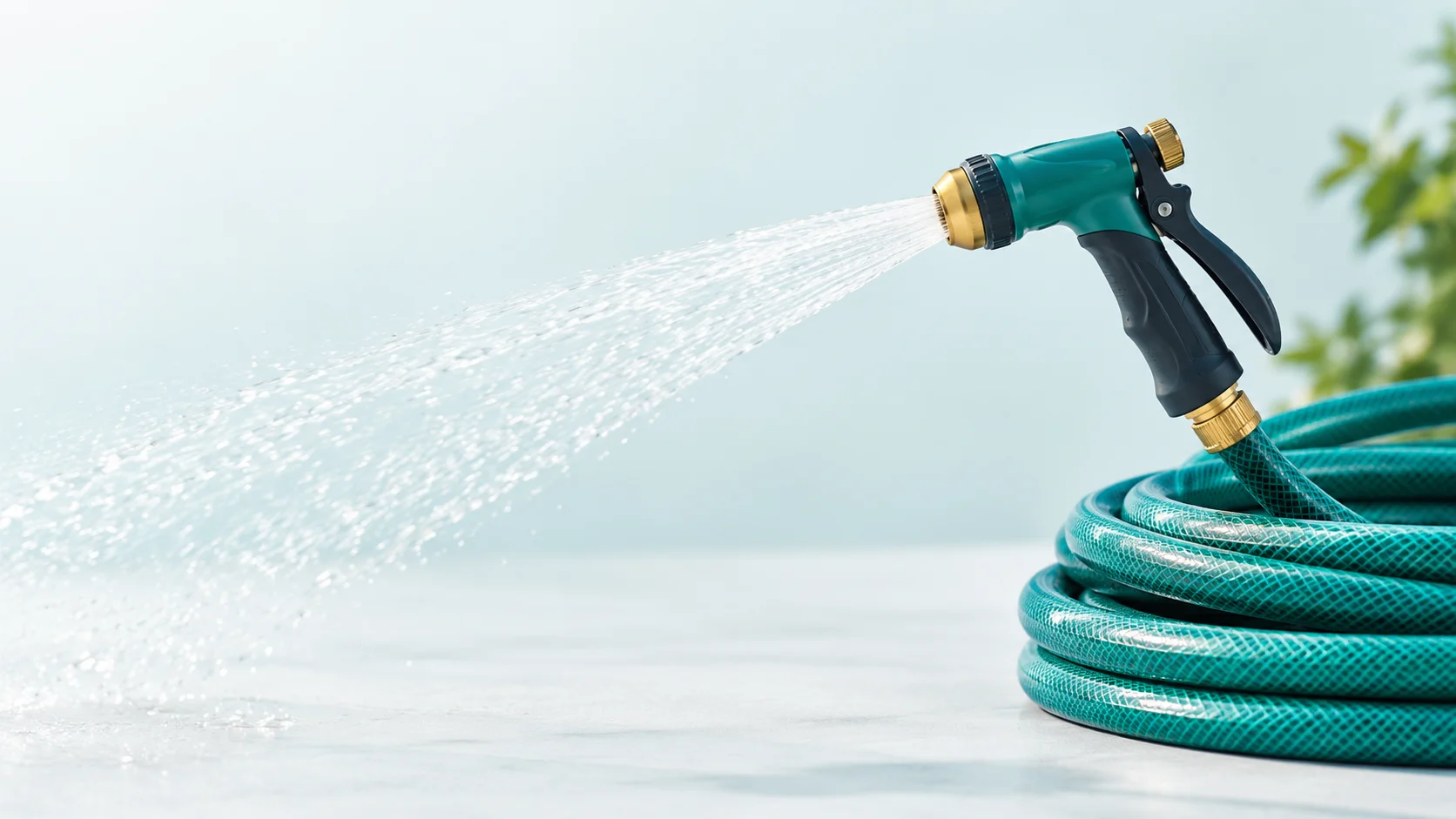
A typical garden hose uses about 10 gallons per minute when it runs wide open — roughly 600 gallons an hour. Real flow ranges from around 5 gpm for a long, narrow hose to 15 gpm or more for a short, wide one on strong pressure, and fitting a nozzle or sprinkler usually brings it down. Because a hose can only pass what your spigot and pipes supply, the surest way to know your own number is a 30-second bucket test, covered below. Here's the full picture: flow by hose size, gallons by time, what common jobs use, what it costs, and how to cut waste.
Skip the math Garden Hose Water Usage Calculator Open →Garden hose water use at a glance
For planning, treat a standard 5/8-inch hose at normal household pressure as a 10 gpm device. Here is what that looks like over time:
| Run time | Gallons | Liters |
|---|---|---|
| 1 minute | 10 gal | 38 L |
| 1 hour | 600 gal | 2,271 L |
| 8 hours (overnight) | 4,800 gal | 18,170 L |
| 24 hours | 14,400 gal | 54,510 L |
Those numbers are larger than most people expect. The hose isn't doing anything unusual — a wide-open tap simply moves a lot of water, and it keeps moving it for as long as it's on. Time, more than any other factor, decides how much you use.
Flow rate by hose size
Inside diameter is the biggest hardware variable. A wider bore gives water more room to move and loses less energy to friction, so flow climbs quickly as hose size goes up:
| Hose inside diameter | Flow (gpm) | Flow (L/min) | Gallons per hour |
|---|---|---|---|
| 1/2 inch | 5–8 | 19–30 | 300–480 |
| 5/8 inch (standard) | 8–14 | 30–53 | 480–840 |
| 3/4 inch | 10–18 | 38–68 | 600–1,080 |
A 5/8-inch hose has about 56% more cross-sectional area than a 1/2-inch hose, and because friction falls off sharply as the bore widens, the real-world gain is often larger than the area alone suggests. The ranges overlap because pressure, length and the tap matter as much as the hose.
Your tap sets the ceiling. A hose can't deliver more than the spigot and the pipe behind it can supply. If your 5/8-inch hose flows 7 gpm while a neighbor's flows 12, supply pressure and pipe size are the usual reason — not the hose.
How much water a hose uses over time
Gallons used is just flow multiplied by time. This table covers three flow rates that span most setups: a long or restricted hose (5 gpm), a typical hose (10 gpm), and a short, wide hose on strong pressure (15 gpm).
| Run time | At 5 gpm | At 10 gpm | At 15 gpm |
|---|---|---|---|
| 1 minute | 5 gal | 10 gal | 15 gal |
| 5 minutes | 25 gal | 50 gal | 75 gal |
| 10 minutes | 50 gal | 100 gal | 150 gal |
| 15 minutes | 75 gal | 150 gal | 225 gal |
| 30 minutes | 150 gal | 300 gal | 450 gal |
| 1 hour | 300 gal | 600 gal | 900 gal |
| 2 hours | 600 gal | 1,200 gal | 1,800 gal |
For scale, EPA puts the average American family's use at more than 300 gallons a day at home. One 30-minute session with an open hose can match that on its own. And outdoor use is a big slice of the total: EPA reports it makes up more than 30 percent of household water use on average and as much as 60 percent in arid regions.
Work out your own hose's water use
Once you know your flow rate, the math is a single multiplication:
To find your gpm, run a bucket test. It takes two minutes and beats any chart, because it measures your actual tap, hose and fittings together:
- Remove any spray nozzle or sprinkler, and open the spigot fully.
- Time how many seconds the hose takes to fill a 5-gallon bucket.
- Divide 5 by that time in seconds, then multiply by 60.
Repeat the test with your nozzle or sprinkler attached to see what you really use while watering. If you'd rather not do the arithmetic, the garden hose water usage calculator turns flow and run time into gallons, liters and cost.
What changes how much water comes out
Water pressure. Higher supply pressure pushes more water through the same hose. Most homes sit somewhere around 40–60 psi, and flow drops when the line is shared — running a hose while someone showers can noticeably cut your output.
Hose diameter. As the table above shows, moving from 1/2 inch to 5/8 inch or 3/4 inch raises flow considerably. This is the single easiest hardware change if you need to fill things faster.
Hose length. Water loses pressure to friction along the hose, so a longer run delivers less at the far end. A 100-foot hose usually flows noticeably less than a 25-foot one on the same tap. The hose itself holds only a little water — about 1.6 gallons for 100 feet of 5/8-inch hose — so that fill-up is a minor, one-time amount.
Nozzles and sprinklers. Whatever sits on the end restricts flow. Trigger nozzles, wands and most hose-end sprinklers draw well below an open hose, commonly a few gallons per minute. Soaker hoses and drip lines use a fraction of that, and most consumer pressure washers use roughly 1.5 to 2.5 gpm. Check the label, or test with the accessory attached.
Kinks, worn fittings and clogs. A kink, a gummed-up washer or mineral buildup in an old hose can quietly cut flow. They lower the rate, not the total — if you simply run the hose longer to make up for it, you use the same water or more.
Slower flow doesn't mean less water. What matters is the total volume delivered. A gentle sprinkler running for two hours can use more than an open hose running for ten minutes. Judge a setup by gallons used, not by how forceful it feels.
Common real-world examples
These all assume about 10 gpm, and they're estimates rather than measured values:
Fill a 5-gallon bucket
30 sec
The same bucket you use for the flow test. Slower than 30 seconds means your flow is below 10 gpm.
Wash a car, hose running
~100 gal
Ten minutes with the hose left open. Shutting the nozzle between rinses cuts this substantially.
1 inch on a 1,000 sq ft lawn
623 gal
Delivering one inch of water takes about an hour of full 10 gpm flow, or two hours at 5 gpm.
12 ft round pool, 3 ft deep
~2,500 gal
Roughly four hours of continuous flow — so check on it rather than leaving the hose unattended.
Daily habits add up too. Hand-watering for 15 minutes a day at 10 gpm uses 150 gallons a day, or about 18,000 gallons across a 120-day watering season.
What hose water costs
Water prices vary a great deal by utility, and many use tiered rates where each extra block of water costs more. As an illustration only, here is the water cost at an assumed $5 per 1,000 gallons — substitute the rate from your own bill:
| Run time | Gallons | Cost |
|---|---|---|
| 10 minutes | 100 gal | $0.50 |
| 30 minutes | 300 gal | $1.50 |
| 1 hour | 600 gal | $3.00 |
| 8 hours | 4,800 gal | $24.00 |
A single session is cheap; a forgotten hose is not. Some utilities also add sewer charges tied to metered water, even though water used outdoors mostly doesn't reach the sewer, so it's worth checking whether yours treats outdoor use differently or offers a separate irrigation meter.
How to use less water with a hose
- Fit a shut-off nozzle. It stops flow whenever you pause, which matters most for washing cars, tools and patios.
- Set a timer. A kitchen timer or a simple hose-end timer prevents the most expensive mistake: leaving the water running.
- Water at the roots, early or late. Cooler hours and low-pressure soakers or drip lines reduce evaporation and runoff. EPA estimates that as much as half of outdoor water is lost to wind, evaporation and runoff from inefficient irrigation.
- Fix leaks at the spigot. A worn washer or loose connection can run unnoticed. Even a 1 gpm trickle wastes 1,440 gallons in a day.
- Measure, then adjust. Knowing your real gpm lets you set run times to deliver the depth of water plants need rather than guessing.
The bottom line
Plan on about 10 gallons per minute and 600 gallons per hour for a standard garden hose running open, with a realistic range of 5 to 15 gpm depending on hose size, length, pressure and what's on the end. Nozzles and sprinklers lower the rate, but run time decides the total. Do the bucket test once, multiply by minutes, and you'll know what any watering job really uses.
Frequently asked questions
How many gallons per minute does a garden hose use?
A typical 5/8-inch garden hose runs about 10 gallons per minute (gpm) wide open. Real flow ranges from roughly 5 gpm for a long, narrow hose to 15 gpm or more for a short, wide one on strong pressure, and a nozzle or sprinkler usually lowers it.
How much water does a garden hose use in an hour?
At about 10 gpm, a hose uses roughly 600 gallons (about 2,270 liters) in an hour. Across a realistic range of 5 to 15 gpm, that is about 300 to 900 gallons.
How much water does a garden hose use in 10 minutes?
About 100 gallons at 10 gpm, or somewhere between 50 and 150 gallons across the typical range. A 5-gallon bucket test will show where your own hose falls.
Does a longer hose use more water?
Not per minute. Friction inside a longer hose reduces flow, so a 100-foot hose usually delivers less than a 25-foot one on the same tap. A longer hose does hold a little water (a 100-foot, 5/8-inch hose holds about 1.6 gallons), but that is a one-time fill, not ongoing use.
How much water does a hose use if it is left on overnight?
At about 10 gpm, eight hours uses roughly 4,800 gallons. Even a slow 1 gpm trickle adds up to about 480 gallons over the same eight hours, or 1,440 gallons in a full day.
How do I measure my garden hose's flow rate?
Time how long the hose takes to fill a 5-gallon bucket, then divide 5 by the number of seconds and multiply by 60. A bucket that fills in 30 seconds means 10 gpm. Test with your spray nozzle or sprinkler attached to see what you actually use when watering.
Sources & references
Outdoor-use context comes from EPA WaterSense. Hose flow rates and cost figures in this guide are planning estimates derived from typical household conditions, not values taken from a single published source — measure your own hose for an exact figure.
- U.S. Environmental Protection Agency, WaterSense — Statistics and Facts. Outdoor water use share of household use, including arid regions, and estimated outdoor losses to wind, evaporation and runoff.
- U.S. Environmental Protection Agency, WaterSense — How We Use Water. Average American family water use at home and the indoor/outdoor split.

Water Quality & Sustainability Specialist · Portland, Oregon
Sarah is a water quality and sustainability specialist who writes the usage, cost, treatment and conservation guides on Water Calculator. Read full bio
MS · Specializes in water quality, treatment, sustainability and water usage