How to Do a Home Water Audit
A meter, a bucket and a stopwatch are enough to find where your home's water goes. Here's the step-by-step method, with the numbers to compare against.
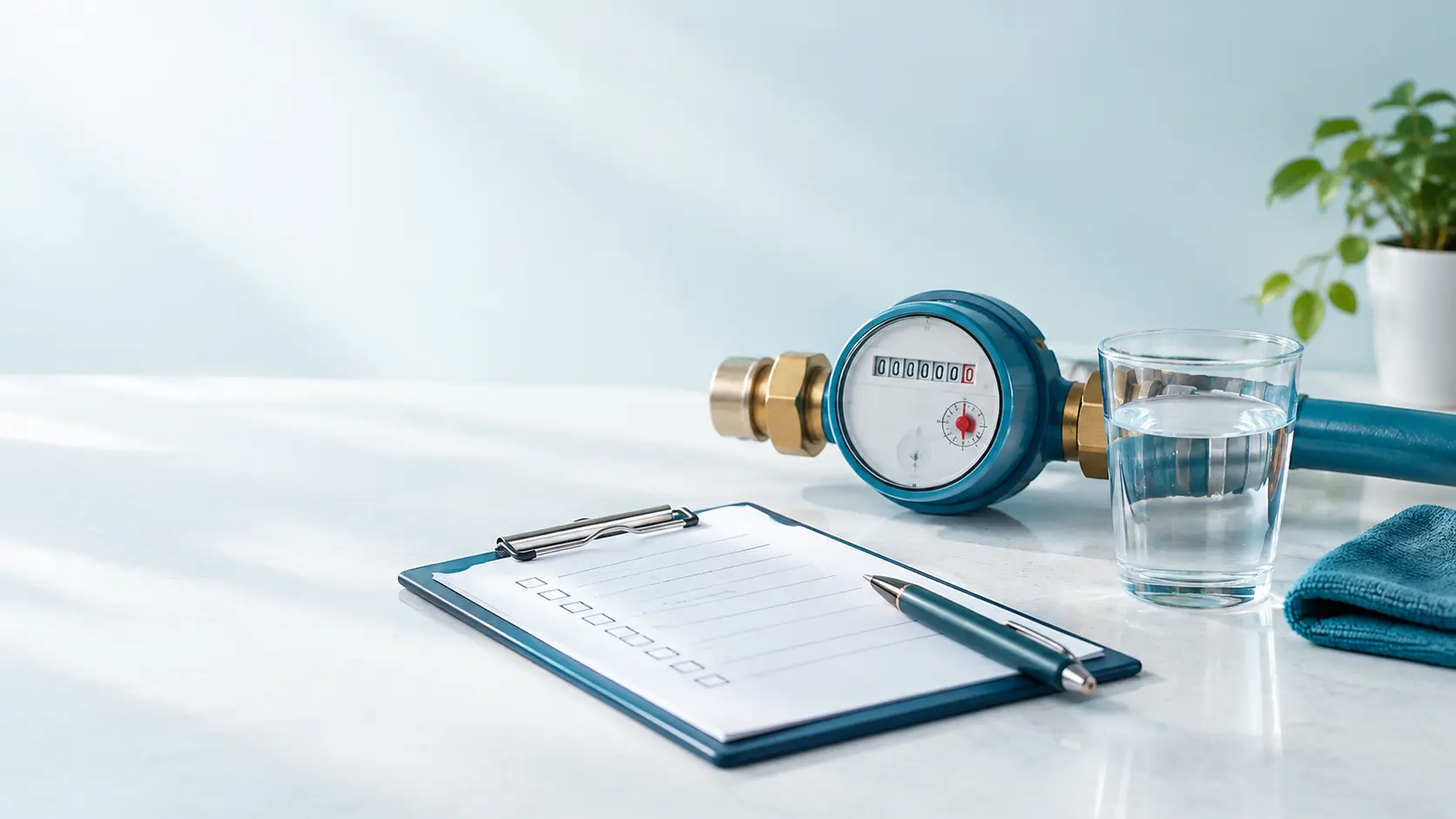
A home water audit is a short, structured check of where your water goes. Do it in six steps: set a baseline from your bills, test for hidden leaks with your meter, measure the flow of every faucet, showerhead and toilet, review your appliances, check outdoor use, then rank the fixes by gallons saved. It takes about an hour of hands-on work, needs only a bucket, a timer and a little food coloring, and very often turns up a leak or a fixture using far more water than it should.
Skip the guesswork Household Water Usage Calculator Open →The home water audit at a glance
Here is the whole audit on one page. Each step is explained below.
| Step | Main tool | Time (approx.) |
|---|---|---|
| 1. Baseline | 12 months of water bills | 15 min |
| 2. Leak hunt | Meter, food coloring | 10 min + 2 h idle |
| 3. Fixture flow | Bucket, timer | 15 min |
| 4. Appliances | Manuals, labels | 10 min |
| 5. Outdoors | Timer, straight-sided cans | 15 min |
| 6. Prioritize | Your notes | 10 min |
Keep a notepad or phone note open as you go. The audit only pays off if you write down what each check finds, because the last step is ranking those findings by how much water they waste.
Step 1: Set your baseline from your water bills
Your water bill is the cheapest data you own. Pull the last 12 months and record the usage and the number of days in each billing period. Utilities bill in gallons, thousands of gallons, or CCF — one CCF is 100 cubic feet, or about 748 gallons — so check the units first. Then work out daily use:
Now compare. USGS puts typical indoor use at about 80 to 100 gallons per person per day, so the example household above sits in the normal range. A figure far above that range is your first clue that something is leaking or running.
Winter bills are the most useful, because irrigation is usually off and the number reflects indoor use. EPA offers a simple benchmark: a family of four using more than 12,000 gallons a month in winter likely has a serious leak. Summer bills that run far above winter show how much your outdoor watering adds. Our household water usage calculator turns your bill into a per-person figure if you'd rather not do the arithmetic.
Check the units on your bill. Mixing up gallons, CCF and cubic feet is the most common baseline error. One cubic foot is about 7.48 gallons, so one CCF (100 cubic feet) is about 748 gallons.
Step 2: Hunt for leaks
Leaks are the cheapest water you will ever save, because repairing one gives all of it back without any change in habits. EPA estimates the average home wastes roughly 9,400 gallons a year to leaks, and about one home in ten leaks 90 gallons a day or more. Three quick tests find most of them.
The meter test
- Stop all water use: close taps, pause the ice maker and irrigation, and make sure the dishwasher, washer and softener are idle.
- Locate your meter, lift the lid, and write down the register reading. Note the position of the low-flow indicator, the small dial or triangle that spins when water moves.
- Wait two hours without using any water.
- Read the meter again. Any change, or a moving indicator, means water is escaping.
Meter moved? Narrow it down. Close the main shutoff valve at the house and check the indicator. If it stops, the leak is in your home's plumbing or fixtures. If it keeps moving, the leak is likely in the line between the meter and the house — call a plumber or your utility.
The toilet dye test
A worn flapper can leak silently for months. Add a few drops of food coloring to the tank (not the bowl), do not flush, and wait about 10 minutes. If color appears in the bowl, the flapper is leaking. Flush afterward to avoid staining the tank. Replacing a flapper is a low-cost repair, and EPA advises replacing flappers that are more than five years old.
The visual sweep
Check every place water passes through a fitting or hose:
- Under sinks, using a dry paper towel against the pipes and supply lines, since it shows moisture your eye misses.
- Behind each toilet, at the supply line and shutoff valve.
- Around the base of the water heater and at its relief-valve discharge pipe.
- At the washing machine hoses and dishwasher supply connection.
- At outdoor hose bibs, sprinkler valves and hose connections.
Stains, warped cabinet floors, a musty smell and unexplained damp spots are all signs of a slow leak. Once you find one, put a price on it with the water leak cost calculator, the running toilet cost calculator or the dripping faucet cost calculator.
Step 3: Measure fixture flow rates
Leaks are waste you can't see. Fixtures are waste you can measure. The bucket test gives you each fixture's true flow in gallons per minute (gpm), which is often different from what the box or your intuition says.
For a shower, hold a bucket marked in gallons under the head; a strong spray fills a 1-gallon jug too quickly to time accurately, so time a larger container. Do the same for each bathroom and kitchen faucet, then compare against current reference values:
| Fixture | Federal maximum | WaterSense label |
|---|---|---|
| Showerhead | 2.5 gpm | 2.0 gpm |
| Bathroom faucet | 2.2 gpm | 1.5 gpm |
| Toilet | 1.6 gal/flush | 1.28 gal/flush |
For toilets, look for the flush volume stamped in the tank or on the bowl (for example, “1.6 gpf”). Toilets made before the mid-1990s often use 3.5 gallons per flush or more, and USGS ranks toilet flushing as the single largest use of household water. If your showerhead measures well above 2.5 gpm, or a toilet is an old high-volume model, it goes near the top of your fix list. The shower flow rate calculator and faucet flow rate calculator help you check your readings, and the low-flow fixture savings calculator and toilet flush savings calculator estimate what an upgrade would save.
Step 4: Review appliances and hot water
Appliances rarely leak at the machine itself; the waste is in how they're run and how their connections are kept. Walk through each one:
- Clothes washer. Find the model's water use per load in the manual or on the label. Older machines use noticeably more than modern high-efficiency ones, and half-empty loads waste water regardless. See the washing machine water usage calculator.
- Dishwasher. Run it only when full. To settle the handwashing question for your own habits, use the dishwasher vs handwashing calculator.
- Water heater. Look for moisture at the base and at the relief-valve pipe. Then time how long a hot tap runs before the water turns warm; all the cold water in that wait goes down the drain, and insulating the first few feet of hot pipe shortens it.
- Water softener. If you have one, check how often it regenerates. Each cycle uses water, and an incorrectly set unit can regenerate more than it needs to. The regeneration frequency calculator shows a sensible schedule.
- Ice maker and humidifier. Small individually, but they run continuously. Check the ice maker and humidifier figures if you use either heavily.
Step 5: Check outdoor water use
Outdoor watering averages about 30% of household use nationally and is far higher in dry climates during summer, so it deserves its own check. Compare your summer and winter bills from Step 1 to see how large your outdoor share really is.
If you have an automatic irrigation system, run each zone by hand and watch for broken or missing heads, geysers, pooling water, and spray landing on pavement or siding. Then run a catch-can test: set four to six straight-sided cans across a zone, run a normal cycle, and measure the depth in each. Big differences between cans mean uneven coverage, which usually leads to overwatering the whole zone to rescue the driest spot. Finally, check that the controller's schedule matches the season, and look for drips at hose spigots and hose connections. Estimate what your watering costs with the sprinkler water cost calculator or the garden hose water usage calculator.
Step 6: Add it up and rank the fixes
For each problem you found, estimate the gallons wasted per year and what it would cost to fix, then work from cheap and high-impact to expensive and modest. In most homes the order comes out the same way: leaks first, then fixtures, then irrigation habits, then appliance replacement.
| Finding | Typical fix | Effort | Savings |
|---|---|---|---|
| Toilet leaking into the bowl | Replace flapper | Low | High |
| Dripping faucet | New washer or cartridge | Low | Low to medium |
| Showerhead above 2.0 gpm | Fit a WaterSense head | Low | Medium |
| Irrigation leaks or overspray | Repair heads, reset timer | Medium | High in summer |
| Old high-volume toilet | Replace the toilet | High | Medium to high |
| Meter moves with everything off | Call a plumber | Varies | Potentially very high |
What common findings are worth
These illustrative estimates show why small problems deserve attention. They are calculated from simple assumptions, not measured results:
1 gallon per hour
8,760 gal/yr
A leak too slow to notice: 1 gallon × 24 hours × 365 days.
Silent toilet leak
~52,600 gal/yr
A flapper leaking just 0.1 gallon per minute, which loses about 144 gallons a day.
Showerhead swap
~1,460 gal/yr
Going from 2.5 to 2.0 gpm saves 4 gallons in an 8-minute shower, at one shower a day.
Dripping faucet
3,000+ gal/yr
EPA notes that one drip per second can waste more than 3,000 gallons a year.
Common audit mistakes and when to call a plumber
- Testing with water still running elsewhere. An ice maker refilling or a softener regenerating during the meter test gives a false alarm.
- Putting dye in the bowl. The dye test only works when the coloring goes into the tank.
- Judging showers by feel. A strong-feeling shower isn't necessarily high-flow, and a weak one isn't necessarily efficient. Measure it.
- Relying on one month's bill. Use 12 months so seasonal swings don't mislead you.
- Skipping the re-check. After any repair, repeat the meter test to confirm the leak is gone.
Call a plumber if the meter still moves after you've ruled out fixtures and appliances, if you find damp patches in a slab floor or a lawn, or if your bill jumps without an obvious cause. Those signs point to a leak in buried or hidden pipe that a DIY check cannot fix.
The bottom line
A home water audit turns a vague suspicion that you use too much water into a short, ranked list of fixes. Start with your bills, run the meter test, dye-test the toilets, time your fixtures, glance over appliances and irrigation, and fix the cheap leaks first. Repeat the audit once a year, or any time your bill jumps, and it will keep paying for itself.
Frequently asked questions
How long does a home water audit take?
About an hour of hands-on work, plus a two-hour window for the meter leak test. Run that test during a quiet stretch — a morning when everyone is out, or overnight — so nothing uses water while you wait.
How do I know if I have a hidden leak?
Use the meter test. Turn off every water-using appliance, note the meter reading, wait two hours without using any water, then read it again. If the reading has changed, water is leaking somewhere. A toilet dye test and a quick check under sinks usually find the source.
How much water should my household use per day?
USGS estimates that the average person uses about 80 to 100 gallons per day for indoor home uses. For a household of four, that works out to roughly 320 to 400 gallons a day indoors. Use in the winter months, when irrigation is off, is the best comparison.
What is the biggest source of water waste in most homes?
Leaks are the easiest to eliminate, and toilets are the most common culprit — a worn flapper can leak silently for months. Among normal uses, USGS notes that flushing the toilet is the largest use of household water, followed by showers and baths.
How do I read my water meter?
Find the meter (usually near the curb, in a utility box, or where the main line enters the house), lift the lid, and read the register digits. Check whether it counts in gallons or cubic feet — one cubic foot is about 7.48 gallons. Most meters also have a small low-flow indicator, a dial or triangle that spins when even a trickle is passing through.
How often should I repeat a water audit?
Once a year is a good habit, and repeat the meter test any time your bill jumps without a clear reason, after a plumbing repair, or before irrigation season starts. Re-testing after a repair also confirms that the fix actually worked.
Sources & references
The reference values and test methods in this guide come from these public sources:
- U.S. EPA WaterSense — Statistics and Facts. Average household leak losses of about 9,400 gallons a year.
- U.S. EPA WaterSense — Fix a Leak Week. The two-hour meter check, the food-coloring toilet test, the 12,000-gallon winter benchmark for a family of four, and the one-drip-per-second leak estimate.
- U.S. Geological Survey, Water Science School — How much water do I use at home each day? Typical indoor use of 80–100 gallons per person per day, with toilets as the largest use.
- U.S. EPA WaterSense — Showerheads. WaterSense showerheads use no more than 2.0 gallons per minute.

Water Quality & Sustainability Specialist · Portland, Oregon
Sarah is a water quality and sustainability specialist who leads the usage, cost and conservation guides on Water Calculator. Read full bio
MS · Specializes in water quality, treatment and sustainability