Virtual Water: How Much Water Is in the Food You Eat?
Every meal carries a hidden water cost, from the rain that grows the feed to the irrigation behind the crop. Here's how much water goes into common foods, why beef towers over grain, and how to estimate your own plate.
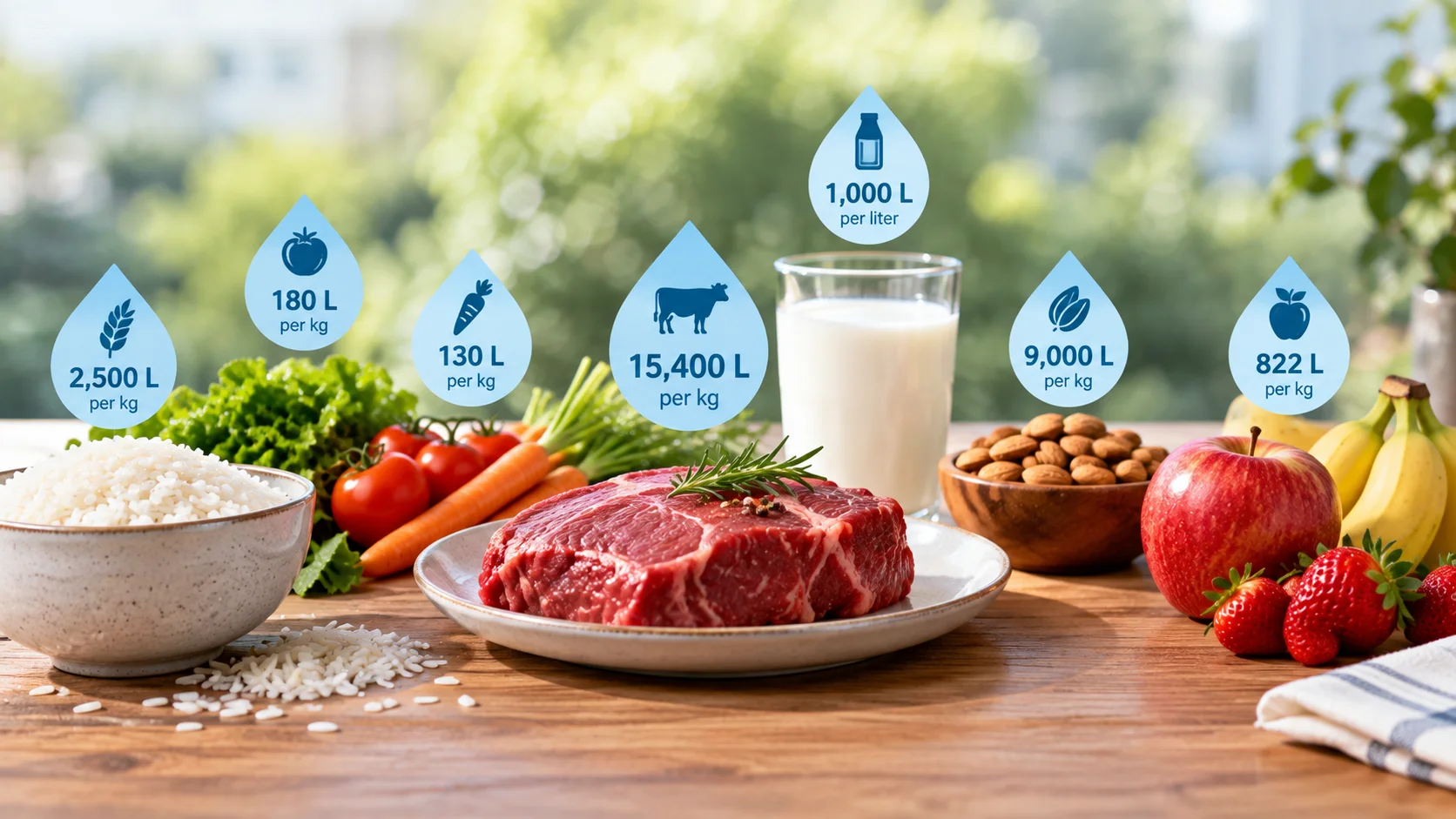
Virtual water is the total freshwater used to grow, process and deliver a food, counted even though you never see it in the finished product. A kilogram of beef carries about 15,400 liters (roughly 1,850 gallons per pound), a kilogram of wheat about 1,830 liters, and a kilogram of milk about 1,020 liters. Those figures dwarf the water that comes out of your tap, and the gap between foods is the most useful part. Here's what the numbers mean, where they come from, and how to estimate your own plate.
Skip the math Virtual Water Calculator Open →Virtual water at a glance
Researchers at the Water Footprint Network have published global average values for hundreds of foods. These are the ones people ask about most:
| Food | Liters per kg | US gallons per lb |
|---|---|---|
| Beef | about 15,400 | about 1,850 |
| Pork | about 6,000 | about 720 |
| Cheese | about 5,060 | about 605 |
| Chicken | about 4,300 | about 515 |
| Eggs | about 3,300 | about 395 |
| Wheat | 1,827 | about 220 |
| Rice (paddy) | 1,673 | about 200 |
| Maize (corn) | 1,222 | about 145 |
| Milk | about 1,020 | about 120 |
| Banana | about 860 | about 105 |
Read the table by ratio, not by absolute value. Beef needs roughly eight times the water of wheat for the same weight, and about three and a half times that of chicken. Weight isn't the whole story, though: a kilogram of beef delivers far more protein than a kilogram of wheat, so researchers also compare footprints per calorie and per gram of protein. Animal foods still come out higher on both measures.
The gallons-per-pound column is my own unit conversion of the liters-per-kilogram figures (1 kg = 2.205 lb, 1 gal = 3.785 L), rounded. It is not a value published by the source.
Green, blue and grey water
A single footprint number hides three very different kinds of water, and they matter in different ways:
- Green water is rain that soaks into soil and is taken up by plants. It's the largest share for most crops and for pasture-fed animals.
- Blue water is surface water or groundwater, such as rivers, lakes and aquifers, drawn for irrigation, livestock drinking and food processing.
- Grey water is the freshwater needed to dilute pollution from fertilizer and pesticide runoff down to acceptable quality standards.
Beef is a good illustration. Roughly 94% of its footprint is green water used to grow feed, and only a small fraction is blue. Wheat splits differently: about one-fifth of its footprint is irrigation (blue) water, which is why wheat and rice together account for a large share of the world's irrigation use.
Why the color matters. A liter of rain that would have fallen on the field anyway is not the same as a liter pumped from a dwindling aquifer. The total footprint tells you how thirsty a food is. The blue share, and where it's drawn from, tells you how much pressure it puts on local supplies.
What a serving costs in water
Per-kilogram numbers are hard to picture, because nobody eats a kilogram of cheese. Scaled to a normal serving, they look like this:
| Serving | Approx. liters | Approx. US gallons |
|---|---|---|
| 4 oz (113 g) beef | roughly 1,740 | roughly 460 |
| 4 oz (113 g) chicken | roughly 490 | roughly 130 |
| 1 oz (28 g) cheese | roughly 140 | roughly 37 |
| 1 cup (240 mL) milk | roughly 250 | roughly 66 |
| 1 large egg (50 g) | roughly 165 | roughly 44 |
| 1 medium banana (120 g) | roughly 105 | roughly 27 |
These are estimates that I derived by multiplying serving weight by the per-kilogram averages. The scale is the point: a palm-sized beef portion carries a footprint in the hundreds of gallons, while a banana sits near thirty.
Why animal foods use more water
The reason is the feed. A beef animal typically eats grain, hay and pasture for around three years before slaughter, and each kilogram of that feed took water to grow. Drinking water and barn cleaning are real but small, since feed accounts for the overwhelming majority of the footprint. The total is then divided by a modest yield of meat.
Eating plants directly skips that conversion. A bushel of grain fed to cattle first passes through the animal's growth, maintenance and waste, and only a fraction comes out as meat. That is also why species matter: pigs and chickens turn feed into meat more efficiently and live shorter lives, so their footprints sit well below beef's. Dairy and eggs fall in between.
Work out your own plate
The math is a single multiplication. Weigh or estimate the food, then multiply by its footprint per kilogram:
For US units, divide liters by 3.785 to get gallons. Add up each ingredient to get a whole meal. The virtual water calculator does the lookup and conversion for you, so you only need to enter foods and portions.
Why the numbers vary
Every figure here is a global average, and real footprints swing widely around it. Four factors do most of the work:
- Climate. Hot, dry regions need more irrigation per unit of crop than temperate ones.
- Yield. Higher yields spread the same water over more food, so productive farms often have lower footprints per kilogram.
- Production system. Grass-fed, mixed and feedlot beef draw on feed and water very differently, so a single beef figure covers a huge range.
- Processing. Turning crops into flour, milled rice or cheese adds water and removes mass, which raises the footprint per kilogram of the final product.
That is why a given country or farm can land far above or below the average. Use these values to compare foods and see scale. Don't treat them as a measured value for a specific meal.
Real-world examples
Putting servings side by side makes the differences easier to remember:
4-oz beef patty
~460 gal
About 1,740 L, an estimate from the global beef average.
4-oz chicken breast
~130 gal
About 490 L. Swapping chicken for beef saves roughly 330 gallons.
Cup of milk
~66 gal
About 250 L from a global average of roughly 1,020 L per kg.
Banana
~27 gal
About 105 L, among the lighter footprints on a typical plate.
The bottom line
Virtual water explains why food dominates a person's real water footprint. Beef sits at the top at roughly 1,850 gallons per pound, with pork, cheese, chicken and eggs in the middle and grains, fruit and milk lower. The biggest swing in your own footprint comes from how often animal foods, especially beef, are on the plate, followed by how much food gets thrown away. When you want numbers for your own meals, the calculator above will total them in seconds.
Frequently asked questions
What is virtual water?
Virtual water is the total volume of freshwater used to produce a food or product, counted across growing, processing and supply. It is “virtual” because you can’t see it in the finished item. Researchers also call it a product’s water footprint.
How much water does it take to produce a pound of beef?
Roughly 1,850 gallons per pound, based on a global average of about 15,400 liters per kilogram. About 94% of that is rain-fed “green” water used to grow feed, so it is not all water pumped from rivers or wells.
Why does beef need so much more water than chicken or grain?
A beef animal eats feed for years before slaughter, and every pound of feed took water to grow. That feed water is spread over a modest amount of meat. Chickens and pigs convert feed faster, and grains skip the animal step entirely.
Is virtual water the same as the water I use at home?
No. Household water is what comes through your taps. Virtual water is the water embedded in the things you buy. For most people the food-related total is many times larger than their tap use.
Does a high virtual water number mean the water was wasted?
Not necessarily. Much of it is green water, meaning rainfall that soaked into soil and would have fallen anyway. The footprint matters most when it is blue water (irrigation, rivers, aquifers) drawn from a place that is already short of it.
Can I trust these numbers for the food I buy?
Treat them as global averages, not exact values. The footprint of the same food can differ several-fold by climate, farming system and yield. They are best used to compare foods and spot big differences, not to claim a precise figure for one meal.
Sources & references
The per-kilogram figures in this guide are global averages from the Water Footprint Network research series. Per-serving and per-pound values are my own conversions and estimates.
- Mekonnen, M.M. and Hoekstra, A.Y. (2011), The green, blue and grey water footprint of crops and derived crop products, Hydrology and Earth System Sciences 15. Global averages of 1,827 m³/ton for wheat and 1,222 m³/ton for maize.
- Mekonnen, M.M. and Hoekstra, A.Y. (2010), The green, blue and grey water footprint of farm animals and animal products, Value of Water Research Report 48. Source for the global beef average of 15,415 L/kg and the animal-product comparison.
- Hoekstra, A.Y. (2008), The water footprint of food. Defines a product's water footprint as its virtual water content and lists banana at 860 L/kg.

Water Quality & Sustainability Specialist · Portland, Oregon
Sarah is a water quality and sustainability specialist who writes the usage, conservation and sustainability guides on Water Calculator. Read full bio
MS · Specializes in water usage, quality and sustainability