What Is a Water Footprint and How Do You Calculate It?
Your water footprint is the freshwater behind everything you use and eat — most of it hidden. Here's what it measures, how big it typically is, and how to work out your own.
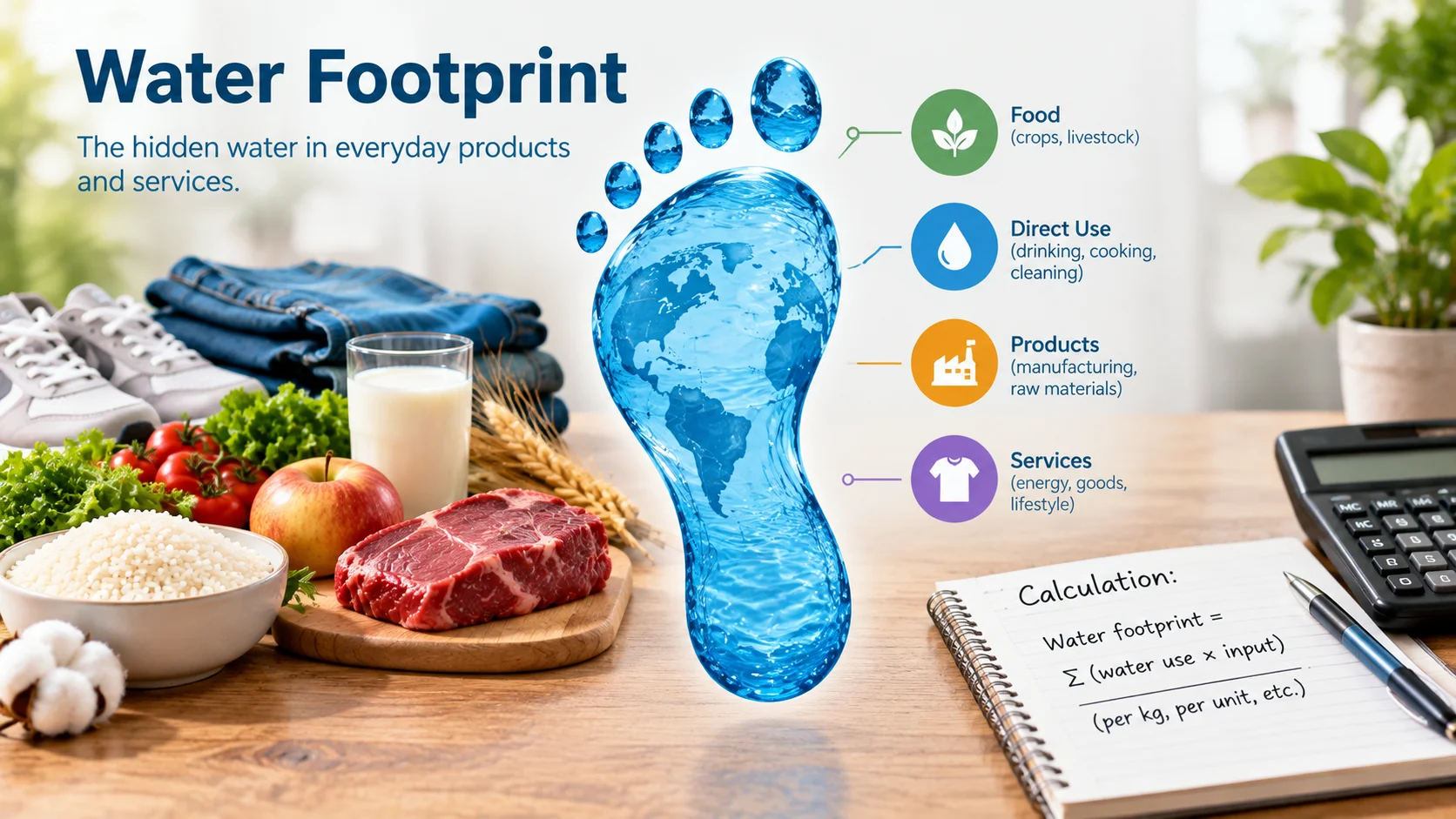
A water footprint is the total volume of freshwater used to produce everything a person, household or country consumes — the water you use directly at home plus the water embedded in the food, clothes and products you buy. It's measured as a volume (liters, gallons or cubic meters), usually per year, and split into three types: blue (surface and groundwater), green (rainwater held in soil) and grey (water needed to dilute pollution). For most people the water on the utility bill is the smallest part of the picture; the bulk is hidden in what they eat.
Skip the math Water Footprint Calculator Open →The three types: blue, green and grey
The water footprint framework was developed by the Water Footprint Network, and it's the standard way to account for water along a supply chain. Rather than one lump figure, it separates water by where it came from and what happened to it:
Blue water
Surface water and groundwater that is evaporated, built into a product, or moved from one water body to another. Irrigation, industry and household supply all carry a blue footprint.
Green water
Rainfall stored in the root zone of the soil that plants then transpire or incorporate. It matters most for crops, pasture and forestry.
Grey water
The volume of freshwater needed to dilute pollutants until the water meets quality standards. It measures pollution, not water taken.
The grey footprint is the one people find strangest, because no water is "used up" in the usual sense. It's a notional volume. The Water Footprint Network's method calculates it from the pollutant load and the gap between the maximum acceptable concentration and the natural concentration in the receiving water:
Globally, the footprint of humanity splits roughly 74% green, 11% blue and 15% grey. Green dominates because agriculture dominates, and most crops are fed by rain.
A big footprint is not automatically a big drain on rivers and aquifers. Green water is rain that would have fallen anyway, while blue water is pumped or diverted. The two don't carry the same local consequences, which is why the colors are reported separately.
Direct vs. indirect, internal vs. external
Two more splits help you read any footprint figure.
Direct vs. indirect. Your direct footprint is the water you use yourself: showers, toilets, laundry, the garden hose. Your indirect footprint is the sum of the water footprints of every product you consume, from breakfast to a new pair of jeans. The direct part is visible on your bill. The indirect part never is.
Internal vs. external. A country's internal footprint is the water drawn from its own resources. The external footprint is water used abroad to make goods it imports. About one-fifth of the global footprint relates to production for export, so a country can lean heavily on other places' water without any of it showing in its own supply statistics.
How to calculate a water footprint
At its core, the calculation is an inventory: add what you use directly to what is embedded in what you consume.
In practice, work through it in four steps:
- Get your direct use. Read the gallons on your water bill and scale to a year. For a household, divide by the number of people.
- List what you consume. Food is the biggest category for most people, so start with how much meat, dairy, eggs, grains, produce and drinks you buy.
- Apply a footprint per unit. Use published per-kilogram values, such as those in the next section, for each item.
- Add it up. Multiply, sum, and convert units if you want gallons or cubic meters. If your data allows, keep blue, green and grey separate.
Here is the direct side for a household of four using about 300 gallons a day, the figure the EPA gives for an average American family at home. These are rough estimates, not source figures:
Now the indirect side. This sample week of animal products shows how fast it grows, using the global-average footprints from the next section:
| Item | Amount | Footprint (L/kg) | Estimated liters |
|---|---|---|---|
| Beef | 0.5 kg | 15,400 | 7,700 |
| Chicken | 1 kg | 4,300 | 4,300 |
| Eggs | 12 (≈0.72 kg) | 3,300 | ≈2,400 |
| Cow's milk | 3.5 L (≈3.6 kg) | 1,000 | ≈3,600 |
| Total | ≈18,000 L |
About 4,750 US gallons for the week, from just four foods. The egg weight (60 g each) and milk density (about 1.03 kg/L) are assumptions used for the conversion.
Compare that with the roughly 520 gallons of direct household water the same person uses in a week (27,000 ÷ 52). The food alone is several times larger. To run your own numbers without a spreadsheet, the water footprint calculator does the multiplication for you.
Water footprints of common foods
Per-unit footprints are what make the indirect calculation possible. These global averages for animal products come from the research behind the Water Footprint Network's data. One cubic meter per metric ton is the same as one liter per kilogram:
| Product | Liters per kg | US gallons per lb (est.) |
|---|---|---|
| Beef | 15,400 | ≈1,850 |
| Sheep meat | 10,400 | ≈1,250 |
| Pork | 6,000 | ≈720 |
| Goat meat | 5,500 | ≈660 |
| Chicken | 4,300 | ≈515 |
| Eggs | 3,300 | ≈395 |
| Cow's milk | 1,000 | ≈120 |
The spread is the point. Most of an animal product's footprint is the water used to grow its feed, so animals that convert feed to meat less efficiently carry bigger numbers. The same research found that, per calorie, beef's footprint is about twenty times that of cereals and starchy roots, and per gram of protein it is about six times that of pulses.
These are averages. The same product can have a much larger or smaller footprint depending on where and how it is produced, so treat any single figure as a starting point rather than a verdict on one purchase.
How big is a typical footprint?
The most-cited per-person numbers come from a study of the period 1996 to 2005. They are older but remain the standard benchmark:
Global average consumer
1,385 m³/yr
Roughly 366,000 US gallons a year, or about 1,000 gallons a day (converted estimate).
Average US consumer
2,842 m³/yr
Roughly 750,000 US gallons a year, or about 2,050 gallons a day (converted estimate).
Share from agriculture
92%
Of the global footprint. Cereals (27%), meat (22%) and milk products (7%) lead what the average consumer eats.
Average family at home
300+ gal/day
Direct household use per the EPA, with about 30% of it outdoors nationally.
Put side by side, those numbers say something useful: a household's direct water use is small next to the footprint of the things it consumes. Rough arithmetic puts direct use at under 4% of the US per-person figure, though the two numbers come from different sources and years, so treat that ratio as an order of magnitude.
What moves your footprint the most
Because the indirect share dominates, the biggest levers are about what you buy, not how long you shower.
- Diet. Meat and dairy are major contributors, and beef is the heaviest. Replacing some beef with chicken, eggs or plant proteins cuts a footprint more than almost any household fixture.
- Food waste. Food you throw away carries all the water used to grow it. Buying and cooking closer to what you eat is a footprint saving.
- Buying less, keeping things longer. Clothing, paper and other manufactured goods embed water too, so durability and reuse lower the indirect total.
- Home use. Fixing leaks and trimming outdoor watering still matters, especially for blue water and your bill, even if it is a small slice of the whole footprint.
What the number can and can't tell you
A footprint is a useful accounting tool, but it has limits worth knowing before you act on one.
It's a volume, not an impact. A liter of blue water pumped from a stressed aquifer does far more harm than a liter of rain on a wet region's pasture. The same total can mean very different things in different places.
Methods differ. The blue-green-grey approach used here is the volumetric method. A separate standard, ISO 14046, assesses water-related environmental impacts and weights for local scarcity. Its results are not interchangeable with volumetric figures, so don't compare one against the other.
Benchmarks age. Per-person averages describe past consumption patterns, and product footprints vary by region and farming practice. Use them for scale and direction, not precision.
The bottom line
A water footprint is the full freshwater cost of how you live: what you use directly plus everything embedded in what you consume. It's built from blue, green and grey water, calculated by multiplying consumption by per-unit footprints, and typically dominated by food. The global average consumer sits at about 1,385 cubic meters a year and the average American at about 2,842. If you want to shrink yours, start with diet and waste, and use the numbers for direction rather than exact scores.
Frequently asked questions
What is a water footprint?
A water footprint is the total volume of freshwater used to produce the goods and services a person, household or country consumes. It counts the water you use directly at home plus the water embedded in the food, clothing and products you buy, and it is usually reported in liters, gallons or cubic meters per year.
What are blue, green and grey water footprints?
Blue water is surface water and groundwater that is consumed, such as irrigation or tap water. Green water is rainfall stored in the soil and used by plants. Grey water is the volume of freshwater needed to dilute pollution enough to meet water quality standards.
What is the average water footprint per person?
In a widely cited study covering 1996 to 2005, the global average consumer had a footprint of about 1,385 cubic meters per year, and the average US consumer about 2,842 cubic meters per year. That is roughly 366,000 and 750,000 US gallons per year, converted from the study's figures. Diet and consumption patterns drive most of the gap.
How do you calculate your water footprint?
Add your direct water use, taken from your water bill, to your indirect use. Indirect use is the amount of each product you consume multiplied by that product's water footprint per unit, such as liters per kilogram of food. Sum everything over the same period, usually one year.
Why do foods like beef have such large water footprints?
Most of an animal product's footprint comes from growing feed, not from the water the animal drinks. Beef is the extreme case: the global average is about 15,400 liters per kilogram, and per calorie it is roughly twenty times that of cereals and starchy roots.
Is a water footprint the same as water use?
No. Water use usually means the water you draw from a tap or meter. A water footprint is broader: it adds the water consumed and polluted in producing everything you buy, which for most people is far larger than the water on their bill.
Sources & references
The definitions and reference figures in this guide come from the Water Footprint Network and peer-reviewed research. Conversions to gallons and weekly totals are our own estimates:
- Water Footprint Network — What is a water footprint? Definitions of the green, blue and grey water footprints, and of direct and indirect footprints.
- Hoekstra, A.Y. & Mekonnen, M.M. (2012), The water footprint of humanity, PNAS 109(9). Global average consumer 1,385 m³/y; average US consumer 2,842 m³/y; global footprint 74% green, 11% blue, 15% grey; agriculture 92%.
- Mekonnen, M.M. & Hoekstra, A.Y. (2012), The green, blue and grey water footprint of animals and animal products. Global-average footprints for beef, sheep, pig, goat, chicken, eggs and milk.
- U.S. EPA WaterSense — How We Use Water. Average American family uses more than 300 gallons per day at home; outdoor use is about 30% nationally.

Water Quality & Sustainability Specialist · Portland, Oregon
Sarah covers water quality, treatment, sustainability and water usage on Water Calculator, turning technical research into practical, plain-language guides. Read full bio
MS · Specializes in water quality, sustainability and water usage