Where Does Your Home's Water Actually Go?
The average home uses more than 300 gallons a day. Here's how that divides between toilets, showers, laundry, leaks and the lawn, and where a household can realistically cut.
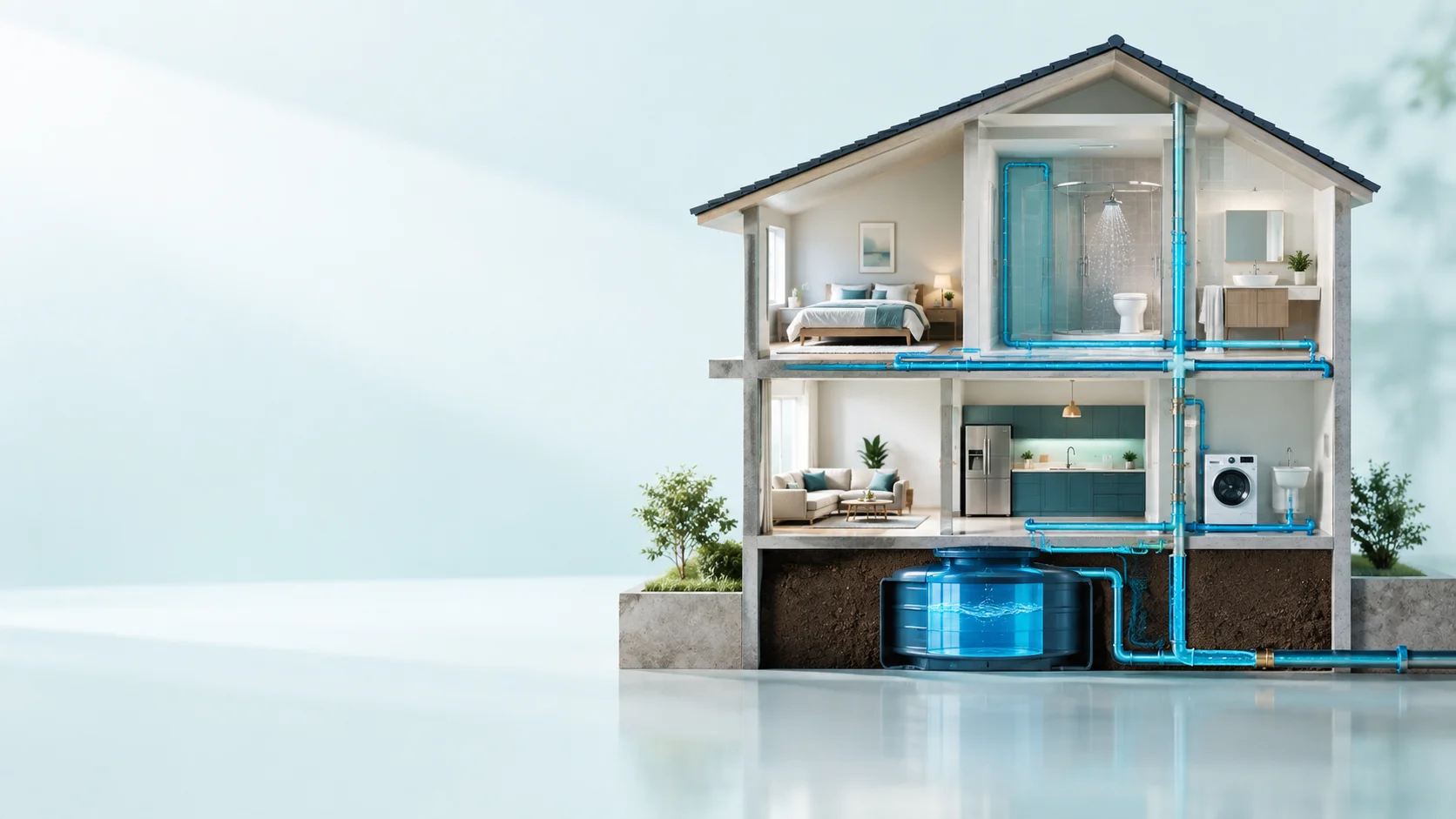
The average American family uses more than 300 gallons of water a day at home, and roughly 70 percent of it is used indoors, according to the EPA. Inside the house, the biggest single use is toilet flushing (about 24 percent), followed by showers (20), faucets (19), clothes washers (17) and leaks (12). Outdoors, watering the lawn and garden takes most of the remaining 30 percent nationally, and far more in dry climates. Here is the full breakdown, why it looks the way it does, and how to find out where your own home's water goes.
Skip the math Household Water Usage Calculator Open →Home water use at a glance
Household water use is easiest to reason about in a handful of numbers. Note that some describe a whole household and one describes a single person, so they are not directly comparable.
| Measure | Typical figure |
|---|---|
| Whole household, per day | 300+ gal |
| Share used indoors | ~70% |
| Share used outdoors (national average) | ~30% |
| Per person, per day | ~82 gal |
| Average household leak loss, per year | 9,300+ gal |
The spread between homes is wide. Occupancy, fixture age, climate and irrigation each move the total. In the arid West, landscape irrigation pushes per-person residential use among the highest in the country. Treat 300 gallons as a midpoint, not a target.
Where indoor water goes
The most detailed picture comes from metering studies that log flow at individual fixtures. The Water Research Foundation's Residential End Uses of Water study (Version 2, 2016) did this in single-family homes and found average indoor use of about 138 gallons per household per day. This is how it divided:
| Indoor use | Share of indoor use | Gallons per household per day |
|---|---|---|
| Toilets | 24% | 33.1 |
| Showers | 20% | 28.1 |
| Faucets | 19% | 26.3 |
| Clothes washers | 17% | 22.7 |
| Leaks | 12% | 17.0 |
| Baths | 3% | 3.6 |
| Dishwashers | 1% | 1.6 |
| Other | 4% | 5.3 |
| Total | 100% | ≈138 |
Two patterns stand out. Bathroom uses (toilets, showers, faucets and baths) add up to about two-thirds of indoor water. And leaks, at 12 percent, use more water than dishwashers, baths and miscellaneous uses combined.
A snapshot, not a scorecard. Those shares are a 2016 average. A newer update to the study (Version 3) documents further declines in indoor use as toilets, showers and washers have become more efficient. A home with new fixtures will use less than the table suggests, and one with an old toilet or a leaking flapper will use more. Use the shares as a map of where to look.
Why toilets, showers and faucets lead
Every fixture's share comes from two things: how often it runs and how much water each run uses. The leaders win in different ways.
Toilets win on frequency
Everyone flushes several times a day, so even a modest per-flush volume adds up. Current US standards cap new toilets at 1.6 gallons per flush, and WaterSense-labeled models use 1.28 or less. Older toilets used 3.5 gallons per flush or more, well over twice as much as a WaterSense model. That is why toilet replacement is one of the highest-impact upgrades in an older house.
Showers win on volume per use
New showerheads are federally limited to 2.5 gallons per minute, and WaterSense-labeled models to 2.0. At 2.5, a 10-minute shower uses about 25 gallons; at 2.0, about 20. For four people showering once a day, that 5-gallon difference is roughly 7,300 gallons a year.
Faucets and appliances
Faucets are the quiet third: dozens of short uses a day, from brushing teeth to rinsing dishes to filling a pot. Federal standards limit bathroom faucets to 2.2 gallons per minute, and WaterSense models to 1.5. Clothes washers use a large volume per load, so load count and machine age matter most. Dishwashers barely register at about 1 percent, because a modern machine uses little water per cycle. That is why the dishwasher versus handwashing comparison often favors the machine.
Where the hot water goes
Hot water is a subset of the same picture. The 2016 study found that hot water made up about a third of indoor use, roughly 45 gallons per household per day. Showers accounted for about 39 percent of that hot water and faucets about 34 percent. Clothes washers took about 10 percent. Toilets used essentially none. So the fixtures that matter most for your water heater's energy use are not the same ones that matter most for your total gallons.
Leaks: the use nobody chose
The EPA says the average household's leaks waste more than 9,300 gallons a year, and that about 9 percent of homes have leaks losing 50 gallons or more per day. The usual culprits are worn toilet flappers, dripping faucets and leaking valves. The 12 percent leak share in the table above and the EPA's annual figure come from different studies and methods, so expect them to differ, but both point the same way. Leaks are common, and most are cheap to fix. The EPA estimates that fixing easy leaks can save about 10 percent on a water bill.
Two checks find most problems:
- The meter test. Stop all water use, note the meter reading, wait two hours without using any water, and read it again. Any change means a leak somewhere.
- The winter bill test. Winter is when outdoor watering is at its lowest. The EPA suggests that a family of four using more than 12,000 gallons a month in winter likely has a serious leak.
For toilets specifically, add a few drops of food coloring to the tank and wait about 10 minutes without flushing. If color shows up in the bowl, the flapper is not sealing. The water leak cost calculator puts a price on what a leak like that is costing you.
Outdoor use: the swing factor
Nationally, about 30 percent of household water is used outdoors, but that average hides enormous variation. A condo with no yard has almost none. A large home with a lawn in a dry climate may use more water outside than in. Outdoor water is also the least efficient, since it evaporates, blows off target or runs off the surface. The EPA estimates that as much as 50 percent of outdoor water is lost this way with inefficient irrigation, and that an automatic system that isn't maintained properly can waste up to 25,000 gallons a year.
You can estimate your own outdoor share from your bills. Compare a summer month with a winter month. The difference is a rough measure of what goes to the yard, since indoor use changes little through the year. The sprinkler water cost calculator can turn that into dollars.
Real-world reference points
Benchmarks make your own numbers easier to judge:
Family of four
~330 gal/day
An estimate from 4 people × 82 gallons each, or about 10,000 gallons a month.
Winter leak threshold
12,000 gal/month
The EPA's warning level for a family of four. That is about 400 gallons a day.
Average household leaks
9,300+ gal/yr
Roughly 25 gallons a day quietly going down the drain.
Toilet replacement
13,000 gal/yr
What the EPA estimates an average family saves by replacing all old, inefficient toilets with WaterSense models.
Work out your own household's numbers
Your water bill already has the data. Check which unit it uses. Many utilities bill in gallons, but others use CCF (hundred cubic feet), where 1 CCF is about 748 gallons. Then divide:
For example, take a household of 3 with a 30-day bill of 8 CCF. That is 8 × 748 = 5,984 gallons, or about 199 gallons per day, or about 66 gallons per person per day. That is below the national average of about 82. If the same bill showed 16 CCF, the per-person figure would double to about 133, and a leak or heavy irrigation would be the first things to check.
For a fixture-by-fixture estimate rather than a bill-level one, the household water usage calculator lets you enter your own showers, flushes and loads and returns daily, monthly and yearly totals.
Where cutting pays off first
Because use is concentrated, savings are too. In rough order of payoff per dollar:
- Fix leaks. A flapper or washer costs a few dollars, and the water is wasted around the clock.
- Replace old toilets. The largest indoor use, and the one where old and new models differ most. The toilet water usage calculator shows the difference for your household.
- Upgrade showerheads and faucet aerators. Cheap, quick and easy to reverse. The low-flow fixture savings calculator estimates what you would save.
- Tune irrigation. Fix misaligned heads, water in the cooler part of the day and match schedules to the season.
The bottom line
A typical home uses more than 300 gallons a day. Indoors, toilets, showers, faucets and laundry account for most of it, with leaks a surprisingly large 12 percent in the 2016 study. Outdoors, the yard can matter more than everything inside the house. The averages are useful for orientation, but the number that counts is yours. Check the meter, do the bill math, and start with whichever of leaks, toilets, showers or irrigation the numbers point to.
Frequently asked questions
How much water does the average home use per day?
The EPA says the average American family uses more than 300 gallons of water per day at home, and roughly 70 percent of it is used indoors. Per person, that works out to an average of about 82 gallons per day, though your own figure depends on household size, fixtures and how much you water outdoors.
What uses the most water in a house?
Indoors, toilets are the largest single use at about 24 percent, followed by showers (20 percent) and faucets (19 percent). Outdoors, irrigation can be much larger than the 30 percent national average in dry regions, and there it can become the biggest single use of all.
How much water does a family of four use per month?
At the national average of about 82 gallons per person per day, a family of four uses roughly 330 gallons a day, or about 10,000 gallons a month. That is an estimate, not a benchmark. The EPA suggests that a family of four using more than 12,000 gallons a month in winter probably has a leak.
How can I tell if I have a water leak?
Turn off every fixture and appliance, note your water meter reading, and check it again after two hours. If the reading has changed at all, water is going somewhere. For toilets, add a few drops of food coloring to the tank and wait about 10 minutes without flushing. Color in the bowl means the flapper is leaking.
Is my water use high compared with the average?
Divide your household's daily use by the number of people living there and compare it with about 82 gallons per person per day. Homes with older toilets, long showers, frequent laundry or automatic sprinklers usually land above it. Homes with efficient fixtures and no irrigation often land well below it.
Which uses more water, a shower or flushing the toilet?
Per use, a shower takes far more: about 25 gallons for 10 minutes at 2.5 gallons per minute, versus 1.6 gallons or less for a flush. But a person flushes many more times per day than they shower, so toilets edge out showers overall, at about 24 percent of indoor use versus 20 percent.
Sources & references
The figures in this guide come from federal and industry research on household water use. Totals we worked out ourselves, such as monthly figures and per-day conversions, are labeled as estimates.
- U.S. EPA WaterSense — How We Use Water. Average family use of more than 300 gallons per day, roughly 70 percent indoors and 30 percent outdoors nationally.
- U.S. EPA WaterSense — Fix a Leak Week. Household leak losses, the 12,000-gallon winter benchmark and the two-hour meter test.
- U.S. EPA WaterSense — Statistics and Facts. Per-person use of 82 gallons per day (citing USGS), toilet-replacement savings and outdoor water losses.
- Water Research Foundation — Residential End Uses of Water: Version 2 (2016), its executive report (indoor end-use shares and hot-water figures), and the newer Version 3.

Water Quality & Sustainability Specialist · Portland, Oregon
Sarah specializes in water quality, treatment, sustainability and water usage, and leads the usage, cost and conservation guides on Water Calculator. Read full bio
MS · Specializes in water quality, sustainability and water usage